UK shoppers put £150 agentic trust threshold on autonomous AI purchases
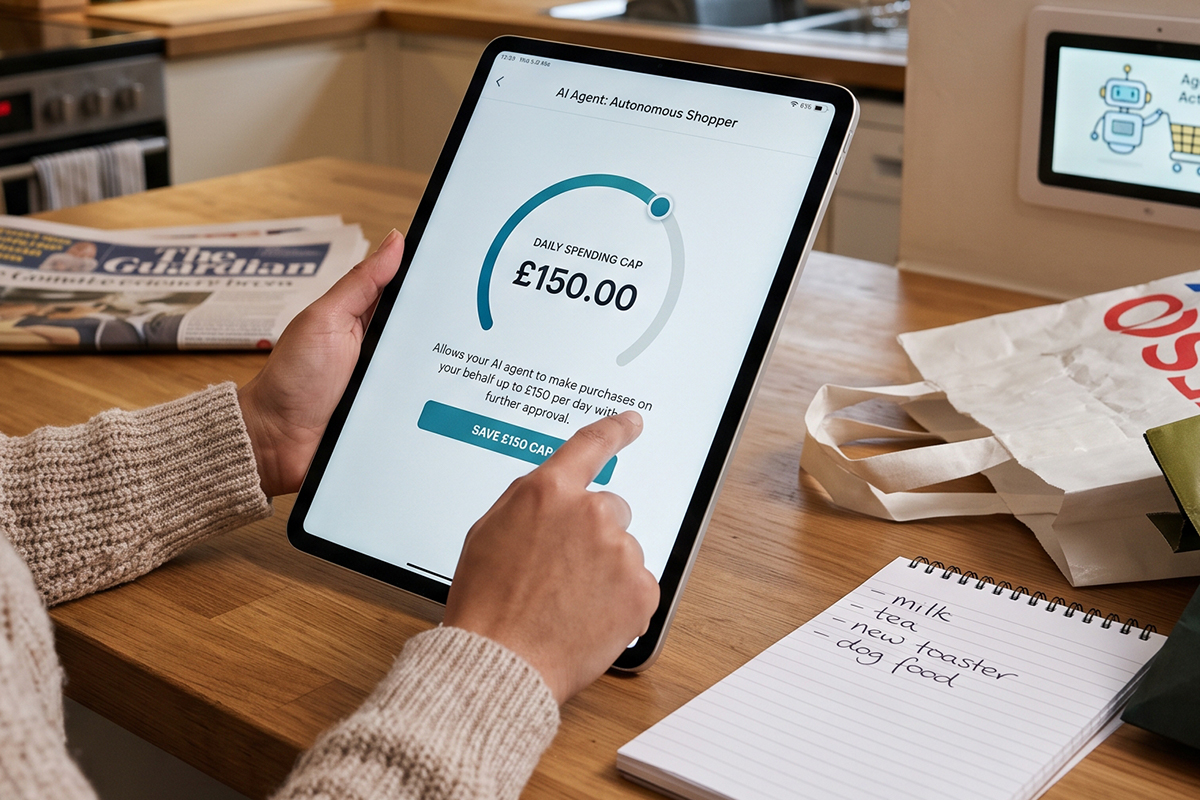
MACH Alliance survey of 1,000 UK consumers finds 67% use AI in search/discovery, but only 9% trust AI to complete payments autonomously — with a hard trust ceiling of £149 (~$190) per transaction before consumers demand manual control.
Agentic commerce accelerates commoditization of low-AOV products as brand selection shifts from human browsing to AI execution — sellers who don't control their structured data and content quality will lose the zero-click sale to whoever does.
The £149 threshold maps almost exactly to impulse/replenishment SKU territory, meaning agentic checkout will accelerate reorders for consumables and low-AOV products first — high-ticket or complex items won't convert autonomously anytime soon. Sellers should prioritize Subscribe & Save enrollment, auto-replenishment optimization, and product listing completeness now, since AI agents pull structured data to execute purchases and incomplete listings will be skipped entirely.
Operational Impact
This story may require teams to revisit workflows, monitoring, or platform assumptions.
Bottom Line
AI agents will auto-buy under $190 -- messy listings lose the sale before humans even see it.
Source Lens
Industry Context
Useful background context, but lower-priority than direct platform, community, or operator intelligence.
Impact Level
medium
AI agents will auto-buy under $190 -- messy listings lose the sale before humans even see it.
Key Stat / Trigger
£149.12 average transaction threshold UK consumers trust AI agents to spend autonomously
Focus on the operational implication, not just the headline.
Full Coverage
Despite fast-growing adoption of agentic AI and consumers becoming more comfortable with zero-click commerce, caution kicks in for higher-value purchases, with UK shoppers putting a £150 price cap on autonomous AI spending, new data from the MACH Alliance, the community that champions best-of-breed commerce and innovation, reveals.
Retaining transactional authority Research of over 1,000 UK consumers, commissioned ahead of MACH X: Amsterdam, showed that two thirds (67%) now use AI within the search and discovery phases of their buying journeys – rising to 92% of Millennials and 89% of Gen Z. However, consumers remain cautious about passing purchasing control fully over to AI agents.
A third (32%) of shoppers say they are happy for AI to take control of researching a purchase, but they still want to retain authority over the final product selection and spending decision.
Just one in ten (9%) said they would be comfortable with AI completing a payment autonomously for them, dipping even lower to 4% for complex or high consideration purchases. The AI trust threshold According to the poll, UK consumers’ trust threshold for AI spending is capped at £149.
12 – the average transaction amount that shoppers would be comfortable with AI agents making on their behalf.
Younger shoppers were more willing to give greater payment autonomy to AI agents compared with older consumer cohorts; Millennials were comfortable with AI making larger transactions of up to £235 on average, while Baby Boomers would cap autonomous AI spend at just £67 per transaction.
This suggests that consumer trust remains a key barrier to end-to-end agentic shopping, with retailers needing to bridge the gap between shoppers being comfortable with AI influencing purchasing decisions and trusting it to transact autonomously on their behalf.
Tackling the AI trust gap will depend on brands’ ability to move agentic AI from influence to reliable execution across the entire buying journey.
As agents take on greater purchasing autonomy, the tech stacks underpinning them must enable them to act accurately and securely across everything from product information and real-time inventory to payments and fulfilment. Trust ultimately comes down to executional accuracy at every stage of the journey.
Retailers need the right agentic capabilities and data, but they also need the flexibility to govern how those agents act. That’s where open, composable architectures become critical, giving businesses the control and agility they need to adopt agentic commerce with confidence.
– Jason Cottrell, President of the MACH Alliance Tackling the AI trust gap Retailers are already beginning to move towards agentic payment execution and zero-click commerce, with brands including JD Sports Fashion testing AI-led shopping journeys that connect product discovery directly into checkout and payment.
Debenhams has also begun exploring native agentic checkout experiences that allow shoppers to discover and purchase products within AI-powered shopping environments.
Speaking at MACH X, JD Sports Fashion’s Head of Platform Innovation, Antonia Hansen, will deliver a keynote exploring the key drivers behind its decision to re-architect its tech infrastructure to a composable stack. She will outline how the retailer is readying its operations for AI-enabled commerce, including moving towards instant checkout.
Audit your catalog for products under $190 -- ensure titles, bullet points, and backend keywords are fully optimized since AI agents rely on structured data to select and purchase SKUs without human review.
Enroll eligible sub-$190 replenishment SKUs in Subscribe & Save or Walmart Auto-reorder within 30 days to capture the first wave of agentic reorder traffic before competitors do.
Original Source
This briefing is based on reporting from Tamebay. Use the original post for full primary-source context.
Style
Audience