Amazon leads ecommerce marketplaces for AI visibility
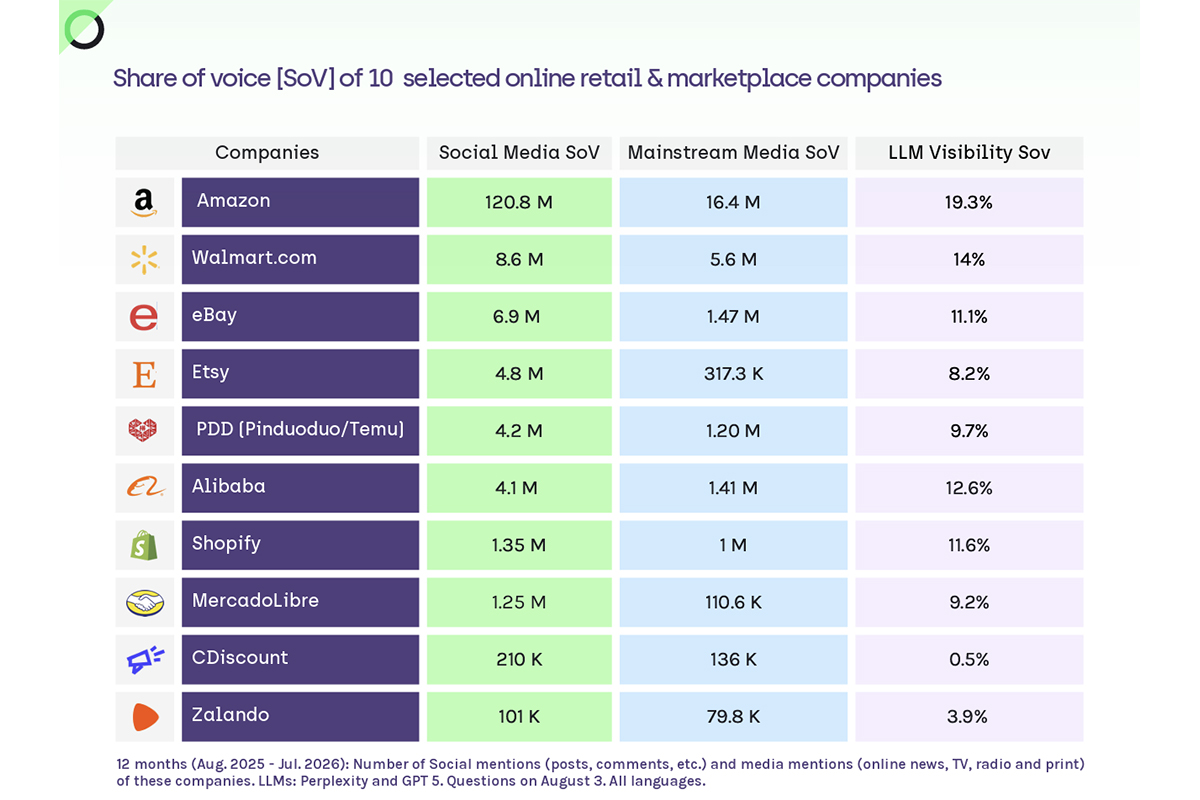
Amazon holds 19.3% AI share of voice across ChatGPT and Perplexity, with a 92% prominence score vs. Walmart's 84% — meaning AI tools cite Amazon first and most often when consumers research products. 74% of global shoppers now use AI for product discovery, making LLM visibility a real acquisition channel.
A new discovery hierarchy is forming above traditional search, and Amazon's dominance there mirrors and amplifies its marketplace dominance — brands relying solely on paid search are underinvesting in an increasingly critical top-of-funnel channel.
Media coverage volume directly correlates with AI visibility — Amazon's 16.4M media mentions vs. Walmart's 5.6M explains much of the gap, meaning brands that generate press, reviews, and editorial coverage will surface more in AI responses. Sellers should audit their brand's third-party content footprint (reviews, press mentions, blog coverage) and treat it as an LLM optimization lever.
Operational Impact
This story may require teams to revisit workflows, monitoring, or platform assumptions.
Bottom Line
AI tools recommend Amazon first — sellers not optimizing for LLM visibility are invisible to 74% of shoppers.
Source Lens
Industry Context
Useful background context, but lower-priority than direct platform, community, or operator intelligence.
Impact Level
medium
AI tools recommend Amazon first — sellers not optimizing for LLM visibility are invisible to 74% of shoppers.
Key Stat / Trigger
74% of global shoppers now use AI for product discovery
Focus on the operational implication, not just the headline.
Full Coverage
Amazon is the most visible major online marketplace across leading generative AI platforms, according to new analysis from Onclusive examining how e-commerce brands appear in responses generated by ChatGPT and Perplexity. The study found that Amazon accounted for 19. 3% of marketplace share of voice, ahead of Walmart at 14%, Alibaba at 12. 6%, Shopify at 11.
6% and eBay at 11. 1%. Temu recorded a share of voice of 9. 7%, followed by MercadoLibre at 9. 2% and Etsy at 8. 2%. European marketplaces Zalando and CDiscount recorded 3. 9% and 0. 5% respectively.
The findings highlight significant differences in how frequently major e-commerce platforms are surfaced by generative AI tools, as consumers increasingly use AI engines to research brands, products and online shopping options. Recent NIQ research found nearly three-quarters (74%) of shoppers globally now use AI for product discovery.
Newer platforms are already competing for AI visibility against more established players, Temu’s 9. 7% share of voice is comparable to Shopify and eBay. LLM Visibility – Share of Voice Amazon 19. 3% Walmart 14% Alibaba 12. 6% Shopify 11. 6% eBay 11. 1% Temu 9. 7% MercadoLibre 9. 2% Etsy 8. 2% Zalando 3. 9% CDiscount 0.
5% Share of voice measures a brand’s visibility relative to competitors within the scope of the analysis, based on the frequency with which each marketplace was mentioned across AI-generated responses. Amazon also achieved the highest average prominence score, at 92%, compared with 84% for Walmart.
Prominence measures how early a brand first appears within an AI-generated response, with a higher score indicating that the brand tends to be mentioned closer to the beginning of the answer. The analysis also suggests that visibility within generative AI is closely associated with brands’ wider media presence.
Marketplaces with greater volumes of traditional media coverage generally also recorded higher LLM visibility. Amazon ranked first across both measures, with a 19. 3% share of AI visibility and 16. 4 million media mentions, while Walmart ranked second for AI visibility at 14% alongside 5. 6 million media mentions.
Generative AI now forms another layer of brand discovery alongside traditional search, social media and other digital channels. What stands out from this analysis is how quickly a new hierarchy of brand visibility is forming within generative AI.
The major marketplaces are not appearing equally, and the gap between the most and least visible brands is already significant. For businesses, the challenge is no longer simply whether they appear in AI-generated answers, but how consistently they are surfaced, how prominently they feature and how they compare with competitors.
As more consumers use AI tools to research brands, products and services, that visibility is likely to become an increasingly important part of the digital discovery landscape. – Christophe Asselin, Senior Insights Manager at Onclusive
Run a brand name search in ChatGPT and Perplexity now — if your brand or products aren't appearing in category-level queries, increase earned media and review velocity on high-authority domains to close the gap.
In the next 30 days, build or brief a PR/content strategy targeting product roundups, listicles, and editorial placements on sites that AI tools frequently cite — this is the new SEO.
Original Source
This briefing is based on reporting from Tamebay. Use the original post for full primary-source context.
Style
Audience