

Daimler Truck brings NextGenH2 to IAA as hydrogen pact forms
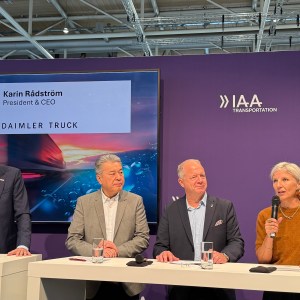
Europe has 187 hydrogen stations, most at the wrong pressure for long-haul trucks. Eight companies used IAA Transportation to say what it will take to fix that. The post Daimler Truck brings NextGenH2 to IAA as hydrogen pact forms appeared first on FreightWaves.
Source Lens
Industry Context
Useful background context, but lower-priority than direct platform, community, or operator intelligence.
Impact Level
medium
Use this briefing to decide whether your team needs an immediate workflow, policy, or reporting change.
Key Stat / Trigger
No single quantitative trigger surfaced in this report.
Focus on the operational implication, not just the headline.
Full Coverage
HANOVER, Germany — Two of Europe’s largest truck makers say the battery-electric rollout got ahead of the chargers needed to run it. Eight companies in a press conference at IAA Transportation on Tuesday said hydrogen would not repeat the same mistake, with the fuel, the stations and the trucks arriving together.
Daimler Truck, Volvo Group, Toyota Motor Corp. , Bosch, Air Liquide, TotalEnergies, TEAL Mobility and MB Energy announced a joint effort to make hydrogen trucking commercially viable in Europe by 2030, with Germany as the template and a request that the European Commission and other national governments copy it.
Daimler Truck brought its Mercedes-Benz NextGenH2 Truck to the show floor at the same event. The company plans to put a small series of 100 into customer operations from the end of 2026, and the first batch of 50 is already sold, said Karin Rådström, president and CEO of Daimler Truck.
Customers have run the previous-generation GenH2 Truck almost 600,000 kilometers. “This isn’t some small side project for us,” Rådström said. “It’s a very important part of our strategy.”
The company is investing a mid-three-digit million euro amount in hydrogen trucks through the end of the decade, and its first hydrogen combustion engine trucks are being prepared for market launch next year. The NextGenH2 runs more than 1,000 kilometers on a single fill of liquid hydrogen, and it carries 1.
3 metric tons more payload than Daimler’s battery-electric eActros 600, because it is not hauling the batteries. Rådström’s third argument was the grid. Europe has roughly 6 million trucks to convert, she said, burning about 60 million metric tons of diesel a year. The truck count holds up: the European Automobile Manufacturers’ Association counted 6.
2 million trucks in use across the EU in Vehicles on European Roads 2026, published in January and drawn from 2024 registrations.
“When you would translate that into electricity, if you would imagine running them all on electricity, that’s around 500 terawatt-hours of energy, which is actually the full annual electrical consumption of the country of Germany,” she said. Germany’s gross electricity production ran 509.
2 terawatt-hours in 2025, according to the Federal Statistical Office’s gross electricity production series, updated this month. Volvo Group President and CEO Martin Lundstedt framed the alliance itself as the lesson from electrification.
“If we should have anticipated this type of lineup on the electric side five, six years ago, we shouldn’t have been standing yesterday saying that the transformation is moving too slow,” Lundstedt said. Six euros a kilogram to make the business case Hydrogen pricing is the pillar the business case rests on, and the panel was barred from discussing it.
Master of ceremonies Andy Johnson opened the Q&A by ruling pump prices off limits, because competing station operators shared the stage. Both truck makers named the same target anyway: €6 ($6. 92) a kilogram.
“When we can get down — and that is our analysis at Volvo — at a price point of 6 euro per kilogram in Europe, then we have the business case going,” Lundstedt said. “Also our analysis shows it’s somewhere around 6 euro where it starts to get very, very competitive,” Rådström said.
“And my understanding from the supply chain is that’s realistic, not today, but over time. That’s where we get to, maybe 2030 or a little bit after that.” Europe’s stations dispense at the wrong pressure Europe has 187 hydrogen stations, Rådström said, and the bulk of them were built for a different job.
“Most of them are 350 bar, so that actually doesn’t give you the added range that you need for it to be really beneficial for trucking,” she said. Air Liquide is building the supply side out.
Armelle Levieux, a member of the company’s executive committee responsible for innovation, technology and hydrogen energy, said the upstream is arriving on schedule: a 20-megawatt electrolyzer running in Oberhausen, Germany, for more than two years, a 200-megawatt unit starting in Normandy, France, before the end of this year, and another 200 megawatts in Rotterdam, Netherlands, the year after.
Heavy-duty trucking has to crack three problems at once, Levieux said: a viable station network, affordable fuel, and synchronization between the truck makers and the infrastructure operators. “The end game is liquid hydrogen, because this is the only way to really have the volumes and the scale-up we need,” Levieux said.
“And obviously this is what is going to drive us to diesel parity.” TEAL Mobility, the 50/50 joint venture Air Liquide and TotalEnergies formed in 2024, runs 16 hydrogen stations across five countries under the TotalEnergies brand.
A TEAL executive said station operators sit at the crossroads of the hydrogen supply chain and truck adoption, which makes them the first to absorb the damage when either one slips. The venture is targeting larger, faster stations that dispense both gaseous and liquid hydrogen un
Original Source
This briefing is based on reporting from Freightwaves. Use the original post for full primary-source context.
Style
Audience