

Automation takes center stage at Smurfit Westrock ‘superplant’ in Wisconsin
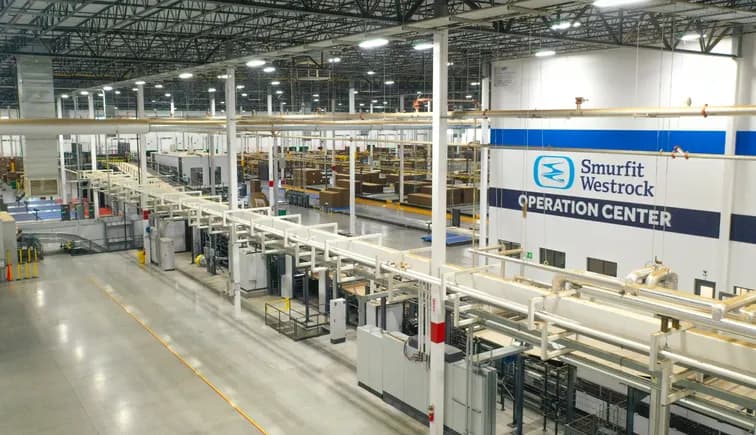
The automation and robotics allow the facility to use about 60% of the labor of a traditional box plant, while the scale enables service to the greater Chicago region.
Source Lens
Industry Context
Useful background context, but lower-priority than direct platform, community, or operator intelligence.
Impact Level
medium
Use this briefing to decide whether your team needs an immediate workflow, policy, or reporting change.
Key Stat / Trigger
No single quantitative trigger surfaced in this report.
Focus on the operational implication, not just the headline.
Full Coverage
An article from Automation takes center stage at Smurfit Westrock ‘superplant’ in Wisconsin The automation and robotics allow the facility to use about 60% of the labor of a traditional box plant, while the scale enables service to the greater Chicago region.
Published May 13, 2026 Katie Pyzyk Lead Reporter Share Copy link Email / Print License Add us on Google Smurfit Westrock's corrugator line is seen inside the box plant in Pleasant Prairie, Wisconsin, which began production in May 2025.
The facility was designed to have a high amount of advanced automation and manufactures about 3 billion square feet of corrugated boxes annually.
Permission granted by Smurfit Westrock First published on “Super” is an adjective that gets thrown around casually in modern society, but Smurfit Westrock's leadership believes it’s a suitable label for its year-old, large-scale corrugated box manufacturing plant in Pleasant Prairie, Wisconsin.
It was the first facility that top management colloquially called a “superplant” during a groundbreaking in June 2024 under WestRock, which months later became Smurfit Westrock. Now the box plant is among an elite few in the company’s network that bear the descriptor.
Such hubs are designed to serve key regions of high demand and volume, in lieu of having multiple nearby plants. For instance, SW closed a legacy plant in nearby North Chicago, Illinois, around the time the superplant opened. So what specific qualities define a superplant?
The designation signifies scale, a high level of advanced automation and the capability to meet all of a complex market's corrugated needs.
The $136 million, 595,000-square-foot Wisconsin facility produces approximately 3 billion square feet of corrugated boxes annually, “which is about three times a typical corrugated box plant today,” said Don Sparaco, Smurfit Westrock president of corrugated packaging for North America.
The plant was completed in April 2025, and production began the following month; product lines include pre-print, white top, recycled board, kraft, high performance liners, wet strength and food packaging. Up to 200 people now work there. The plant manufactures a variety of boxes to satisfy the growing demand in the Great Lakes market.
These include mid-sized slotted cartons like moving boxes, rotary die-cut boxes like those for pizza, jumbo boxes for industrial use such as with chemicals and produce, and small options for healthcare and beauty. The Pleasant Prairie facility has rotary die-cut machinery for making products such as pizza boxes.
Katie Pyzyk/Packaging Dive Location is a key attribute this plant has going for it. Pleasant Prairie's pastoral name contrasts with the industrial boom the village has experienced during the last 15 years as major companies create and expand their campuses along Interstate 94.
The village is home to Uline's corporate headquarters, Amazon has an ever-growing footprint there, and confectioner Haribo placed its first U. S. manufacturing facility in Pleasant Prairie in 2023.
Around the same time as the plant groundbreaking in 2024, the Wisconsin Department of Transportation granted the village $885,000 for a project to develop a rail spur to connect the box plant site with the Union Pacific mainline. Smurfit Westrock uses this rail access for inbound shipments of raw materials such as paper and starch.
WisDOT also noted the investment’s capability to attract other businesses with rail needs to the area. The box plant is strategically positioned along the Wisconsin-Illinois border to serve the greater Chicago area, which is considered one of the top regions in the United States for corrugated box consumption — second only to the greater Los Angeles area.
This consumption is driven in part by Chicago being the nation's food and beverage manufacturing capital, home to giants including Conagra, Kraft Heinz and Mondelēz International. Chicago is also one of North America’s main transportation hubs and the largest and busiest freight rail hub in the U. S.
, handling an estimated one in four of the nation’s freight trains daily. A superplant has the scale to meet a complex market's various box needs, such as for food, healthcare and industrial applications.
Katie Pyzyk/Packaging Dive In short, an enormous proportion of America's consumer goods and raw materials travel through Chicago — and they tend to do so in corrugated boxes. “It was certainly one area that we’ve had on our radar to modernize our assets, to optimize our footprint and to serve existing as well as new customers,” Sparaco said.
“Investing in the Great Lakes area was the right thing to do.” Pleasant Prairie is one of only two facilities in North America that Smurfit Westrock refers to as a superplant, with the other in Longview, Washington. The latter opened in November 2023, and Smurfit Westrock incorporated dozens of best practices learned there when developing Pleasant Prairie.
“A lot of them have to do w
Original Source
This briefing is based on reporting from Supply Chain Dive. Use the original post for full primary-source context.
Style
Audience