Amazon DSP Audience Suppression: Cutting Waste by Excluding the Wrong Shoppers
Amazon DSP audience suppression allows advertisers to exclude recent purchasers, existing subscribers, and high-frequency non-converters from campaigns, reallocating budget toward higher-probability converters. Brands running DSP without suppression lists are burning impressions on audiences with near-zero incremental lift potential.
As Amazon DSP adoption grows among mid-market brands and agencies, suppression strategy is becoming a core competency that separates efficient accounts from wasted spend — directly tied to margin compression pressure across sponsored and programmatic budgets.
Most DSP accounts over-index on audience expansion and ignore the exclusion side — meaning retargeting budgets frequently cannibalize customers who already converted. Pull your DSP overlap report in Amazon Marketing Cloud and check what percentage of your prospecting impressions are hitting existing purchasers from the last 30 days.
Operational Impact
This story may require teams to revisit workflows, monitoring, or platform assumptions.
Bottom Line
DSP without suppression lists means paying full CPM to re-advertise to customers who already bought.
Source Lens
Industry Context
Useful background context, but lower-priority than direct platform, community, or operator intelligence.
Impact Level
medium
DSP without suppression lists means paying full CPM to re-advertise to customers who already bought.
Key Stat / Trigger
No single quantitative trigger surfaced in this report.
Focus on the operational implication, not just the headline.
Full Coverage
Amazon DSP audience suppression helps advertisers improve campaign efficiency by deliberately excluding shoppers who are unlikely to generate incremental value.
Instead of increasing reach, it reduces wasted impressions by preventing ads from serving to audiences such as recent purchasers, existing subscribers, or shoppers who are already overexposed to your campaigns. Most Amazon DSP optimization efforts focus on audience expansion.
Teams spend time identifying high-intent in-market audiences, testing lookalike segments, and layering contextual signals to reach more potential buyers. These are all important targeting decisions, but they address only one side of campaign optimization. The other side is deciding who should not see your ads.
In every DSP account, a portion of the budget is spent on impressions that have little chance of driving additional revenue. Recent customers continue seeing acquisition campaigns, overlapping audience segments compete for the same shoppers, and high-frequency non-converters accumulate impressions without moving closer to purchase.
These impressions consume budget without creating incremental value. Amazon DSP audience suppression solves this problem by systematically removing these audiences from campaign eligibility.
Rather than reducing scale, it reallocates impressions toward shoppers who are more likely to convert, improving reach efficiency, reducing audience overlap, and making better use of media spend.
This guide explains what Amazon DSP audience suppression is, how to identify suppressible audiences, when suppression improves performance, when it can backfire, and how to measure its impact across Amazon DSP campaigns. Quick GuideWhat Is Audience Suppression in Amazon DSP? How Much Is the Wrong Shopper Costing You?
The 8 Audiences Most Brands Should Be SuppressingWhen You Should NOT SuppressBuilding Suppression Audiences: DSP Console vs.
Amazon Marketing CloudPushing AMC Audiences into DSP Line ItemsUsing Cross-Account Reach & Frequency Reporting for De-Duplicated ReachA Suppression Framework by Funnel StageMeasuring the Impact of SuppressionIsolating Suppression Impact with a Holdout Line ItemCommon Suppression Mistakes to AvoidHow SellerApp Automates DSP Audience SuppressionFinal Takeaway: Suppression Is a Precision Tool, Not a Blanket RuleFAQs What Is Audience Suppression in Amazon DSP?
Amazon DSP audience suppression means deliberately removing defined groups of shoppers from a campaign’s eligible reach, so budget only reaches people who can move the needle. Three terms get used interchangeably. Amazon DSP audience exclusion is the mechanical act of dropping a segment into the exclude field.
Amazon DSP negative audience targeting is the same idea in search vocabulary. Amazon DSP audience suppression is the strategy behind both. Who gets removed, from which line items, for how long, and why. One is a button, the other is a plan. It operates at two levels.
Order-level exclusions cascade to every line item below, which suits universal rules like blocking employees. Line-item exclusions apply to one tactic, and that is where most Amazon DSP audience targeting strategies actually live, since prospecting and retargeting need very different exclude lists.
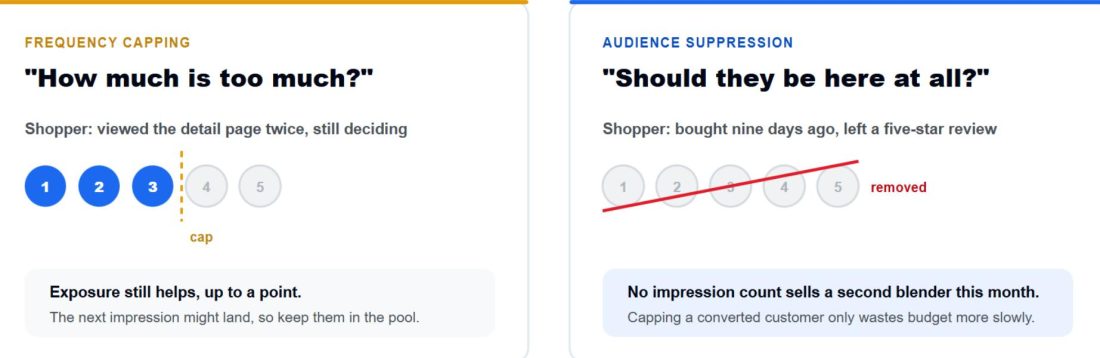
Getting that split right depends on clean Amazon DSP audience segmentation, because segmentation decides who is on the map and suppression decides who comes off it. Suppression vs. Frequency Capping Capping limits how often a shopper sees the ad. It answers “how much is too much?” Suppression removes the shopper entirely.
It answers “should this person be here at all?” A shopper who viewed the detail page twice and is still deciding needs a cap, because exposure helps up to a point and then irritates. A shopper who bought nine days ago and left a five-star review needs suppression, because no number of impressions will sell that person a second blender this month.
Capping a converted customer just wastes budget more slowly. Run both. Amazon DSP audience suppression cleans the pool, capping controls the pressure inside it, and a well-built Amazon DSP retargeting exclusion usually beats another afternoon of bid tweaks. For caps, frequency groups, and pacing, see the SellerApp guide to Amazon DSP frequency capping.
Amazon DSP audience exclusion How Much Is the Wrong Shopper Costing You? Put a number on it first. Amazon DSP audience suppression sells itself internally the moment it stops being a best practice and becomes a line on a spreadsheet. At the platform average of $7. 82 CPM, a million misdirected impressions cost $7,820.
Category CPMs stretch that range: Pet Supplies runs $11. 66 and Health & Wellness $11. 13, while Toys & Games sits at $4. 30. A pet brand pays almost three times what a toy brand pays for the identical mistake. Waste takes three forms.
Duplicate reach means two line items paying to reach the same person, which inflates frequency and CPMs without adding a prospect, and it is the classic symptom of untr
In DSP Console, add recent purchasers (30-90 day window) as line-item exclusions on all prospecting line items — if that audience is receiving more than 5% of prospecting impressions, you have a direct budget leak.
Within 30 days, build an AMC query to identify high-frequency non-converters (7+ impressions, zero purchases) and push that segment as a suppression audience into active retargeting line items.
Original Source
This briefing is based on reporting from SellerApp Blog. Use the original post for full primary-source context.
Style
Audience