Selling supplements on EU marketplaces from the UK: why your stock location matters more than your listing
As of July 1, 2026, the EU charges a flat €3 customs duty per item type on parcels valued under €150 shipped from the UK, directly hitting UK supplement brands selling on Amazon.de, bol, and Allegro with per-order cost increases and slower delivery.
Post-Brexit regulatory friction is now fully cost-visible at the parcel level, accelerating the bifurcation of UK and EU ecommerce operations -- brands that don't localize inventory will cede EU marketplace share to local competitors permanently.
The compounding effect is the real killer: a mixed supplement order (vitamin D + magnesium + protein) can trigger €9+ in duty alone before local handling fees in France or Italy. UK brands without EU warehouse infrastructure are now structurally uncompetitive on price and delivery speed versus local sellers.
Operational Impact
This story may require teams to revisit workflows, monitoring, or platform assumptions.
Bottom Line
€3-per-item EU duty makes UK-warehoused supplement orders structurally unprofitable.
Source Lens
Industry Context
Useful background context, but lower-priority than direct platform, community, or operator intelligence.
Impact Level
high
€3-per-item EU duty makes UK-warehoused supplement orders structurally unprofitable.
Key Stat / Trigger
€3 flat customs duty per item type on EU-bound parcels under €150, effective July 1, 2026
Focus on the operational implication, not just the headline.
Full Coverage
UK supplement brands spend weeks on their EU listings. They translate titles, test images and research keywords for Amazon. de, bol or Allegro. Then the order leaves a warehouse in England, and the buyer waits for a parcel that must clear customs first. Since the 1st of July 2026, that gap costs more.
For supplement sellers, the location of the stock now shapes price, delivery time and compliance more than any change to the listing. A customs border sits behind every UK parcel Since Brexit, every parcel from Great Britain to an EU consumer is an import.
It needs a customs declaration, and someone has to pay import VAT: the seller at checkout or the buyer at the door. On the 1st of July 2026, the EU added a flat customs duty of €3 on goods in parcels worth €150 or less. The charge applies to each type of item in the parcel, not to the parcel as a whole. It will remain until at least the 1st of July 2028.
Some countries add their own costs. France and Italy, for example, charge national handling fees on top of the EU duty. This matters for supplement baskets. A typical order mixes products: a vitamin D spray, a magnesium tablet, a protein powder. Each type of item can attract its own €3 charge.
According to Parcel2Go, 85% of EU-bound orders on its platform in May 2026 would fall under the new rule. Supplements also face product rules Customs is only one part. Supplements are food under EU law, and most EU countries want to know about a product before it is sold.
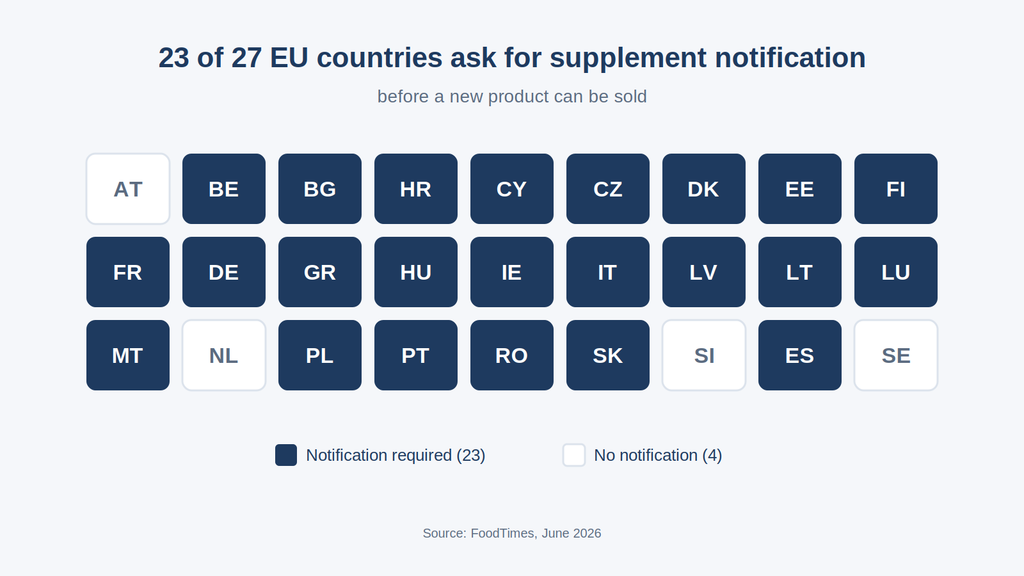
National notification 23 of the 27 EU member states require a notification before a supplement can be sold. Only Austria, the Netherlands, Slovenia and Sweden do not. Each procedure is different. Lead times vary from one week to three months, and some countries charge up to €250 per product.
EU address and local language The label must show the name and address of a food business in the EU. For a UK brand, this is usually the EU importer. A UK address alone is not enough. Most countries also expect the label in their own language. These rules apply wherever your stock is.
But the location of your stock decides how often your product crosses the border and how much each order costs. What changes when stock sits inside the EU One customs clearance instead of thousands You send stock to an EU warehouse in bulk. It clears customs once, as one commercial shipment, and you pay import duty and VAT on that shipment.
After that, every order is a domestic or intra-EU parcel. There is no customs declaration per parcel and no €3 charge per item type. Delivery that matches local sellers Local warehouses usually deliver the next working day. From one warehouse in Germany or Poland, you can often reach neighbouring markets in two to four days.
Marketplace buyers compare delivery dates, and a parcel from the UK rarely wins that comparison. Fewer checks between EU countries Goods inside the single market move with fewer controls. In May 2026, the Court of Justice of the EU ruled that a member state cannot require advance notice for every supplement shipment that arrives from another member state.
What UK brands need to prepare This route takes more work at the start. Expect these steps: VAT registration in each EU country where you store stock. Non-EU sellers have no registration threshold. On marketplace sales to consumers, the marketplace usually collects the VAT, but you still need the local VAT number for the stock itself.
An EU importer and an EU EORI number for the bulk shipment. Product notifications in each country where you plan to sell. Labels with an EU address in the local language. Choosing a fulfilment partner Many UK brands keep their UK stock where it is and add one or two EU warehouses. Some 3PLs run both sides in one system.
WAPI, for example, operates a supplement warehouse in Chorley, Lancashire, and sites in Germany, Poland, Spain, Italy and other EU countries, with batch and expiry tracking and introductions to VAT partners.
When you compare providers, ask these seven questions: Can it hold your UK and EU stock in one system and serve several EU marketplaces from one stock pool? Does it record batch numbers and expiry dates on arrival and ship the batch that expires first? Are supplements stored apart from chemicals and cleaning products?
Can it prepare stock for Amazon FBA and ship your other marketplace orders from the same stock? Does a team member check the seal on every return before the product returns to stock? Does the quote show every cost as a separate line? Can it introduce you to VAT partners in the countries where you store stock?
Start with the stock, then the listing Good listings still matter. But on EU marketplaces, a strong listing with slow and costly delivery often loses to an average listing that arrives tomorrow. Since July 2026, each order that crosses the border costs more. For UK supplement brands that want steady EU sales, the first decision is where the stock sits.
Audit your EU order mix now -- if average orders contain 2+ product types and ship from UK, recalculate landed cost including €3 per item type + national fees to see if margins are negative.
In the next 30 days, request quotes from 3PLs with EU warehouse presence (Germany or Poland covers most of Central Europe) and initiate VAT registration in your primary EU market -- non-EU sellers have no registration threshold.
Original Source
This briefing is based on reporting from Tamebay. Use the original post for full primary-source context.
Style
Audience