

Dalilah’s Law that tightens CDL issuance gets House committee OK
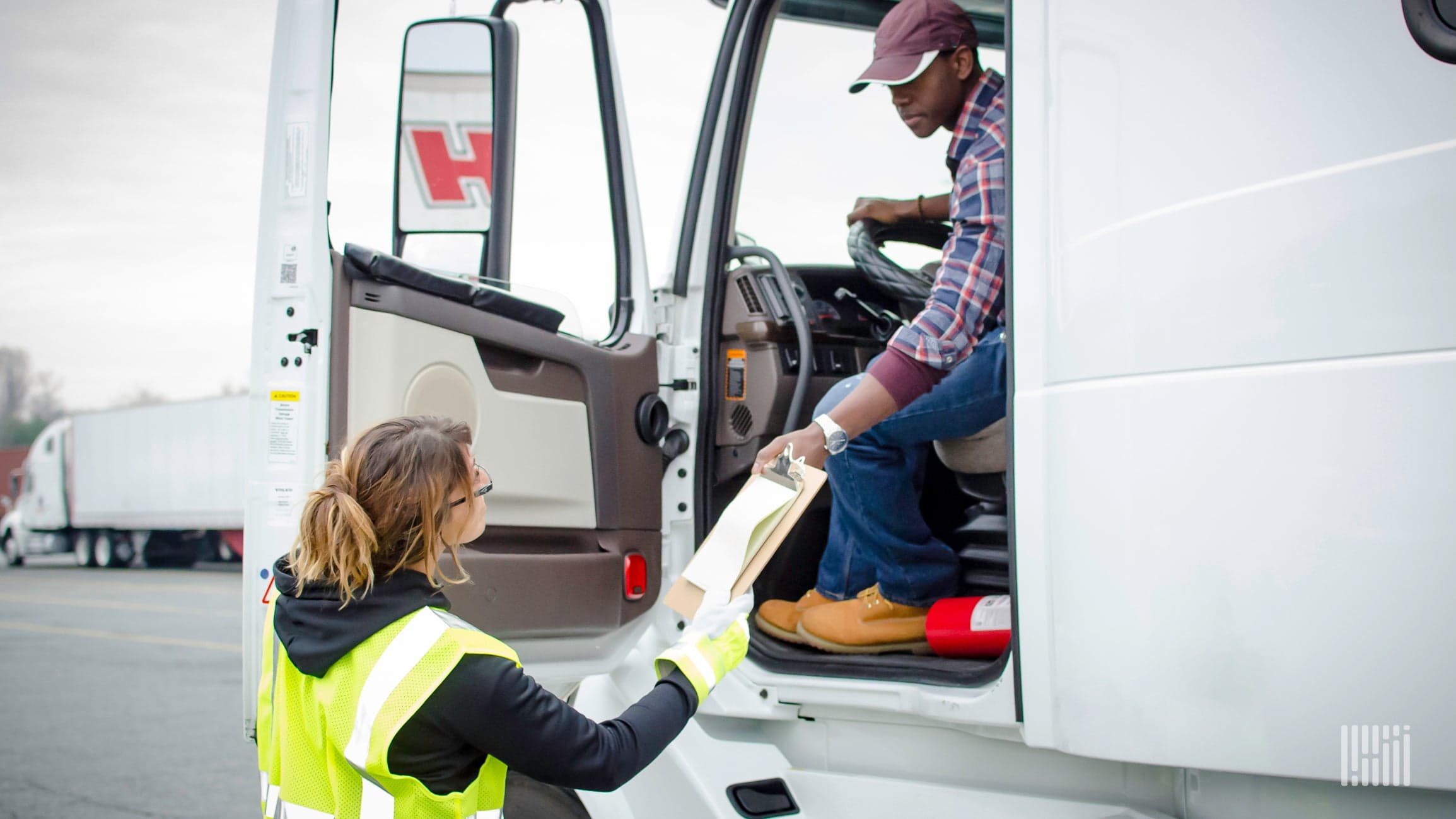
Dalilah's Law cleared the House Transportation & Infrastructure Committee 35-26 on a party-line vote, advancing legislation that would tighten CDL issuance by requiring English proficiency and removing drivers lacking approved legal status from service immediately upon inspection. The bill's one-year out-of-service penalty for English proficiency failures and new restrictions on driver training schools could meaningfully shrink the active CDL driver pool at a moment when freight capacity is already strained. Senate companion bill S. 3917 has Trump's explicit endorsement but no scheduled hearings yet, meaning full passage is likely 6-18 months out. The trucking industry employs roughly 3.5 million drivers, and any structural reduction in eligible driver supply will flow directly into spot and contract rates within quarters of enactment.
The non-obvious play here is supply chain positioning, not compliance theater.
If this bill passes in anything close to its current form, last-mile and truckload capacity contracts signed at today's rates become underpriced assets — and sellers who lock in 3PL and carrier agreements now, before a capacity squeeze reprices the market, gain a structural cost advantage over competitors scrambling for trucks at premium spot rates.
For a $10M/year Amazon or Walmart seller with meaningful inbound freight volume, Monday's action is to call your 3PL and ask specifically whether a meaningful share of their driver pool could be affected by English proficiency enforcement — because carriers absorbing compliance costs will pass them through as fuel surcharge-style line items within 60-90 days of any enforcement uptick.
This is also a margin compression story for sellers in heavy/bulky categories (furniture, fitness equipment, outdoor) where FTL and LTL costs as a percentage of COGS are already 8-15%; a 5-10% freight rate increase in that environment is the difference between a profitable SKU and a catalog cut.
Dalilah's Law is part of a broader 2026 regulatory tightening wave that is simultaneously hitting labor supply (CDL restrictions), platform compliance (FTC and state AG actions on marketplace sellers), and cross-border sourcing (tariff escalation) — creating a perfect storm of input cost pressure for e-commerce operators who built margin models on cheap freight, cheap labor, and cheap goods.
This is not an isolated trucking story; it connects directly to the inventory positioning decisions sellers are already making around tariff front-loading, and a freight capacity crunch layered on top of a tariff-driven import surge is the exact scenario that caused 2021-era shipping chaos.
Agencies managing brands with physical goods catalogs should be treating supply chain resilience — domestic sourcing, 3PL diversification, nearshoring — as a core service offering, not an afterthought, because the operators who solve this first will be taking share from those who don't.
Pull your Seller Central or Walmart Seller Center COGS report filtered by heavy/bulky ASINs (weight over 10 lbs or dimensions triggering dimensional weight) and flag any SKU where inbound freight exceeds 8% of landed cost — those are your first cuts if truckload rates spike 10%+ over the next 12 months, and you need a reprice or supplier renegotiation plan ready now.
This week, contact your top 2-3 carrier or 3PL partners and ask them directly: what percentage of your CDL driver workforce could be impacted by English proficiency enforcement or legal status audits? If the answer is above 10%, immediately get competing bids and explore locking 6-12 month contract rates before enforcement creates a capacity event.
In the next 30-90 days, model a freight cost stress test assuming a 10-15% rate increase on your top 20 inbound shipment lanes — if any SKU goes negative contribution margin in that scenario, either renegotiate supplier FOB terms to shift freight responsibility, consolidate shipments to reduce per-unit freight cost, or begin transitioning those SKUs to suppliers with domestic warehousing closer to your FBA or WFS fulfillment nodes.
Bottom Line
CDL supply is about to tighten — sellers with heavy catalogs who don't lock freight rates this quarter will pay the penalty in Q4.
Source Lens
Industry Context
Useful background context, but lower-priority than direct platform, community, or operator intelligence.
Impact Level
medium
CDL supply is about to tighten — sellers with heavy catalogs who don't lock freight rates this quarter will pay the penalty in Q4.
Key Stat / Trigger
14 people killed daily in truck crashes
Focus on the operational implication, not just the headline.
Full Coverage
The House of Representatives’ version of Dalilah’s Law that would significantly impact the issuance of CDLs and the ability of driver training schools to stay in business sailed through the Transportation & Infrastructure Committee Wednesday, approved on a 35-26 party-line vote.
It was the first step for the proposal that has manifested itself in separate House and Senate versions that have some key differences. The bill is named for Dalilah Coleman, the California girl injured in 2024 when she was five, in a collision involving a truck driven by a driver in the U. S. illegally. Dalilah suffered long-term injuries.
She and her family were in the committee chambers for the hearing and vote by the House Transportation & Infrastructure committee. Rep. David Rouzer of North Carolina, a Republican, introduced the legislation. The counterpart bill in the Senate was introduced by Sen. Jim Banks, a Republican of Indiana.
Banks’ bill was introduced first and received an endorsement by President Donald Trump in this year’s State of the Union address. The Senate bill, S. 3917, has been referred to the Senate’s Committee on Commerce, Science, and Transportation. There are no scheduled hearings or markups in the Senate as of Wednesday.
Despite the differences between the House and Senate versions, the main thrust of both pieces of legislation remains the same: to remove drivers whose legal status in the U. S. does not fall under several different approved categories.
“The open border policies of the Biden administration flooded our country with far more illegal immigrants than at any time in our country’s history,” Rouzer said in his opening remarks at the bill’s markup Wednesday.
“Additionally, a lack of oversight enabled states to issue commercial driver’s licenses to these unqualified foreigners, creating an unacceptable risk to the traveling public and we are paying the price.” English proficiency at the heart of the House bill The key provisions in the House bill passed by the committee begin with a focus on English proficiency.
The Department of Transportation, the House bill says, will “ensure an individual may only operate a commercial motor vehicle if the individual can read and speak the English language.”
What is defined as sufficiency is that the driver must be able to “converse with law enforcement officers; understand highway traffic signs and signals in the English language; respond to official inquiries; and make entries on reports and records.”
Initially, the determination of proficiency would be up to law enforcement or an inspector that is communicating with a driver. If the determination is that the driver is not English proficient, they will be taken out of service.
Criticism from the other side of the aisle A year following the passage of the bill, the Secretary of Transportation will issue guidelines of how states will enforce the question of English proficiency. The lead Democrat on the committee, Rick Larsen of Washington, criticized the speed at which the legislation made its way to the committee.
“We were unable to be participants in developing the language of this bill,” he said. “I do hope we get back to regular order and work together to pass a comprehensive bipartisan surface transportation bill.” Larsen emphasized he understood the problem Dalilah’s Law was trying to solve.
“Fourteen people are killed every day (in a truck crash) and it has been this way for decades, far too long,” he said. But Larsen said there are provisions in the bill that are unnecessary. He said an English language proficiency requirement is already being implemented by the administration.
“Every state and the District of Columbia is currently adhering to the administration’s enforcement guidance, and which requires commercial drivers to be placed out of service for failing English language proficiency tests,” Larsen said.
Larsen also criticized the one-year out of service requirement in the bill for drivers that were found to not be English proficient, saying it’s on the same level as “drivers who are caught driving drunk or who flee the scene of a crash.”
On the heels of a new FMCSA regulation The House action took place two days after the implementation of a FMCSA rule that over time according to some estimates will take about 200,000 non-domiciled drivers off the road. A non-domiciled driver is defined as one that receives a CDL in a state other than where the driver resides.
That non-domiciled rule was published February 13, going into effect 30 days later. FMCSA has provided a list of FAQs on the regulation. While the wording between the Senate and House bills is not identical, the definition of non-citizens who could still qualify for a CDL under the parallel pieces of legislation came in for criticism from Larsen.
It could be interpreted to shut off any opportunity for a CDL holder who is in the U. S. under the DACA program (immigrants who were brought to the U. S. illegally as a child and still do not have lega
Original Source
This briefing is based on reporting from FreightWaves. Use the original post for full primary-source context.
Style
Audience