Daimler Truck Defence sells scale to armies short on trucks
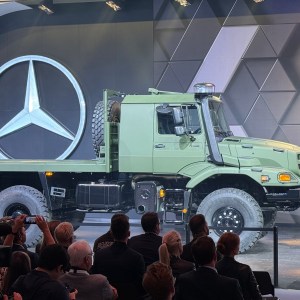
Daimler Truck Defence is fulfilling contracts for up to 7,000 trucks to France and 1,500+ to Canada, targeting €1B in defense revenue by 2028. This is a B2G military logistics story with zero marketplace commerce impact.
Defense procurement scaling is entirely outside the consumer marketplace ecosystem — no platform, logistics, or margin implications for ecommerce operators.
No relevance to Amazon, Walmart, or Target sellers. No fee changes, policy shifts, or supply chain effects touching consumer goods or marketplace operations.
Operational Impact
This story may require teams to revisit workflows, monitoring, or platform assumptions.
Bottom Line
Military truck contracts mean nothing for marketplace sellers.
Source Lens
Industry Context
Useful background context, but lower-priority than direct platform, community, or operator intelligence.
Impact Level
medium
Military truck contracts mean nothing for marketplace sellers.
Key Stat / Trigger
€1 billion in defense revenue targeted by 2028
Focus on the operational implication, not just the headline.
Full Coverage
Since Russia’s full-scale invasion of Ukraine, European armies have needed military trucks in volume and on short timelines. Daimler Truck is betting that need favors a manufacturer whose defense vehicles come out of the same plants, and the same parts bins, as its commercial trucks.
The company folded its military work into a single global brand, Daimler Truck Defence, in June. It plans to invest what it calls a mid-three-digit million-euro sum over the coming years and is targeting €1 billion in defense revenue by 2028, according to an announcement earlier in June.
About 1,000 employees work in the business today, and Daimler expects that number to grow, particularly at its Wörth am Rhein plant in Germany.
“Scaling is one of the key challenges in the defense industry these days,” said Dennis Kinzelmann, CEO of Daimler Truck Defence and head of Mercedes-Benz Special Trucks, during a media roundtable at IAA Transportation in Hanover, Germany.
“Unfortunately, with the, I would say, full-scale invasion of Russia into Ukraine, it has shown, especially in Europe, that Western societies and governments have to be prepared for widespread and longer-lasting conflicts,” Kinzelmann said.
“This means that we also have to have the ability to provide the right equipment at the right time and also at the scale that is needed.” Two large programs anchor the order book.
In January, France’s Ministry of the Armed Forces selected Daimler Truck and French partner Arquus to build trucks for its PL6T program, with deliveries running more than 10 years, Daimler Truck said at the time. Daimler builds the chassis at Wörth and at Molsheim, France. Arquus handles militarization, protected cabs and integration at its French sites.
Kinzelmann said the framework covers up to 7,000 Zetros-based trucks. “This will basically be the new platform for the land forces of France, with very different applications,” Kinzelmann said.
In Canada, Daimler is supplying more than 1,500 Zetros logistics trucks to the Logistics Vehicle Modernization program, where General Dynamics Land Systems-Canada is the prime contractor and Marshall Canada builds mission modules, according to the company’s 2024 award announcement.
The chassis are built at Wörth and shipped to Canada, where Kinzelmann said partners add the bodies and a “substantial” share of local content. Germany’s Bundeswehr has also ordered military logistics vehicles in the three-digit unit range, according to the June release.
France will most likely become the unit’s largest defense customer on the strength of the PL6T award, Kinzelmann said, “closely followed by Canada,” with Germany “still on a very important level.”
Civil Parts on Military Trucks The defense lineup runs from the Unimog at the light end through the Zetros to the Arocs, a severe-duty vocational truck Daimler sells in Europe. The Arocs runs in applications above 100 tons gross combination weight, Kinzelmann said, and the lineup covers “from 10 tons to 100 tons.”
On a military Arocs, Daimler shares the axles, some transmissions, the engine and the cab design with the civil version. Kinzelmann estimated the shared content could run “north of 70, 80 percent,” while noting he had not counted the parts. Tailored military equipment makes up the rest.
“Those vehicles and the components that we use typically have been deployed a hundred thousand times already, so well established in the field,” he said. Capacity is the other half of the pitch. “Once you’re going to see the Wörth plant, it’s one of the largest truck plants in the world,” Kinzelmann said.
“We can switch quite flexibly the volumes depending on the situation.” A Service Network for Decades-Long Fleets Defense customers typically keep vehicles in service for 20 to 30 years, Kinzelmann said, so each order has to ship with the aftersales support to keep those trucks running.
Daimler Truck’s aftersales network spans more than 160 countries, and he said the defense unit uses that civil parts backbone to move spares with the same speed as the commercial side. The Unimog, which turns 80 this year, is the durability case Kinzelmann reaches for.
Argentina placed new Unimog orders, and when the country’s defense minister visited Wörth, the delegation showed him photos of Unimogs from the 1960s and 1970s still running in Argentina. “I asked my engineers, how long does a Unimog last?” Kinzelmann said. “And they say, we don’t know because we’ve only been building it for 80 years.”
Procurement Still Runs Country by Country “It’s still very much a national procurement effort in Europe,” Kinzelmann said. He said he hopes for more European alignment over time to close capability gaps faster. Where Daimler lacks a capability, it partners, as it did with Arquus in France and GDLS in Canada.
Kinzelmann named Rheinmetall among the established defense players in Europe and said Scandinavian truck manufacturers also supply military vehicles. “To us it’s probably less about competition, but more
No action required — this article has no bearing on marketplace selling operations.
Skip monitoring this space unless you sell commercial truck parts on marketplace platforms.
Original Source
This briefing is based on reporting from Freightwaves. Use the original post for full primary-source context.
Style
Audience