

What 24/7 actually costs: the operational anatomy of round-the-clock support for mid-market retailers
Sponsor content is created on behalf of and in collaboration with Bazoom by DigitalCommerce360. Our editorial staff is not involved in the creation of the sponsored content. Round-the-clock support looks like a simple hiring problem: three shifts instead of one, so roughly triple the payroll. In practice, mid-market retailers often discover that the real costs […] The post What 24/7 actually costs: the operational anatomy of round-the-clock support for mid-market retailers appeared first on Digi
Source Lens
Analyst Intelligence
Research or editorial analysis that adds market context beyond the official announcement.
Impact Level
medium
Use this briefing to decide whether your team needs an immediate workflow, policy, or reporting change.
Key Stat / Trigger
No single quantitative trigger surfaced in this report.
Focus on the operational implication, not just the headline.
Full Coverage
Sponsor content is created on behalf of and in collaboration with Bazoom by DigitalCommerce360. Our editorial staff is not involved in the creation of the sponsored content. Round-the-clock support looks like a simple hiring problem: three shifts instead of one, so roughly triple the payroll.
In practice, mid-market retailers often discover that the real costs show up later in night-shift premiums, attrition-driven hiring and training, and supervision hours that rarely make it into the initial budget. That is why proposals for seemingly identical 24/7 support often vary so widely.
The difference usually boils down to how each ecommerce BPO provider structures coverage: which time zones handle which hours, who supervises the overnight queue, and whether quality controls remain active when headquarters goes home.
In the following paragraphs, we break down the main cost drivers behind 24/7 support as well as the questions retailers should ask before signing a contract. With the intro out of the way, let’s get started. Why the three-shift math understates the cost A 24/7 support desk costs more than three times an eight-hour operation.
Overnight coverage comes with wage premiums, higher attrition, dedicated supervision, and minimum staffing requirements that force you to pay for capacity your overnight ticket volume may never fully use. Start with staffing. A queue that averages four tickets per hour overnight still needs at least two agents on the clock.
A single agent leaves you exposed to breaks, sick days, and simultaneous escalations. In other words, you are paying for resilience, not just workload, and overnight demand rarely fills that capacity. Wage law adds another layer.
In the Philippines, the world’s largest offshore support market, Article 86 of the Labor Code mandates a night-shift differential of at least 10% of an employee’s regular wage for every hour worked between 10 p. m. and 6 a. m. Competitive employers often pay above that minimum to retain experienced overnight staff.
Similar premiums, whether statutory or market-driven, exist across most support delivery locations. Growing ecommerce demand is pushing more retailers to confront these costs.
US ecommerce sales grew nearly 10% year over year in Q1 2026, and every point of growth brings more customer support activity outside traditional business hours: order-tracking requests at midnight, chargeback disputes on weekends, or checkout failures during a flash sale in another region.
How follow-the-sun staffing works Follow-the-sun staffing transfers support coverage between teams in two or three time zones so agents can work local daytime hours.
The model eliminates night-shift premiums and reduces the fatigue associated with overnight work, but it introduces costs of its own in the form of handoffs, overlap hours, and additional sites to manage.
A common setup for a US retailer combines a nearshore team in Mexico covering US business hours with an offshore team in the Philippines or Eastern Europe whose local daytime aligns with the US night. Each team operates during normal working hours, which often improves retention and reduces the risk of errors associated with overnight shifts.
The costs do not disappear; they move elsewhere. Every handoff creates an opportunity for information to be lost, so mature programs invest in 30 to 60 minutes of shift overlap, shared ticketing systems with detailed case notes, and structured handoff processes where open escalations are reviewed live rather than passed along asynchronously.
Multiple sites also mean multiple recruiting pipelines, training schedules, and management teams. At lower overnight volumes, a single site running a compensated night shift is often less expensive than maintaining a second location. As overnight demand grows, however, follow-the-sun staffing often becomes the stronger option on both cost and quality.
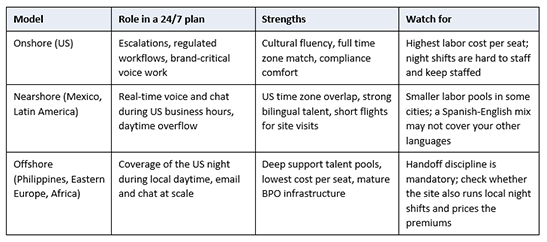
Onshore, nearshore, and offshore: how geography shapes cost and coverage Most mid-market 24/7 support programs combine multiple delivery locations rather than relying on a single geography.
Onshore teams often handle regulated workflows and brand-sensitive interactions, nearshore teams provide real-time coverage during US business hours, and offshore teams deliver scalable support while covering overnight demand during their local daytime. The mix of locations, more than any single hourly rate, often determines the total cost of a program.
When reviewing a proposal, map every hour of your support schedule to a delivery location and local time zone. If a provider covers your 2 a. m. support volume from a site where it is also 2 a. m. locally, you are still paying for a night-shift operation, along with the premiums, turnover, and supervision costs that typically accompany it.
Maintaining quality across every shift Quality in a 24/7 support operation depends on controls that remain active around the clock. That includes QA reviews across every shift, cross-site calibration, clearly de
Original Source
This briefing is based on reporting from Digital Commerce 360. Use the original post for full primary-source context.
Style
Audience