

The Faster Labor Contracts Act passed the House
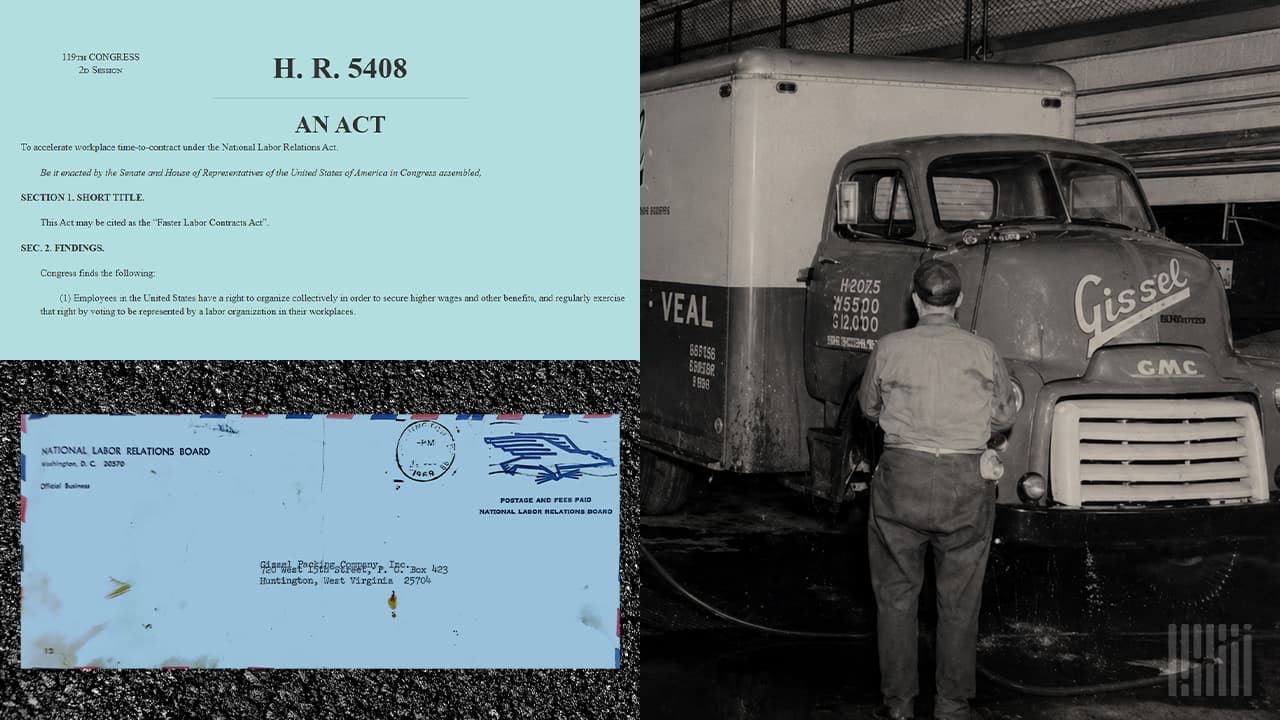
H.R. 5408 gives employers 120 days to reach a first union contract or a government arbitrator writes one for them. The House passed it 230-193 on June 9. The Senate is the last wall. If you run trucks, this is not someone else's problem. The post The Faster Labor Contracts Act passed the House appeared first on FreightWaves.
Source Lens
Industry Context
Useful background context, but lower-priority than direct platform, community, or operator intelligence.
Impact Level
medium
Use this briefing to decide whether your team needs an immediate workflow, policy, or reporting change.
Key Stat / Trigger
No single quantitative trigger surfaced in this report.
Focus on the operational implication, not just the headline.
Full Coverage
I come from some really wild people and some really wild stories. My paternal grandfather, Jack Emerson, was a farmer in VA who helped raise me on their farm with his daughter. My Dad’s paternal grandfather, Irvin Carpenter, became the subject of a Supreme Court case that held that not declaring all marital assets voids prenuptial agreements.
The most notorious was my mother’s European side and my grandfather, Roman Gissel of Gissel Packing in Huntington, West Virginia. He literally started with nothing, came to America, and built a meatpacking company from the ground up, and shut down an empire rather than bargain with the NLRB. He closed the doors. Every employee went looking for work.
The Gissel Packing case, NLRB v. Gissel Packing Co. , decided by the Supreme Court in 1969, remains the fundamental case law for NLRB authorization card bargaining orders to this day. It is taught in every labor law course in every law school in the country. My grandfather lost that case, and it didn’t matter because he had already made his choice.
He would rather put the key in the door and walk away from everything he built than operate a business on someone else’s terms. That’s the principle, and it’s one that H. R. 5408 is designed to render irrelevant.
The Faster Labor Contracts Act amends the National Labor Relations Act to impose a compressed, federally mandated timeline for first contract negotiations between an employer and a newly certified union. The sequence is mechanical and non-negotiable. By day 10 after union certification, the employer must begin bargaining.
By day 100, if no agreement has been reached, federal mediation is triggered through the Federal Mediation and Conciliation Service. By day 130, if mediation fails, binding interest arbitration is initiated.
By day 144, an arbitration panel is seated and empowered to impose a complete first collective bargaining agreement covering wages, benefits, work rules, and all related terms.
That is a maximum of 120 days of actual bargaining, 90 days of negotiation, plus 30 days of mediation, before a government-appointed arbitrator who has never dispatched a truck, managed a terminal, priced a freight lane, or calculated the cost of a mile writes the contract that governs your operation.
The bill was introduced last year by Representative Donald Norcross of New Jersey. It reached 218 signatures on a discharge petition on May 20, 2026, which forced it out of committee and onto the floor, bypassing committee chairs, regular order, CBO scoring, and stakeholder input.
The discharge petition is one of the most aggressive procedural tools available in the House, and it almost never succeeds. This one did. The floor vote on June 9 passed 230 to 193. Twenty Republicans voted yes alongside all 210 Democrats.
The bill is a provision lifted directly from the Protecting the Right to Organize Act (PRO Act), which failed to advance on a bipartisan basis across multiple Congresses. Proponents isolated this one piece and used the discharge petition to ram it through. The 20 Republican yes votes tell you everything you need to know about the political math.
Five came from Ohio: Mike Carey, David Joyce, Max Miller, Michael Rulli, and Michael Turner. Five came from New York: Andrew Garbarino, Nick LaLota, Nicholas Langworthy, Michael Lawler, and Nicole Malliotakis. Two from Pennsylvania: Robert Bresnahan and Brian Fitzpatrick. Two from New Jersey: Christopher Smith and Jefferson Van Drew.
Two from Florida: Carlos Gimenez and Maria Elvira Salazar. One each from Nebraska, West Virginia, Minnesota, and Wisconsin: Don Bacon, Riley Moore, Pete Stauber, and Derrick Van Orden. The pattern is not subtle. These are Republicans in union-heavy swing districts in the Rust Belt and the Northeast, members who need union households to win reelection.
Ohio, where the Teamsters are deeply embedded in freight and manufacturing, cast five yes votes on its own. New York sent five more. Stauber, who represents Minnesota’s Iron Range, is a former police officer who organized his own union and said so in his press release supporting the bill. These are not ideological converts to organized labor.
They are members reading their district demographics and making a survival calculation, and that same calculation applies to Republican senators in Ohio, Pennsylvania, Wisconsin, and Michigan when this bill reaches the Senate floor. What happens in the Senate The bill now moves to the Senate, where it needs 60 votes to advance past a filibuster.
That is the firewall. The political dynamics, however, are not as comfortable as they were six months ago.
Fisher Phillips, one of the largest management-side labor law firms in the country, noted before the House vote that there was a meaningful possibility the White House could issue a Statement of Administration Policy in support, given the administration’s efforts to appeal to working-class voters.
If that happens, it provides political cover for Republican senators i
Original Source
This briefing is based on reporting from Freightwaves. Use the original post for full primary-source context.
Style
Audience