

How long should a YouTube Short be?
Adobe Express just surveyed 507 YouTube creators with at least 1,000 subscribers to find out exactly how long a YouTube Short should be for maximum performance. The research breaks down ideal video length by views, shares, click-throughs, saves, and subscriber growth, along with the best day and time to post. The takeaway: shorter is almost […]
Source Lens
Industry Context
Useful background context, but lower-priority than direct platform, community, or operator intelligence.
Impact Level
medium
Use this briefing to decide whether your team needs an immediate workflow, policy, or reporting change.
Key Stat / Trigger
No single quantitative trigger surfaced in this report.
Focus on the operational implication, not just the headline.
Full Coverage
Adobe Express just surveyed 507 YouTube creators with at least 1,000 subscribers to find out exactly how long a YouTube Short should be for maximum performance. The research breaks down ideal video length by views, shares, click-throughs, saves, and subscriber growth, along with the best day and time to post.
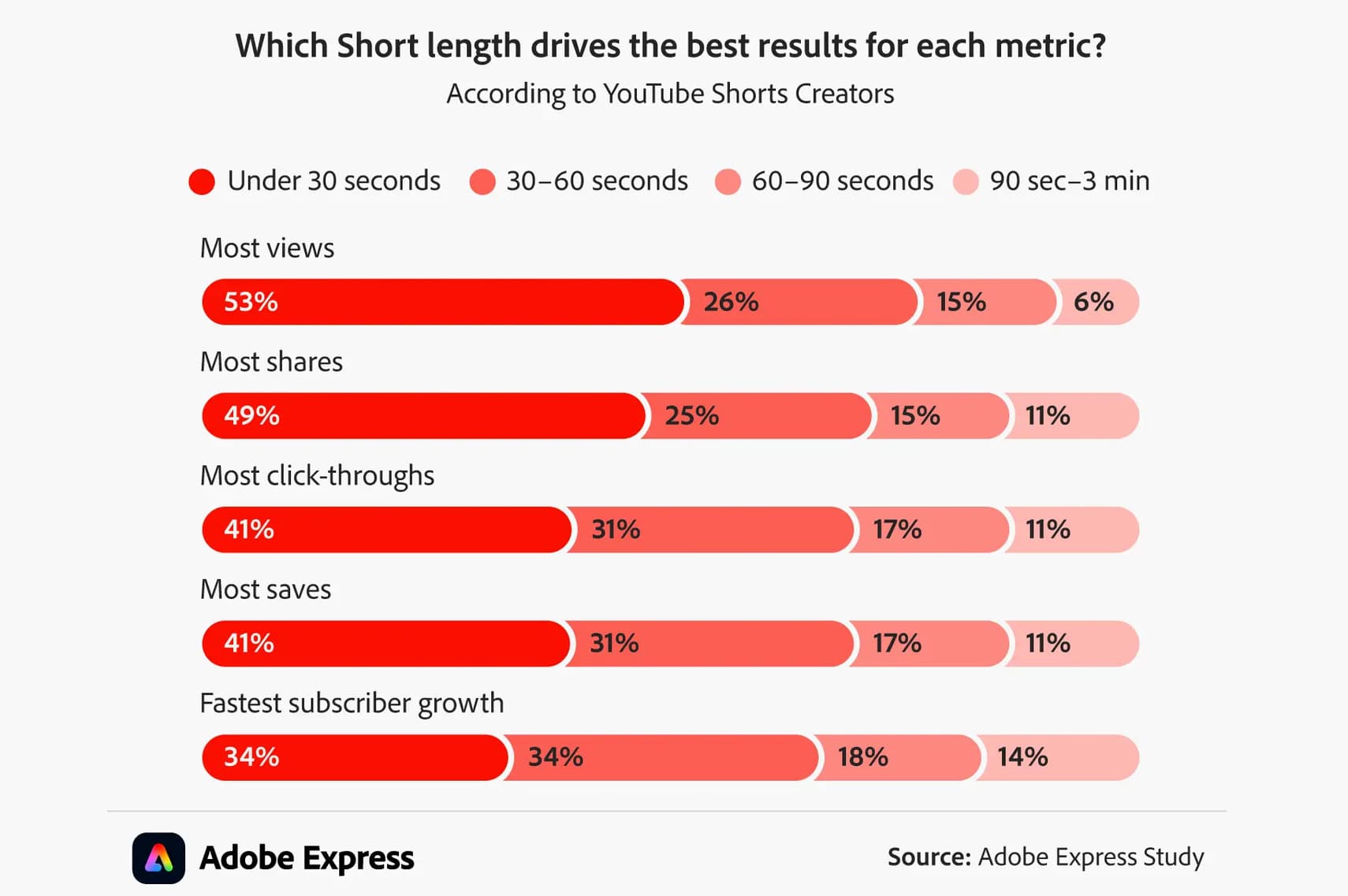
The takeaway: shorter is almost always better, but not in every case. Short-form success often comes down to how quickly you can capture attention and deliver value. Creators consistently pointed to shorter videos as the strongest performers across key metrics. Under 30 seconds drives the most views, cited by 53% of creators.
Shorts under 30 seconds generate more click-throughs to long-form videos than longer ones, according to 49% of creators. 70% of creators have had a Short go viral, with under-30-second clips accounting for 40% of viral moments. Saturday and 6–8 p. m. are the best day and time to post, according to creators.
On average, 46% of creators said the ideal YouTube Shorts length for views, shares, click-throughs, and saves is under 30 seconds. When focusing specifically on views, 53% identified under 30 seconds as the top-performing format.
Drivign traffic to long-form videos When it comes to driving traffic to long-form videos, 49% of creators said Shorts under 30 seconds generate more click-throughs than longer ones, compared to 36% who favored videos over 30 seconds. Shorts hovering around 30 seconds also lead in shares, with 49% citing them as the top format.
For creators focused on growing a channel, that makes brevity one of the more practical tools for turning casual viewers into a longer-term audience. Viral potential also leaned heavily toward brevity. A majority of creators (70%) said they had a Short go viral, with videos under a minute most likely to break through.
When it came to subscriber growth, results were more balanced: 34% favored under 30 seconds, and another 34% favored 30–60 seconds. The best YouTube Shorts length by content niche Not every audience consumes content the same way, and video length preferences can shift depending on your niche. Understanding these differences can help you tailor your approach.
Entertainment and comedy creators leaned strongly toward shorter formats, with 48% saying that Shorts under 30 seconds deliver the best results. These quick, punchy videos align well with humor and fast-paced storytelling, keeping viewers engaged from start to finish.
Speaking of engagement, 82% say this category is the most likely to keep viewers engaged up to a minute. Lifestyle and vlog creators saw a similar pattern. A total of 67% said the ideal YouTube Short length falls under 60 seconds, suggesting that slightly longer formats give more room for storytelling, context, or personality-driven content.
Creators ranked Saturday as the best day of the week for views and engagement (25%), followed by Friday (23%). Overall, 21% said they don’t track daily views or engagement, so they couldn’t say which days are best. Evening hours proved especially effective, with 19% of creators reporting peak engagement at 6 p. m. , 7 p. m. , and 8 p. m.
This points to a clear window for posting when Shorts users are most active.
Original Source
This briefing is based on reporting from Tamebay. Use the original post for full primary-source context.
Style
Audience