

Behind the scenes of Amazon’s automated Washington warehouse
Hercules robots and packing technology help power the fulfillment center in Kent. Here's a step-by-step tour.
Source Lens
Industry Context
Useful background context, but lower-priority than direct platform, community, or operator intelligence.
Impact Level
medium
Use this briefing to decide whether your team needs an immediate workflow, policy, or reporting change.
Key Stat / Trigger
No single quantitative trigger surfaced in this report.
Focus on the operational implication, not just the headline.
Full Coverage
An article from Behind the scenes of Amazon’s automated Washington warehouse Hercules robots and packing technology help power the fulfillment center in Kent. Here’s a step-by-step tour. Published Aug.
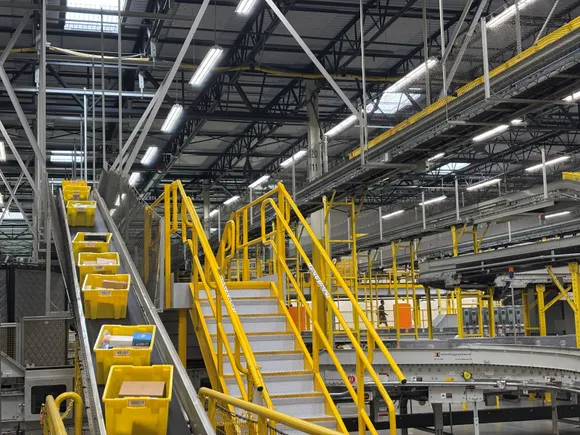
4, 2026 Kelly Stroh Senior Editor Share Copy link Email / Print License Add us on Google Items move on a conveyor belt at an Amazon fulfillment center in Kent, Washington, on July 23. The automated facility is capable of handling more than 1 million items per day. Kelly Stroh/Supply Chain Dive Listen to the article 4 min This audio is auto-generated.
Please let us know if you have feedback. Millions of packages flow through Amazon's ever-expanding network of fulfillment centers daily, and more and more are leveraging automation technology.
One of those sites in Kent, Washington, is capable of handling 1 million parcels daily alone, leveraging employee know-how, robotics, technology-enhanced workstations, inventory "pods" and automated packaging machines to keep packages moving. I got to put on a pair of steel-toed shoe covers and take a peek behind the curtain to see how it all comes together.
Here’s what I saw: Welcome to the warehouse A light up sign welcomes employees to the BFI4 fulfillment facility in Kent, Washington. Kelly Stroh/Supply Chain Dive Welcome to BFI4, an Amazon fulfillment center in Kent, Washington.
Initially opened in 2016, the facility is the first in the e-commerce giant’s network capable of handling more than 1 million items per day. To process such a large volume of goods, the facility combines the power of about 3,500 associates with automation and robotics technology to stow, pick and pack products.
Items arrive at BFI4 Workers unload items from a truck to be moved into inventory storage. Kelly Stroh/Supply Chain Dive Parcels first arrive at the facility by truck, after which staff members unload packages onto a conveyor belt to be moved and stowed into inventory. Stowing occurs at a “Universal Station,” which is operated manually by an associate.
At Universal Stations, totes of goods arrive at the workspace, which employees then stow onto the corresponding inventory shelf, called a “pod.” Picking for order fulfillment also occurs at these stations. Semi-automated workstations in action An Amazon Robotics Semi-Automated Workstation, or ARSAW.
Kelly Stroh/Supply Chain Dive In a typical warehouse, employees will need to walk to a shelf in order to pick or stow items. At BFI4, the inventory pods — which span four floors — are transported to Amazon Robotics Semi-Automated Workstations or Universal stations via Hercules robots.
To fulfill customer orders, employees pick items from inventory shelving pods at ARSAWs. These workstations, which are only used in the picking process, move the selected items into bins called totes. Projector lights highlight specific parts of the pod to help visually guide employees to the right item to pick.
Employees then place the picked items then into totes. Hercules robots transport inventory Inventory pods move across a warehouse floor via Hercules robots. Kelly Stroh/Supply Chain Dive The inventory pods and Hercules robots stay in a dedicated fenced area of the warehouse, located next to ARSAW and Universal Stations.
Amnesty Floor Monitors are critical for troubleshooting various issues in this section, such as restarting the mobile robots or clearing obstructions on the active floor. Items are en route to the packing department Gray trays with items are being transported on conveyor belts in a warehouse.
Kelly Stroh/Supply Chain Dive At a high level, once items are picked by employees, they are sorted into trays or totes and routed to the corresponding packing station based on order type. Single-item orders and multi-item orders follow automated paths to different sections of the packing process. The packing process A manual packing station.
Kelly Stroh/Supply Chain Dive The different packing sections also leverage automation. For instance, a CW1000 packaging machine uses advanced sensors to measure each item and apply the exact amount of wrapping material needed for protection during the shipping process. This helps eliminate the use of excess packaging that can accompany manual boxing.
The site also utilizes manual packaging stations, where automated processes supplement human work. Orders with multiple items go to the Amazon Fulfillment Engine area, where employees pack items together. In this section, associates are guided by systems that help identify which box size to use and are equipped with automated tape dispensers.
Orders are ready for delivery The ship dock area of the fulfillment facility. Kelly Stroh/Supply Chain Dive Employees then transport the packaged items to a ship dock area. The parcels are packed onto trailers to be transported to either sorting centers, which orchestrate further transportation, or delivery stations, which deliver to customers’ doors.
This story was first published in our Operations W
Original Source
This briefing is based on reporting from Supply Chain Dive. Use the original post for full primary-source context.
Style
Audience