

Diesel is $5.62 a gallon. Hire the right Driver.
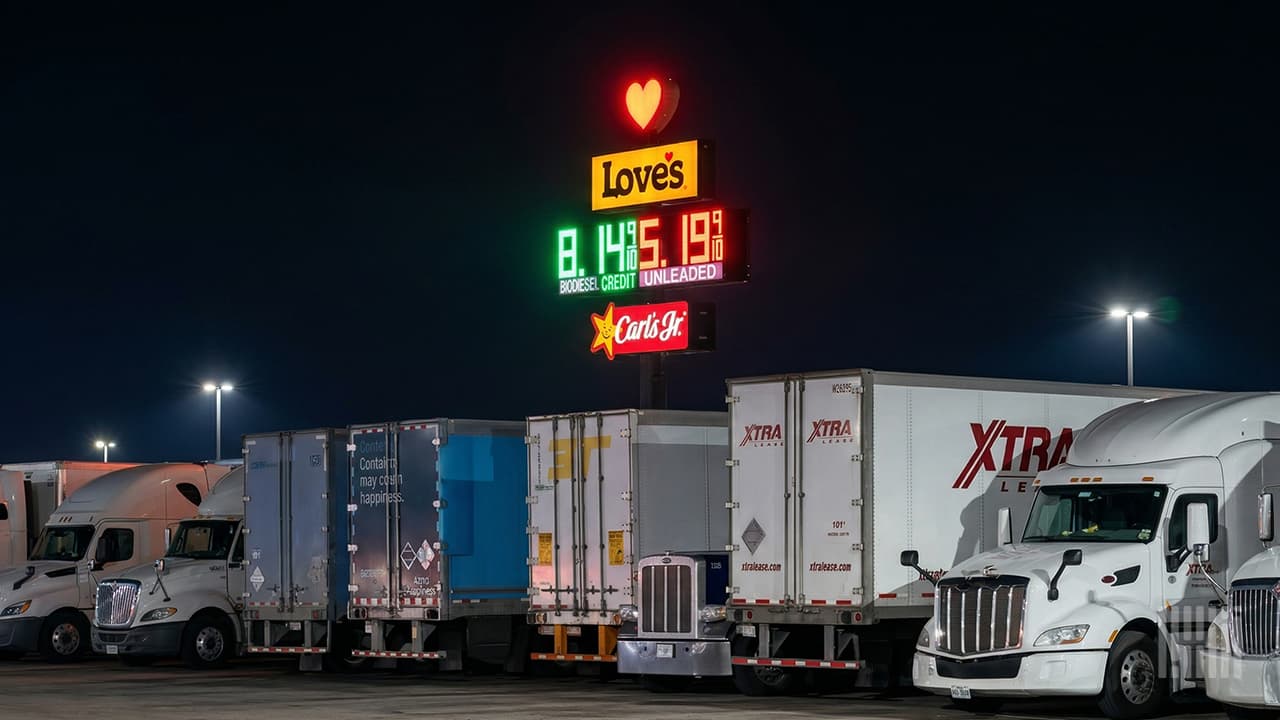
Diesel prices surged 50% to $5.62/gallon due to Iran war disrupting Strait of Hormuz, adding $26,700 annual fuel costs per truck. Carriers are repricing surcharges while shippers absorb new fees across all logistics networks.
Higher fuel costs will cascade into increased shipping rates for FBA inbound, LTL freight, and last-mile delivery within 30-60 days. Sellers should lock in Q2 inventory shipments now before carriers fully reprice their fuel surcharges.
This represents broader supply chain cost inflation that will compress seller margins, similar to 2021-2022 logistics disruptions but driven by geopolitical conflict rather than pandemic demand.
Accelerate Q2 inventory shipments to FBA before fuel surcharges get repriced - check current carrier contracts for fuel adjustment clauses
Review shipping cost assumptions in your unit economics models - budget 15-25% increases for inbound freight over next 90 days
Bottom Line
$5.62 diesel means higher FBA and shipping costs incoming.
Source Lens
Industry Context
Useful background context, but lower-priority than direct platform, community, or operator intelligence.
Impact Level
medium
$5.62 diesel means higher FBA and shipping costs incoming.
Key Stat / Trigger
$5.62 per gallon diesel price, up 50% in five weeks
Focus on the operational implication, not just the headline.
Full Coverage
The war with Iran changed your fuel budget overnight. On Feb. 28, when the first strikes began, diesel was running around $3. 75 a gallon nationwide. By late March, it had crossed five dollars for the first time since December 2022. We’re now at $5. 62, up nearly 50 percent in five weeks, and analysts are not done talking about where it could go.
Some have modeled $6. Some are discussing $7 if the Strait of Hormuz stays disrupted into the summer. A group out of Australia put the probability of $200-per-barrel crude at 40 percent if the conflict extends. That is no longer a fringe number. That is a scenario serious people are pricing in.
The Strait of Hormuz carries roughly 20 percent of the world’s oil supply. Iran closed it. The International Energy Agency called it the largest supply disruption in the history of the global oil market. The United States opened the Strategic Petroleum Reserve and released 172 million barrels.
A ceasefire was announced this week after Trump threatened to level Iranian power plants, and Brent dropped about 15 percent on the news. It is still sitting above $90 a barrel, well above the $70 it was at before the war started.
Analysts are already saying that even if the ceasefire holds, production in the region will not fully resume for months because of infrastructure damage. The diesel number at the pump hasn’t been back to where it was for a while. Plan your operation around that reality.
For a carrier running 100,000 miles a year at 7 miles per gallon, the difference between diesel at $3. 75 and diesel at $5. 62 is roughly $26,700 per truck per year in additional fuel cost. If you run 20 trucks, that is over half a million dollars in new annual exposure from a single geopolitical event you had no control over.
The equipment, the routes and the freight rates are largely fixed in the near term. The driver is not. The driver is one of the biggest levers you have on your fuel line that most fleets are not pulling hard enough.
The CDL is not a performance evaluation The Federal Motor Carrier Safety Regulations allow a carrier to use a valid commercial driver’s license in lieu of a road test during the driver qualification process. It is right there in 49 CFR 391. 33. The CDL itself is accepted as evidence of driving proficiency.
You can check that box, put the license in the file and move on. Many carriers do exactly that. They treat a CDL as proof that a driver can operate a commercial vehicle at a professional level. They call it a road test waiver and they use it routinely because it saves time and because the regulation permits it.
The problem is that the CDL is not a performance evaluation. It is a minimum competency credential. It tells you the holder passed a knowledge test and a skills evaluation at some point in the past. It does not tell you how that person actually drives. It does not tell you whether they maintain a following distance.
It does not tell you whether they pace traffic, manage momentum through traffic flow changes, brake smoothly or hammer the pedal. It does not tell you how they handle grades, how they read the road ahead or whether their situational awareness is sharp enough to avoid the hard inputs that destroy fuel economy and wear out equipment.
That was before the current state of CDL credentialing became what it is. We have spent years documenting the failure of the CDL system in this publication and elsewhere. Entry-level driver training ran on a self-attestation honor system for years and still relies heavily on provider self-certification.
Third-party CDL examiners have been caught accepting bribes. There are documented cases of examiners passing drivers in exchange for Swedish fish and Fiji water. CDL mills have graduated people with credentials and minimal actual skill.
The FMCSA issued more than 550 notices of proposed removal to CDL training providers in a recent enforcement sweep, citing unqualified instructors, improper training vehicles and failure to meet federal requirements. None of that accounts for the fundamental shift in what a CDL actually tests in 2026.
Roughly 90 to 95 percent of new Class 8 trucks sold today are automatic transmissions. The CDL skills test most recently completed by licensed drivers was conducted automatically. There is no gear management component. There is no clutch feel.
There is no requirement to demonstrate mechanical understanding of the drivetrain, engine speed management or anything that requires the driver to actively interact with the powertrain. You press the brake, you press a button, you press the accelerator and the truck figures out the rest.
The credential most drivers now hold was earned on equipment that requires the least mechanical skill of any commercial vehicle configuration in the industry’s history. That does not mean automatic transmission drivers cannot be skilled professionals. Many of them are.
But the CDL no longer filters for fuel-efficient operation the way it once did, when passing the
Original Source
This briefing is based on reporting from Freightwaves. Use the original post for full primary-source context.
Style
Audience