Daimler Truck maps what it takes to scale electric trucks
Daimler Truck reports electric trucks hit 4.2% of EU market in 2025, up from 2.3%, but infrastructure gaps — only 2,000 public charge points vs. 35,000 needed by 2030 — are slowing fleet adoption. This signals freight cost volatility for sellers relying on European logistics partners.
Regulatory pressure on European carriers to electrify faster than infrastructure allows creates a margin compression squeeze that will pass costs to shippers and ultimately marketplace sellers operating in EU markets.
As European carriers like Dachser struggle to electrify fleets affordably, surcharges and rate instability will flow downstream to brands shipping into or within Europe. Sellers with EU operations should audit carrier contracts now for fuel/energy surcharge clauses that could expand.
Operational Impact
This story may require teams to revisit workflows, monitoring, or platform assumptions.
Bottom Line
EU freight electrification gaps mean rising surcharge risk for European sellers.
Source Lens
Industry Context
Useful background context, but lower-priority than direct platform, community, or operator intelligence.
Impact Level
medium
EU freight electrification gaps mean rising surcharge risk for European sellers.
Key Stat / Trigger
4.2% of EU heavy truck registrations were electric in 2025, up from 2.3% in 2024
Focus on the operational implication, not just the headline.
Full Coverage
HANNOVER, Germany — Daimler Truck laid out what it says Europe needs to move battery-electric and hydrogen trucks from early adopters into mainstream fleets. It includes public megawatt chargers, hydrogen stations built for trucks and road tolls that reward zero-emission vehicles.
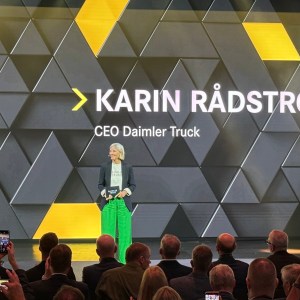
CEO Karin Rådström made the case at the company’s Media Night in Hanover, Germany, ahead of IAA Transportation 2026.
Mercedes-Benz Trucks held about 38% of Europe’s market for locally CO2-free medium- and heavy-duty trucks in the first half of 2026, and customers have driven the eActros 600 more than 160 million kilometers since series production began at the end of 2024, the company said.
“Today, there are over 60 electric or zero-emission trucks available in the market, and over 25 different zero-emission bus models from us and from our competitors,” Rådström said. “So our industry has clearly delivered.”
Heavy-duty battery-electric trucks took 2% of Europe’s market in 2025, according to Daimler Truck, which estimates about 35% of new trucks would need to run on batteries or hydrogen by 2030 to meet EU CO2 targets. The European Automobile Manufacturers’ Association’s full-year 2025 commercial vehicle registration data, released Jan.
29, put all electrically chargeable trucks above 3. 5 tonnes at 4. 2% of the EU market, up from 2. 3% a year earlier. Customers hold back for two reasons, Rådström said: infrastructure and cost parity with diesel.
Chargers, hydrogen stations and tolls Europe has fewer than 2,000 public truck charge points today, most of them standard CCS chargers, Rådström said. By 2030, she said, it needs 35,000 megawatt charging points to support the battery-electric trucks the CO2 targets require.
Europe has around 187 hydrogen stations, most supplying only 350 bar, which Rådström said is not suitable for trucks. She said Europe needs 1,000 by 2030. On cost, Rådström pointed to CO2-based road tolls.
In Germany, the toll difference between a diesel truck and an electric truck comes out to about 33 to 35 cents per kilometer, which she said helps offset the higher investment cost. Only 13 of the EU’s 27 member states have adopted CO2-based tolls, she said, and fewer than a handful of those set a meaningful gap between electric and diesel.
What Dachser sees in its network Stefan Hohm, chief development officer at Dachser, the German logistics provider, said on stage that the company has 25 emission-free delivery areas in Europe and more than 200 battery-electric trucks on the road, including more than 160 Mercedes-Benz Actros models.
“We are proud to have more than 200 battery-electric trucks on the road, but the truth is we run more than 15,000,” Hohm said. “So this is only a beginning. And financing the first generation of battery-electric vehicles remains the main hurdle for our transport partners.” Hohm called grid access and capacity the main pain point.
A Dachser network study found almost all of its 300 European branches have access to 1 to 3 megawatts of grid capacity, he said, and in Germany the company deals with 800 energy providers. He wants clear timelines and binding commitments from them.
Toll gaps between diesel and electric trucks vary by country: almost 33 cents per kilometer in Germany, nothing in France and almost €1 in Switzerland, Hohm said. He wants a stable framework that holds for at least five to six years. Dachser has built more than 800 charging stations on its own yards, and Hohm said depot charging works best.
He said Dachser still needs public and semi-public charging along European corridors, at stable prices. “If you have your own tariff in the depot, it sometimes really messes up the business case if you have to pay more than double when you are charging publicly,” he said.
Lowliner and NextGenH2 timelines The eActros Lowliner, a battery-electric tractor with a low fifth-wheel height for high-volume mega trailers, opened for orders Sept. 15, with series production at the Mercedes-Benz plant in Wörth, Germany, set for the second quarter of 2027.
The three-battery version offers around 500 kilometers of range at full load, and megawatt charging arriving in the second half of 2027 will take it from 10% to 80% in under 30 minutes, the company said.
On hydrogen, a small series of 100 Mercedes-Benz NextGenH2 fuel-cell trucks enters customer operations from the end of 2026, with Dachser as the first customer. Hohm said the first truck will run two shifts out of Malsch, near Karlsruhe, with a target of 220,000 kilometers a year.
The regulatory review Daimler Truck is asking the EU for an early review of its heavy-duty CO2 regulation, with the 2030 target tied to infrastructure rollout and customers’ total cost of ownership.
That target calls for a 43% cut in CO2 emissions from new heavy-duty vehicles compared with 2019, and the Council of the EU adopted a temporary flexibility on March 30 that lets manufacturers accumulate credits from 2025 through 2029 by beating their own annual targets. The s
Review EU carrier contracts for energy surcharge language — if open-ended, negotiate caps before Q1 2027 rate cycles lock in.
If sourcing or selling in Europe, build a 5-8% freight cost buffer into 2026-2027 margin models to absorb carrier electrification costs.
Original Source
This briefing is based on reporting from Freightwaves. Use the original post for full primary-source context.
Style
Audience