Amazon Scaling Risk Management: A 2026 Guide for Mid-Market and Enterprise Sellers
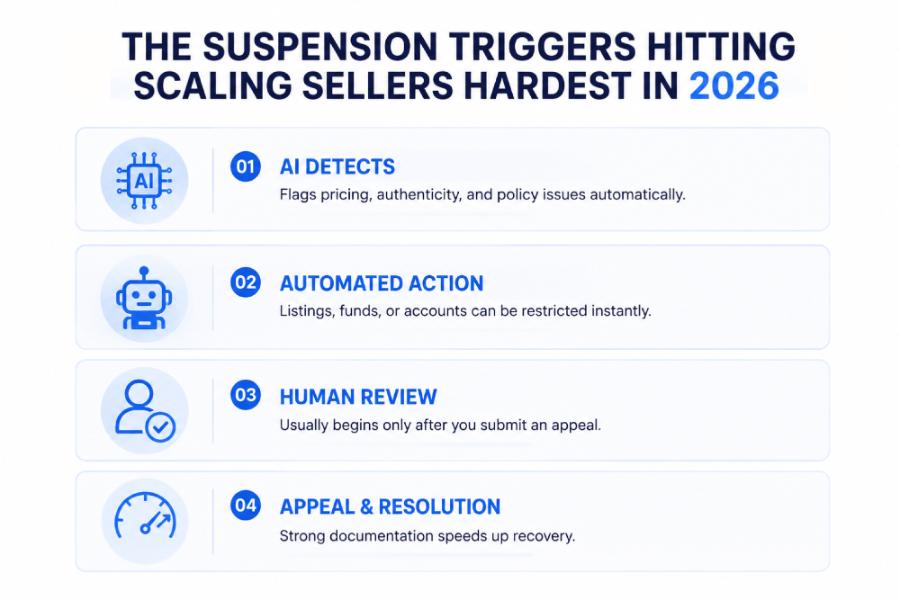
Amazon's AI-first enforcement in 2026 applies identical automated thresholds to scaling sellers — critical violations (counterfeit, IP complaints) drop Account Health Rating to zero instantly, regardless of prior standing. Sellers crossing $300K+/month with 40+ ASINs face disproportionate suspension risk simply due to higher order volume triggering defect rate thresholds faster.
Amazon's AI enforcement creates a structural penalty for growth, pushing mid-market and enterprise sellers toward agency or in-house compliance ops — accelerating margin compression as operational overhead scales alongside revenue.
A seller's compliance standards don't have to change for their metrics to deteriorate — volume does the damage automatically. Assign a dedicated account health owner, switch from monthly to weekly AHR checks in Seller Central's Account Health dashboard, and audit every 3PL's handling time SLA before onboarding.
Operational Impact
This story may require teams to revisit workflows, monitoring, or platform assumptions.
Bottom Line
Higher Amazon volume means faster metric deterioration — weekly monitoring is now mandatory.
Source Lens
Industry Context
Useful background context, but lower-priority than direct platform, community, or operator intelligence.
Impact Level
high
Higher Amazon volume means faster metric deterioration — weekly monitoring is now mandatory.
Key Stat / Trigger
Critical violations drop Account Health Rating to zero instantly, regardless of prior standing
Focus on the operational implication, not just the headline.
Full Coverage
Amazon scaling risk management is the practice of identifying and controlling the operational, compliance, and structural risks that intensify as a seller’s revenue, ASIN count, and headcount grow. It covers account health, documentation, access control, and channel dependency, not just isolated fixes after something breaks.
Here’s the part nobody tells you before you cross seven figures on Amazon.
The same automated systems Amazon uses to catch counterfeiters, hijackers, and policy abusers also watch order volume, pricing changes, listing edits, and review velocity, and those systems don’t have a separate, gentler ruleset for a seller who’s growing quickly for entirely legitimate reasons.
A seller doing $30K a month with three SKUs and a handful of reviews is invisible to most of Amazon’s enforcement algorithms. A seller doing $300K a month across 40 ASINs, three warehouses, and a growing ad budget looks completely different to those same systems. More order volume means more chances to trip an order defect rate threshold.
More SKUs mean more chances for a listing to get auto-edited or suppressed. More people touching Amazon Seller Central means more chances for a compliance gap nobody notices until Amazon does.
Scaling risk management means matching your monitoring effort to that exposure, like checking account health weekly instead of monthly once order volume climbs, and assigning an actual owner to documentation and access once more than one or two people touch the account.
This article covers the standard risks every seller needs to manage and the ones that only show up once you’re actually scaling.
Quick Guide: The account health metrics that decide whether you keep sellingWhat happens to your revenue on the day Amazon suspends your account Building a risk register instead of waiting for the next Seller Central alert Final thoughtsFAQs The account health metrics that decide whether you keep selling Every risk conversation on Amazon eventually comes back to the Account Health Rating (AHR), a score from 0 to 1,000 that every seller account carries.
New accounts start at 200. From there, the score moves up or down based on policy compliance and performance over a rolling 180-day window.
ZoneScore rangeWhat it meansHealthy (green)200–1,000The account is not at risk of deactivationAt risk (yellow)100–199Amazon may restrict selling privilegesUnhealthy (red)99 or belowThe account is eligible for deactivation or already deactivated The metrics feeding that score matter more at scale, not less. The order defect rate has to stay under 1%.
The late shipment rate has to stay under 4%. The valid tracking rate needs to sit above 95% and On-Time Delivery above 90%. Here’s roughly what that costs you.
Amazon deducts somewhere between 2 and 8 AHR points per policy violation depending on severity (low, medium, high, or critical), and a critical violation, like a suspected counterfeit or IP complaint, can drop the score straight to zero regardless of your prior standing. You get points back too.
Roughly 4 for every 200 orders fulfilled cleanly in the trailing 180 days, which is why a high-volume account can absorb one violation that would sink a smaller one. Amazon doesn’t publish an exact formula, so treat these as directional, not a guarantee. At low volume, a couple of bad orders barely move these numbers.
At high volume, the same percentage represents hundreds of actual orders, and a single bad batch from a new 3PL or a single week of missed handling times can tip a metric from comfortable to flagged within days. This is why sellers who were perfectly compliant at $50K a month sometimes get their first warning at $500K a month.
Nothing about their standards changed. The math did. The suspension triggers hitting scaling sellers hardest in 2026 Amazon’s enforcement in 2026 runs on an AI-first model.
Automated systems flag pricing anomalies, authenticity concerns, and policy gaps, then act immediately, which in practice means suppressing the listing, withholding disbursed funds, restricting selling privileges on the affected ASIN, or deactivating the account outright, depending on severity.
Human review typically only happens once a seller appeals, which means the first real conversation with a person at Amazon often happens after the damage is already done.
This is precisely why scaling risk management has to be preventative rather than reactive, by the time a human at Amazon is reading your appeal, the ASIN has usually already lost sales, ranking, or both. Four categories of risk show up in almost every scaling seller’s story at some point.
The suspension triggers hitting scaling sellers hardest in 2026 Automated listing edits Amazon’s system can shorten titles, rewrite bullets, or suppress images to enforce policy, often with no meaningful notification.
A title that gets quietly cut from 200 characters to 80 can lose the keywords driving a large share of its organic traffic, and a seller managing dozens of SKUs may
Check Account Health Rating weekly in Seller Central > Account Health -- if score drops below 200, pull the Order Defect Rate, Late Shipment Rate, and Valid Tracking Rate reports immediately to isolate the trigger before Amazon escalates.
Within 30 days, build a risk register with named owners for: listing compliance, access permissions, documentation, and fulfillment SLA monitoring -- one person per area, not shared responsibility.
Original Source
This briefing is based on reporting from SellerApp Blog. Use the original post for full primary-source context.
Style
Audience