

Meet the product managers leading project44’s AI push
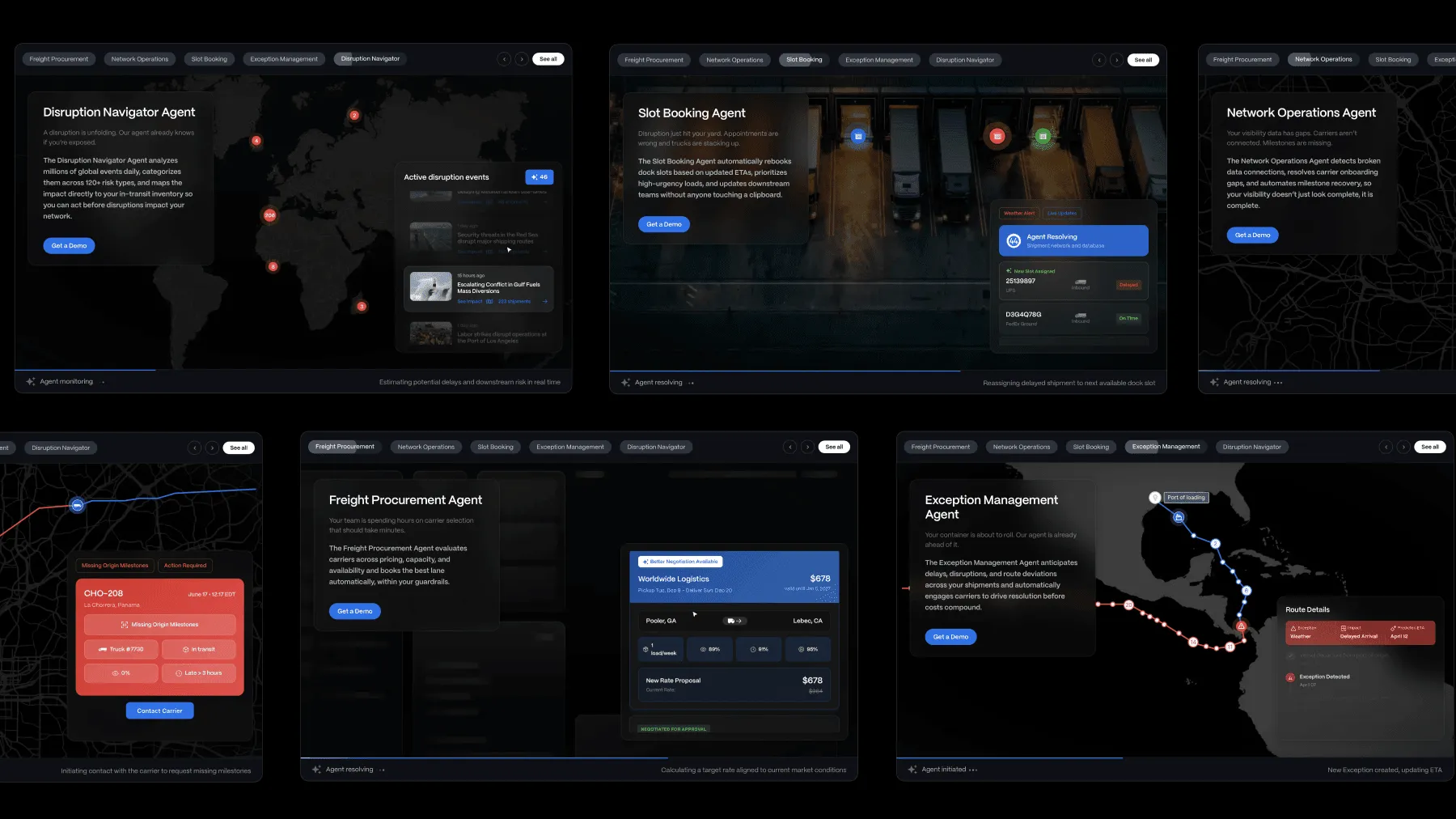
Project44 unveiled AI agents at Decision44 event that analyze supply chain data to identify shipping delays and chargebacks for big box retailer deliveries. The AI chatbot 'Mo' helps determine if delays occurred at origin, transit, or destination and assigns responsibility between shippers, carriers, and receivers.
This could reduce chargeback disputes for sellers shipping to Walmart and Target by providing data-driven proof of where delays actually occurred. Sellers using project44's platform may get faster resolution on disputed fees and better visibility into carrier performance issues.
Supply chain AI is moving from basic tracking to intelligent analysis that could shift liability disputes in favor of sellers with better data documentation.
Monitor your project44 dashboard for 'Mo' AI analyst rollout if you ship to big box retailers - it could help dispute chargebacks with data proof.
Document your current chargeback dispute process to compare resolution times once AI tools become available.
Bottom Line
Project44's AI could help sellers fight big box retailer chargebacks with data proof.
Source Lens
Industry Context
Useful background context, but lower-priority than direct platform, community, or operator intelligence.
Impact Level
medium
Project44's AI could help sellers fight big box retailer chargebacks with data proof.
Key Stat / Trigger
No single quantitative trigger surfaced in this report.
Focus on the operational implication, not just the headline.
Full Coverage
At Decision44, project44’s customer event, the company showcased its new AI agents that promise to collapse the Truth-Decision-Action sequence that contributes so much to lagging and reactive supply chain and logistics operations into a singularity. Product managers spoke about the agents they were building and where they sat in the shipment lifecycle.
While the whole team includes Lauren Fitzpatrick, Ellie Crist, Aaron Kestenbaum and others, I spoke to three key product managers deep in the trenches of project44’s AI blitz. (Nimrit Vest.
Photo: JP Hampstead / FreightWaves) Nimrit Vest: Building the AI supply chain analyst ‘Mo’ Nimrit Vest, Staff Product Manager at project44 in her fourth year with the company, previously spent four years at Flexport in operations and customer solutions. Vest is responsible for project44’s supply chain analyst chatbot Mo.
When you ask Mo questions, he isn’t just scraping the web; he’s sifting through your company’s own supply chain data for the answer. The chatbot is still in preproduction.
A key ‘gold standard’ use case for Vest’s team was the ability to answer complex chargeback questions for shippers delivering to big box retailers— figuring out exactly where delays happened (origin, transit, or dwell at destination) and who was responsible (shipper, carrier, receiver), something that previously took analysts a long time.
Vest’s team has also been researching off-platform data analysis to better understand customer needs. Vest said that she manages three senior engineers who are focused on the architecture, who are themselves supervising numerous 24/7 coding agents.
The only reason project44 was able to start on a project like ‘Mo’ was because of the data normalization happening behind the scenes, Vest said, explaining how project44’s early agents worked on data quality, making inquiries to fill gaps in information about carriers and shipments.
Vest described layers of skills built into Mo: how it understands p44 data and what fields mean, giving it the ability to reason more than an out-of-the-box LLM. Then there are customizations that customers add to the platform, or what project44 calls ‘the context module,’ which includes SOPs and other business rules.
One approach is turning large text files or SOPs from Confluence into “skill files.” The context modules have to be thoughtfully chosen and attached to specific workflows and processes due to the limits of LLM context windows. Vest said that project44 strongly encourages teams to try new tools and bring insights back.
That’s led to rapid adoption of AI coding tools. “The line between what an engineer and a PM can do has blurred extremely fast,” Vest noted. PMs can now write a skill file in Claude, pull from GitHub and ask AI what the engineers did that day. (Ilias Pagonis.
Photo: JP Hampstead / FreightWaves) Ilias Pagonis: Leading the intelligent TMS product suite Ilias Pagonis, Senior Staff Product Manager with four years at project44 and previously in supply chain at Nike for four years, is based in Amsterdam.
He leads the Intelligent TMS product suite and manages the interoperability domain, building integrations with any system of record. His dev team is mostly in Bangalore, with a product designer in Amsterdam working alongside him. “AI has completely transformed the speed at which we get to a prototype,” Pagonis said.
Gone are the days of only heavy research and lengthy product requirement documents (PRDs). Now, after customer interviews, teams can ingest transcripts and automatically create a PRD that references the conversations. “Something that took weeks takes days if not hours,” Pagonis said.
They quickly get prototypes in front of customers for feedback and iterate rapidly. About 65% of code is initially drafted by AI, with up to 90% on the front end.
Pagonis reminded me that project44 started in 2014 as a one-to-many API integrations partner focused on visibility, then expanded into different modes and packaged functionality into a full TMS with order consolidation, shipment building, freight audit and full lifecycle coverage.
To some extent, Pagonis said, Intelligent TMS just bundles many of the capabilities project44 already had, filled in some gaps in the shipment cycle like payment and invoice, and called it what it is: a TMS. Building an agent requires breaking down the total work into small ‘jobs to be done’ modules. “Procurement has 6 or 7 micro agents,” Pagonis explained.
“You have to break everything down to its atomic parts.” Reducing the tasks to their component parts and simplifying the prompts was necessary for driving hallucination out of the system.
For freight procurement, users set their own criteria — for example, automatically extending an expiring contract with a high-performing carrier, but throttling the introduction of brand-new carriers. “We try to set that throttle on a use case by use case basis to make sure the customers trust the agentic solutions we’re building.” Pagonis stre
Original Source
This briefing is based on reporting from Freightwaves. Use the original post for full primary-source context.
Style
Audience