

Amazon DSPs in NYC fight for survival against ‘no subcontractor’ proposal
NYC's proposed Delivery Protection Act would ban Amazon from using DSPs (delivery service providers) and force direct employment of delivery workers. The bill has 30+ co-sponsors in the 51-member city council and faces heated opposition from Amazon and DSP operators.
If passed, this could create a domino effect in other major cities, potentially increasing Amazon's delivery costs and reducing Prime delivery speed in urban markets. Sellers should monitor delivery performance metrics closely as Amazon may need to restructure logistics operations.
This represents growing regulatory pressure on gig economy models that could reshape last-mile delivery costs and speed across major metropolitan markets.
Monitor your Amazon delivery performance metrics in NYC market - any degradation could signal logistics disruption if the bill passes.
Consider diversifying fulfillment options beyond Amazon FBA for NYC customers to maintain delivery speed guarantees.
Bottom Line
NYC delivery ban could slow Prime shipping and increase Amazon's costs.
Source Lens
Industry Context
Useful background context, but lower-priority than direct platform, community, or operator intelligence.
Impact Level
medium
NYC delivery ban could slow Prime shipping and increase Amazon's costs.
Key Stat / Trigger
30+ co-sponsors in 51-member NYC council
Focus on the operational implication, not just the headline.
Full Coverage
New York–The proposed legislation before the New York City Council that would, among other things, likely force the closure of Amazon’s direct service providers (DSPs) in the city with their activities absorbed into Amazon itself was on center stage Thursday at Gotham’s City Hall, the day kicking off with loud demonstrations outside by supporters and opponents.
But inside the city council chambers, a hearing before the Committee on Worker and Consumer Protection, while exhibiting its own fair amount of bombast, could be seen in one 45-minute presentation as moving toward a possible compromise on a bill that can realistically be described as “draconian.” Testimony kicked off at 10 a. m. It closed around 5 p. m.
But it was the panel discussion midmorning with three borough chamber of commerce presidents–Brooklyn, the Bronx and Manhattan–that turned the conversation from a litany of complaints and accusations about Amazon to a more practical topic: what happens to the workers if the DSPs disappear and their activities are directly performed by the e-commerce giant?
(Zach Miller, the vice president of government affairs at the Trucking Association of New York, also was on the panel). The stakes in New York City can’t be overstated for Amazon (NASDAQ: AMZN).
The fundamental business model for Amazon and other companies that make local deliveries, like FedEX (NYSE: FDX), is that much of that task (or in the case of Amazon, all of it), are made by separate, independently-owned companies operating under a contract with the larger entity. The workers are employees of the smaller delivery company, like an Amazon DSP.
The Delivery Protection Act, as it is called, currently has just over 30 co-sponsors in a chamber of 51. The original bill introduced near the end of the session that ended December 31, 2025, had more than 40 co-sponsors. That bill died when the calendar on the year ran out and a new Council was seated, when it was reintroduced.
There are several key provisions in the act that could be the most disruptive to current economic models. Big changes projected by the law One is a requirement that delivery companies be licensed by the city, with the license regulated by the city’s Department of Consumer and Worker Protection (DCWP).
That department would have the ability to deny or revoke a license to a company based on various standards of conduct, and the law’s backers and their recitation of various Amazon practices make clear that many Amazon policies might put the company in DCWP’s crosshairs.
Another is that the delivery companies, which are defined as those that also operate warehouse facilities, can not contract out their work to a third party. The warehouse is key; a retail store that makes a delivery out of its bricks and mortar operations would not fall under the law. The entire Amazon DSP model rests on that subcontracting.
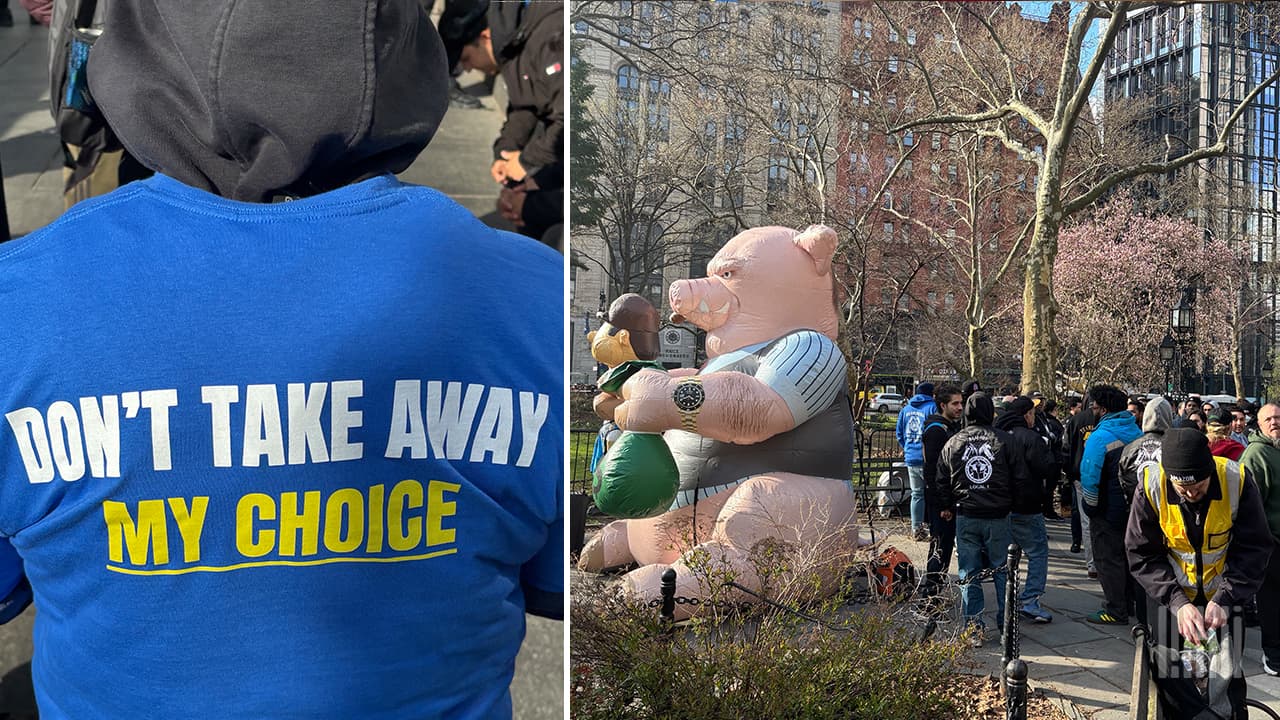
Teamsters and sponsor have been out demonstrating already Most of the discussion on the bill so far has been driven by its supporters. Its sponsor is Council member Tiffany Caban, and the Teamsters is a major backer. A rally in February on City Hall’s steps was attended by well over 100 Teamsters and DSP workers, as well as Caban.
A protest against the closure of some DSPs in Queens in September featured an address by Caban, who discussed her legislation that was introduced soon after. A similar Teamsters-driven rally was held at a small park in front of City Hall Thursday prior to the hearing.
Separately, DSP workers opposing the bill lined up on either side of the park to get into their own rally on the steps of the building, but faced a limitation on attendance at the event that a long-term observer of New York City governance told FreightWaves was rare.
In the chamber itself, the anti-legislation attendance in the audience looked like it had surpassed the number of pro-legislation workers in the room. At the Teamsters rally, their speakers had an explanation for that: the DSP workers were bribed or scared, but no evidence of that was presented.
When the chamber of commerce presidents began their presentation, the subject matter shifted away from anti-Amazon criticism and to a larger question: what happens to the DSPs and their workers if Amazon needs to bring them under its roof in New York City?
(From left to right at the table: Randy Peers, Brooklyn Chamber of Commerce; Jessica Walker, Manhattan Chamber of Commerce; Lisa Soren, Bronx Chamber of Commerce; Zach Miller, Trucking Association of New York). Randy Peers, the president of the Brooklyn Chamber of Commerce, didn’t speak first, but his words were the most stark.
“The licensing requirement is a red herring,” Peers said. “This is not about the proliferation of these facilities in our communities, because you can address that through capping them or through proximity laws, like we do with liquor licenses.” The proposed law, he said, is “all about the direct hire mandate.
At the end of the day, this direct hire mandate puts
Original Source
This briefing is based on reporting from Freightwaves. Use the original post for full primary-source context.
Style
Audience