Amazon FBA Partial Refund Strategy for 2026: What Actually Moves the Needle
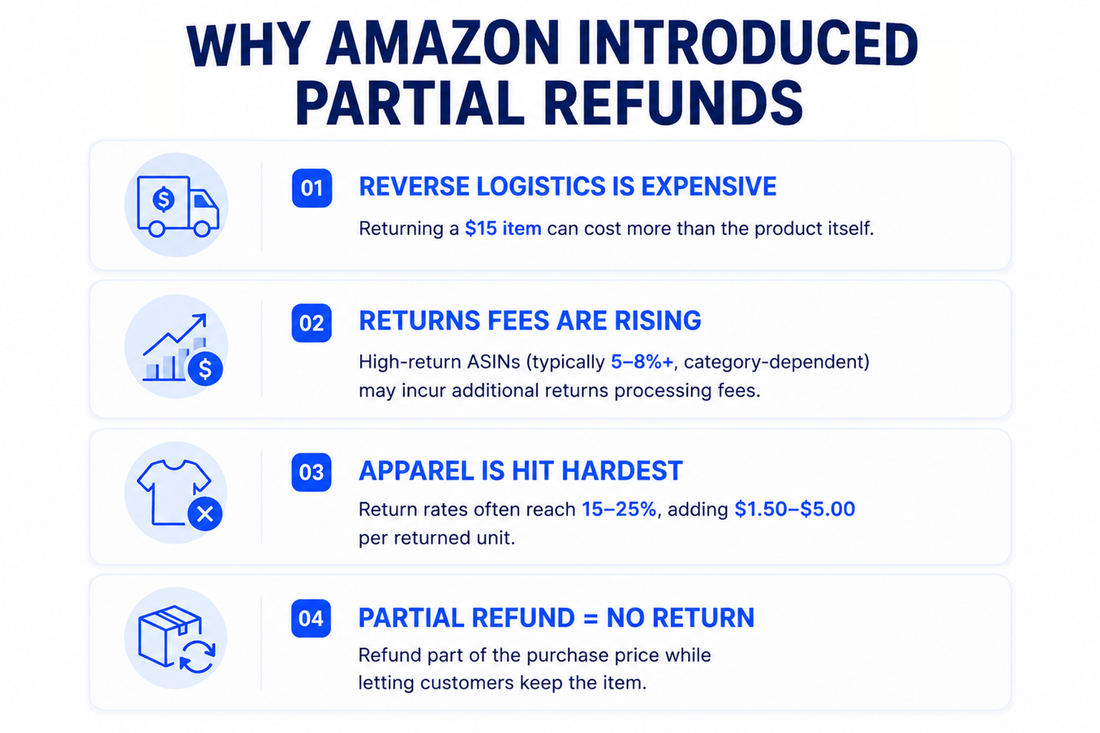
Amazon FBA Partial Refunds (launched Oct 2025) lets US/UK/EU sellers issue 10-40% refunds on eligible orders without requiring product returns, configurable at the ASIN level. Sellers who apply blanket settings across their catalog risk margin erosion on high-cost SKUs where the partial refund exceeds their true return cost savings.
Amazon continues shifting operational cost decisions to sellers while automating the baseline — partial refunds are another lever that compresses margins if not managed actively, part of the broader trend of fee layering and reverse logistics cost offloading onto third-party sellers.
The hidden risk: sellers opting in globally will subsidize refunds on ASINs where return costs are actually lower than the partial refund issued — essentially paying customers to keep products they might not have complained about otherwise. Run a SKU-level breakeven (true return cost vs. refund amount) before enabling, and exclude any ASIN where your refund percentage exceeds net reverse logistics savings.
Operational Impact
This story may require teams to revisit workflows, monitoring, or platform assumptions.
Bottom Line
Blanket partial refund opt-in quietly destroys margin on low-return-rate SKUs.
Source Lens
Industry Context
Useful background context, but lower-priority than direct platform, community, or operator intelligence.
Impact Level
medium
Blanket partial refund opt-in quietly destroys margin on low-return-rate SKUs.
Key Stat / Trigger
$1.50 to $5.00 per returned unit in additional fees for apparel/footwear ASINs exceeding category return rate thresholds in 2026
Focus on the operational implication, not just the headline.
Full Coverage
Amazon FBA Partial Refunds program lets sellers in the US, UK, Germany, France, Italy, and Spain refund 10-40% of an order without asking for the product back. On the surface, it looks like Amazon is handing you free money and savings on reverse logistics with none of the usual hassle. But, for sellers, this isn’t a “set it and forget it” feature.
It’s a margin call, and it needs to be made SKU by SKU, not with one blanket setting across your whole catalog. This guide is built to go further, including which SKUs actually belong in this program, what refund percentage makes sense, and how to keep it from nibbling away at your margin while you’re not looking.
Quick GuideWhat Amazon FBA Partial Refunds Actually AreThe Breakeven Method Behind Every Partial Refund DecisionHow to Roll Out Partial Refunds Without Guessing at Your Refund Percentages What Else Changed in 2026 That Touches This DecisionWhere Reporting Falls Short And Why That Hits Bigger Catalogs HarderFinal ThoughtsFAQs What Amazon FBA Partial Refunds Actually Are Amazon rolled out FBA partial refunds in October 2025.
It lets you offer a customer a partial refund, say 15% off a $22 item, and the buyer keeps the product. So there is no return label, no inbound freight, no warehouse touch. You set eligibility and percentage either globally or ASIN by ASIN or through a CSV upload in FBA settings.
Here’s where a lot of sellers get tangled up, as this isn’t the same thing as FBA Returnless Resolutions. That’s an older, mostly automated program where Amazon decides to refund the buyer in full and let them keep the item, usually for low-value goods where return shipping costs more than the product itself.
Partial refunds put you in the driver’s seat on eligibility and amount. Returnless Resolutions doesn’t ask you first.
Here is a table to make things clear: FeatureFBA Partial RefundsFBA Returnless ResolutionsStandard FBA ReturnWho decides eligibilitySeller (ASIN-level opt-in)Amazon (automatic)Amazon return policyRefund amountSeller-set, 10-40%Full refundFull refundProduct returnedNoNoYes, goes back to inventoryReverse logistics costNoneNoneInbound freight, grading, and storageSeller control over the triggerHighLowLowBest suited forLow-cost items with a thin defect riskSub-$75 items where return isn’t worth processingHigher-value items, damage/defect claims Knowing which bucket a return falls into matters because your reporting and reconciliation depend on it, and right now, that reporting isn’t built out the way it should be.
More on that shortly. Why Amazon Built This In the First Place Reverse logistics on a $15 phone case can run Amazon more than the item is worth once you factor in the prepaid label, inbound scanning, grading, and either restocking or disposal.
Amazon’s own returns processing fee, which now applies more broadly across product categories in 2026, targets ASINs whose return rate crosses 5-8% depending on category. For apparel and footwear, where return rates commonly sit at 15-25%, that fee alone can add $1. 50 to $5. 00 per returned unit.
Partial refunds are Amazon’s way of short-circuiting that cost before it happens. For sellers, the incentive lines up, at least on paper. You avoid the freight and grading cost, the customer gets an instant resolution instead of a multi-day return cycle, and your return rate metric (which Amazon does watch) ticks down.
But “the incentive lines up on paper” is doing a lot of work in that sentence, and the real math is where things get interesting. The Breakeven Method Behind Every Partial Refund Decision Here’s the calculation most sellers skip, and it’s the one that actually decides whether a SKU belongs in this program.
A standard return doesn’t just cost you the return processing fee. It costs you the fee, plus inbound freight, plus a share of your landed cost that you never recover because a chunk of returns come back damaged, opened, or graded as unsellable. Add those three together and you get your true return cost.
Compare that to what a partial refund would cost on the same SKU, and the cheaper number wins. Return cost = processing fee + inbound freight + [(1 − resale recovery rate) × landed cost] “Resale recovery rate” is the percentage of returned units that actually come back in sellable condition.
Amazon’s grading data on this vary wildly by category, durable electronics accessories often recover north of 85%, while apparel and anything with packaging that gets torn in transit can drop to 55-65%. That number moves your math more than almost anything else.
Run it against four real SKU profiles: SKU exampleSale priceLanded costResale recovery rateReturn cost (fee + freight + unrecovered cost)Partial refund costWinnerPhone case$18$5. 5090%$5. 65$3. 60 (20%)Partial refund saves $2. 05/claimKitchen gadget$42$1775%$12. 25$6. 30 (15%)Partial refund saves $5. 95/claimBluetooth speaker$78$3485%$15. 10$11.
70 (15%)Partial refund saves $3. 40/claim, thinner marginPremium knife set$120$5892%$16. 64$18. 00 (15%)Stand
In Seller Central > FBA Settings, audit each ASIN's return rate — if below 5%, exclude it from partial refunds; opt-in only ASINs where reverse logistics cost (label + inbound + unsellable rate) exceeds your 10-40% refund dollar amount.
Within 30 days, pull your FBA Returns report and calculate true return cost per ASIN (return fee + freight + unsellable loss) to build your eligibility list before Amazon's 2026 returns processing fee expansion hits higher-rate categories.
Original Source
This briefing is based on reporting from SellerApp Blog. Use the original post for full primary-source context.
Style
Audience