

Walmart WFS vs Amazon FBA: Which Fulfillment Model Wins in 2026?
If you’ve been selling on Amazon or Walmart for more than a year, the Walmart WFS vs Amazon FBA comparison has probably crossed your mind. Maybe you’re already using FBA and wondering if WFS is worth adding. Or you’re figuring out where to send your first shipment. Either way, the question isn’t just about which… The post Walmart WFS vs Amazon FBA: Which Fulfillment Model Wins in 2026? appeared first on SellerApp Blog.
Source Lens
Industry Context
Useful background context, but lower-priority than direct platform, community, or operator intelligence.
Impact Level
medium
Use this briefing to decide whether your team needs an immediate workflow, policy, or reporting change.
Key Stat / Trigger
No single quantitative trigger surfaced in this report.
Focus on the operational implication, not just the headline.
Full Coverage
If you’ve been selling on Amazon or Walmart for more than a year, the Walmart WFS vs Amazon FBA comparison has probably crossed your mind. Maybe you’re already using FBA and wondering if WFS is worth adding. Or you’re figuring out where to send your first shipment. Either way, the question isn’t just about which platform gets more traffic.
It’s about which fulfillment model actually works for your product, your margins, and how you operate. The difference between Walmart WFS vs Amazon FBA fees alone can shift your annual profit by tens of thousands of dollars on a single SKU.
This guide breaks down the real differences between selling on Walmart WFS vs Amazon FBA: fees, competition, size limits, inventory management, customer behavior, and who each platform actually works for. By the end, you’ll know exactly where your products belong. Table of ContentsWalmart WFS vs Amazon FBA: Which Is Better for Your Business?
Fulfillment by Amazon vs Walmart Fulfillment Services: How Each Program WorksWalmart WFS Fees vs. Amazon FBA Fees: The Real Cost BreakdownInventory Management: Walmart Fulfillment vs Amazon FulfillmentMulti-Channel Fulfillment: A Key Difference Between Walmart Fulfillment Services vs Amazon FBAWhich Products Belong on Amazon FBA vs. Walmart WFS?
Understanding Your Customer: WFS vs FBA for SellersReturns: Another Difference Between Walmart WFS and Amazon FBAWalmart WFS vs Amazon FBA: How to DecideFinal Thoughts on Walmart WFS vs Amazon FBA in 2026 Walmart WFS vs Amazon FBA: Which Is Better for Your Business? Here’s the straight answer to the Walmart WFS vs. Amazon FBA, which is better question.
Neither wins universally. Amazon FBA wins on volume, traffic, and brand reach. Walmart WFS wins on lower fees, less seller competition, and more predictable operations. The right choice depends on your product velocity, margin structure, and category.
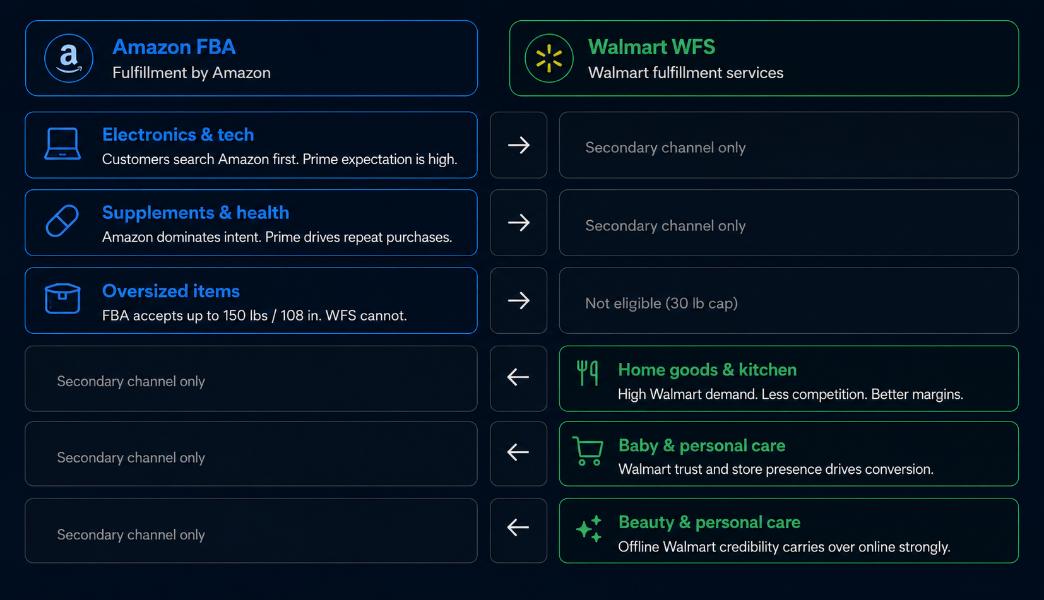
For sellers running home goods, kitchen items, or baby products with margins above 20%, Walmart WFS almost always delivers a better net profit. For sellers in electronics, supplements, or high-velocity categories where Amazon’s traffic is non-negotiable, Amazon FBA is the stronger channel. Most established sellers end up running both.
Getting Approved: Amazon FBA vs Walmart WFS Before you can start selling on Walmart WFS vs. Amazon FBA, you need to get approved. And this is the first place the two platforms diverge sharply. Amazon FBA Getting into Amazon FBA is straightforward. A seller account, a government ID, and a bank account, and you can be live within days.
That low barrier is exactly why the platform has nearly 2 million active third-party sellers and why standing out organically now requires serious investment in ads and listing optimization. When comparing Walmart WFS vs. Amazon FBA for new sellers, Amazon FBA is the faster door. Walmart WFS Walmart Marketplace has a more selective entry process.
You apply, and Walmart reviews your application. They want a verified U. S. business (EIN), a trackable e-commerce history, and a product catalog that adds genuine value to their customers. Roughly 70% of applicants are declined. The process typically takes one to four weeks, and approval isn’t guaranteed even with a strong application.
The most common reasons Walmart WFS applications fail: Documentation mismatches: Your EIN, W-9, LLC name, and website need to be consistent across every field. Walmart cross-checks them. Thin sales history: Walmart isn’t interested in onboarding sellers who are still finding their footing.
Category gaps: applying in supplements, beauty, or baby without the relevant safety certifications or brand authorization letters gets you declined before anyone reads the rest of your application. A few things that actually move the needle when applying for Walmart WFS: link directly to your active Amazon FBA, eBay, or Shopify storefronts.
Have a product catalog ready with titles, images, pricing, and UPCs. Even a clean spreadsheet signals operational readiness. Some sellers report better outcomes using a domain-based email rather than Gmail, though Walmart officially confirms nothing, but it’s a credibility signal that costs you nothing.
The selectivity that makes Walmart WFS harder to enter is also what makes it worth getting into. Fewer sellers mean less listing clutter, less aggressive price competition, and a customer base that isn’t constantly pulled toward sponsored results before they see your product. That’s a core part of the Walmart WFS vs Amazon FBA pros and cons calculation.
Fulfillment by Amazon vs Walmart Fulfillment Services: How Each Program Works Both fulfillment by Amazon and Walmart fulfillment services do the same core job: you ship inventory to their warehouses, and they handle storage, picking, packing, and shipping. But the operational experience is meaningfully different.
With Amazon FBA, you send inventory to Amazon’s fulfillment centers, and Amazon handles everything through to delivery. The benefit is access to Prime
Original Source
This briefing is based on reporting from SellerApp Blog. Use the original post for full primary-source context.
Style
Audience