
What Amazon’s Free Seller Tools Do, and Where Third-Party Software Takes Over
Your Amazon ad spend just crossed $50,000 a month, and Seller Central still can’t tell you whether that spend is profitable. You look at ACoS, and it looks…fine. Revenue is climbing. But nobody in your team can answer a basic question your CFO just asked: What’s the actual margin on this, after fees, after COGS,… The post What Amazon’s Free Seller Tools Do, and Where Third-Party Software Takes Over appeared first on SellerApp Blog.
Source Lens
Industry Context
Useful background context, but lower-priority than direct platform, community, or operator intelligence.
Impact Level
medium
Use this briefing to decide whether your team needs an immediate workflow, policy, or reporting change.
Key Stat / Trigger
No single quantitative trigger surfaced in this report.
Focus on the operational implication, not just the headline.
Full Coverage
Your Amazon ad spend just crossed $50,000 a month, and Seller Central still can’t tell you whether that spend is profitable. You look at ACoS, and it looks…fine. Revenue is climbing.
But nobody in your team can answer a basic question your CFO just asked: What’s the actual margin on this, after fees, after COGS, after the ad spend that Amazon’s dashboard refuses to connect to anything else?
That’s what happens when a brand managing multiple SKUs across marketplaces, or an agency running a portfolio of client accounts, outgrows a free tool that was never built for that scale. Seller Central wasn’t designed to give a $2M/month brand the visibility it needs to protect its margins.
It was designed to manage the platform relationship, and it does that job well. It just isn’t the same job. This article maps exactly where Amazon’s free tools earn their keep, where they quietly cost you money, and what third-party platforms like SellerApp actually add.
Quick Guide: What Amazon Seller Central Actually Gives YouOrder and inventory managementBusiness reports and the sales dashboardBrand AnalyticsAmazon’s 2025–2026 upgradesWhere Seller Central Falls Short and What It Costs YouWhat Third-Party Software Actually FixesSeller Central vs.
SellerApp: Full Feature ComparisonWhat Third-Party Software Actually FixesSellerApp: The All-in-One Platform Built for This TransitionWhen Successful Sellers Add SellerApp after Seller CentralFinal thoughts FAQs What Amazon Seller Central Actually Gives You Seller Central is a genuinely capable platform for the problems it was built to solve, and mischaracterizing it doesn’t help sellers make smarter decisions.
Order and inventory management Seller Central lets you manage product listings, the full catalog, inventory levels, order fulfillment, pricing, and advertising from a single dashboard. Amazon FBA takes packing and shipping entirely off your plate. For a brand running a narrow catalog on a single marketplace with minimal ad spend, this is workable.
The moment you’re managing multiple SKUs across US, UK, and EU storefronts or running a portfolio of client accounts as an agency, the single dashboard becomes the bottleneck rather than the convenience. Business reports and the sales dashboard The Sales Dashboard shows preliminary revenue data within hours of a sale.
SKU-level Business Reports give you sessions, units, conversion rate, and Buy Box percentage by ASIN. These are the core inputs for spotting which products are gaining traction and which are fading, without paying for a third-party tool. These are workable for a single-marketplace operation with a handful of SKUs.
They stop being sufficient the moment you’re managing performance across multiple brands, multiple marketplaces, or a client portfolio where one dashboard per account isn’t a viable workflow. Brand Analytics Available to Amazon Brand Registry members.
Gives you search frequency rank data, market basket analysis (what customers bought alongside your product), and repeat purchase behavior by time window. Genuinely useful for understanding category dynamics and customer loyalty trends.
The limitation is the cadence; Brand Analytics refreshes weekly or monthly, and it shows only your own brand’s behavior, not competitors’. Amazon’s 2025–2026 upgrades Amazon’s Accelerate 2025 conference delivered real improvements worth acknowledging.
Amazon Marketing Cloud (AMC) is now open to all sellers, no DSP contract required, which previously locked smaller brands out entirely.
In Q1 2026, Amazon extended AMC’s lookback window to 25 months and added cross-channel attribution covering Sponsored Display and DSP in the same workbench, a direct response to brands asking for unified reporting across ad types.
The Custom Analytics Workbench added 100+ metrics and a no-code interface, replacing the old workflow of exporting from five separate reports and stitching them together in a spreadsheet. These are meaningful upgrades for operational analytics.
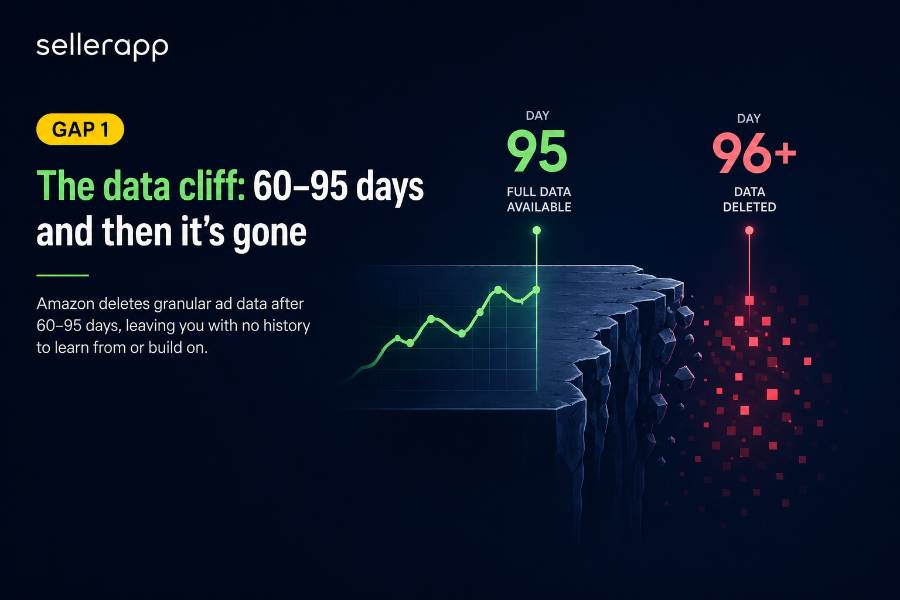
But the structural gap hasn’t closed: as of 2026, Amazon’s analytics workbench still contains no advertising data, still calculates no TACoS, and still deletes granular PPC history after 60–95 days. The improvements closed the operational visibility gap. They did not touch the PPC decision-making gap.
Verdict: Seller Central is a sound operating layer for a single brand running a lean catalog on one marketplace. It was not built to give visibility to brands managing six and seven figures in monthly ad spend, multiple marketplaces, or agencies running dozens of client accounts side by side. At that scale, the free tool’s gaps aren’t an inconvenience.
They’re a blind spot your finance team is already asking about. Where Seller Central Falls Short and What It Costs You The gaps in Seller Central aren’t bugs. Amazon built Seller Central to manage the platform relationship between Amazon and its sellers, not to maximize individual seller profitability. What looks like missing features are, in man
Original Source
This briefing is based on reporting from SellerApp Blog. Use the original post for full primary-source context.
Style
Audience