AI gold rush transforms trans-Pacific trade and logistics
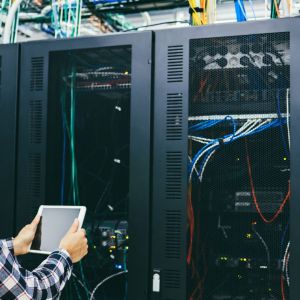
The data center boom has become a lucrative market for logistics companies, especially in the Asia-Pacific and United States. The post AI gold rush transforms trans-Pacific trade and logistics appeared first on FreightWaves.
Source Lens
Industry Context
Useful background context, but lower-priority than direct platform, community, or operator intelligence.
Impact Level
medium
Use this briefing to decide whether your team needs an immediate workflow, policy, or reporting change.
Key Stat / Trigger
No single quantitative trigger surfaced in this report.
Focus on the operational implication, not just the headline.
Full Coverage
The artificial intelligence infrastructure boom is creating significant new trade flows and opportunities for third-party logistics providers and carriers.
Freight transportation companies are rapidly scaling up capabilities, especially to support semiconductor supply chains in Asia, the epicenter for production and distribution of advanced chips used to power AI applications, data centers, connected devices and next-generation vehicles.
Two reports issued on Wednesday show how AI-related goods such as semiconductors and data-transmission equipment have become a major driver of international trade growth, spawning increasingly complex regional and global supply chains that depend on speed, visibility, cross-border expertise and resilience.
Unlike traditional consumer electronics, AI infrastructure requires the coordinated movement, including customs clearance and storage, of oversized, high-value and highly sensitive equipment from manufacturers across Asia to hyperscale data centers under construction around the world.
Semiconductors, data transmission equipment and data center hardware accounted for 42% of all goods trade growth in 2025, and that share rose to about 76% during the first quarter, according to an annual report on globalization trends by the New York University Stern School of Business, and commissioned by DHL Group.
Trade in critical minerals, batteries, and electric vehicles also expanded rapidly during the first quarter, it said, relying on research by the World Trade Organization and the Organization for Economic Co-operation and Development. The large-scale AI buildout in the U. S. has fueled import growth, while imports of other goods have declined.
The Federal Reserve Bank of Minneapolis estimates that without the AI investment boom, U. S. imports would have declined 10% in 2025 rather than increasing modestly. The second-largest trade bump was in East Asia & Pacific, supported by that region’s leading role in producing AI-enabling hardware, the DHL report added.
“The biggest story in global trade right now is AI – not tariffs,” said John Pearson, CEO of DHL Express, in a news release promoting the report. “Every AI query ultimately depends on logistics. Chips, networking equipment and the many other goods behind this technology must be in the right place at the right time.”
A report this week from Frost & Sullivan underscored how AI is influencing trade patterns.
Production and investment in semiconductors and related digital infrastructure is accelerating in the Asia-Pacific region, which now accounts for about 58% of global semiconductor industry revenue, amid insatiable demand for artificial intelligence, high-performance computing, electric vehicles and advanced communications, it said.
The research, sponsored by FedEx, identifies AI and high-performance computing as the fastest-growing drivers of semiconductor demand. More than 2,000 new data centers are expected to be built globally between 2026 and 2035, according to IEEE Spectrum.
FedEx (NYSE: FDX) conservatively estimates the addressable transportation market focused on data centers and IT service equipment is $7 billion, Chief Commercial Officer Brie Carere said at the company’s Investor Day event in February. DHL Supply Chain specialists install server equipment in a data center.
(Photo: DHL) DHL Global Forwarding put the market size for data center logistics market in 2025 at about $23 billion and estimates that figure to rise to at least $35 billion by 2030, said Amanda Rasmussen, chief commercial officer and data center executive lead, in a company article.
Last month, global logistics powerhouse Kuehne+Nagel was named the primary logistics provider for Amazon Web Services, supporting data center installation and operations around the world. Cloud computing giants could spend up to $525 billion on data center construction in 2026 alone, by some estimates.
The infrastructure investment supercycle is expected to reach $3 trillion by 2030, says commercial real estate services firm JLL. In an article last month, consulting firm PwC projected global data center capital expenditure could reach $31. 6 trillion through 2050, with a plausible upside of nearly $50 trillion if AI adoption accelerates.
The Worldwide Semiconductor Trade Statistics forecasts the global semiconductor market to reach about $975 billion by the end of the year. Data center investment is expected to keep rising because servers, GPUs, and other information and communication technology equipment require refreshes every four to six years. Server values have surged.
Several years ago, servers cost around $100,000 to $250,000. Today, it is common for servers to cost $1 million and $3 million — and the value is expected to continue rising as AI workloads demand increased power.
Modern AI servers pack exponentially more processing power, custom silicon, and advanced cooling requirements into every unit — making them both more valuable and more complex to handle saf
Original Source
This briefing is based on reporting from Freightwaves. Use the original post for full primary-source context.
Style
Audience