J.B. Hunt urges STB to reject Union Pacific–Norfolk Southern merger
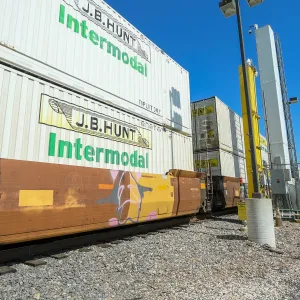
J.B. Hunt’s STB filing challenges projected truck-to-rail conversions and seeks enforceable protections if regulators approve the merger. The post J.B. Hunt urges STB to reject Union Pacific–Norfolk Southern merger appeared first on FreightWaves.
Source Lens
Industry Context
Useful background context, but lower-priority than direct platform, community, or operator intelligence.
Impact Level
medium
Use this briefing to decide whether your team needs an immediate workflow, policy, or reporting change.
Key Stat / Trigger
No single quantitative trigger surfaced in this report.
Focus on the operational implication, not just the headline.
Full Coverage
J. B. Hunt Transport is urging the Surface Transportation Board to reject Union Pacific’s (NYSE: UNP) proposed merger with Norfolk Southern (NYSE: NSC), arguing that the deal overstates potential shipper savings and truck-to-rail growth while threatening competition and service reliability. In comments filed Nov.
18, the transportation company (NASDAQ: JBHT) said the merger, as proposed, would likely deliver “more harm than benefit” to its intermodal customers.
It argued that the railroads have not provided adequate assurances that operating efficiencies would translate into lower customer costs or that intermodal shippers would have meaningful remedies for service failures. The filing signed by Darren Field, Hunt’s executive vice president and president of intermodal, said that the company moved approximately 2.
25 million intermodal loads in the preceding 12 months and is the largest intermodal customer of both BNSF Railway (NYSE: BRK-B) as part of the railroad’s Quantum service, and Norfolk Southern. It also has commercial relationships with every Class I railroad.
Hunt took particular issue with the railroads’ projection that the merger would generate approximately 1. 2 million annual intermodal loads converted from highway transportation, phased in over three years. The company argued that the forecast does not reflect how customers actually choose between truck and rail service.
According to the filing, the railroads’ model uses haul length and interchange information as a proxy for reliability. Hunt said that approach overlooks other causes of service failures, including freight left behind at origin terminals, congestion, equipment shortages and delays at destinations.
“But moving the dots on a map to create different single-line origins and destinations does not, by itself, give a customer a reason to move freight from highway to intermodal,” Field said in the filing. Field contrasted the projected growth with Hunt’s own experience. The company’s largest intermodal growth year, 2013, added 181,000 loads, he said.
In 2016, a strategy using steep price discounts generated 144,000 additional loads, below a target of 200,000. Those results illustrate the challenge of achieving the railroads’ conversion forecast, he argued. Hunt said substantial conversion opportunities already exist without consolidation. Its internal research estimates that approximately 9.
8 million to 11. 2 million annual loads could shift from truck to intermodal across all Class I railroads using existing routes and arrangements between carriers. Savings claims leave cost questions The company also challenged the railroads’ projected $3.
5 billion in annual shipper savings, arguing that the application does not guarantee that merger efficiencies would reach customers through lower rates. It warned that rate increases could instead absorb some or all of the projected difference between truck and rail costs.
The filing said the cost estimates understate the expense of converting freight to intermodal, including first- and last-mile trucking, containers, chassis and terminal capacity. Field estimated that handling an additional 1.
2 million annual intermodal loads would require more than 60,000 additional 53-foot containers, along with supporting equipment and capacity. Hunt said the application does not explain who would supply that equipment, who would pay for it or how quickly it could be integrated into the network.
Failure to secure sufficient capacity could undermine reliability and push freight back onto highways, the company argued.
Harrisburg routing options raise concerns Competition concerns center partly on the possibility that a combined Union Pacific–Norfolk Southern would favor freight moving entirely over its own network over traffic exchanged with competing railroads. Hunt identified BNSF–Norfolk Southern service into Eastern Pennsylvania as a particular concern.
The company described Harrisburg, Pennsylvania, as a network-critical intermodal market and a significant opportunity for future growth. Today, freight can reach that market from either Union Pacific or BNSF through interchange with Norfolk Southern in Chicago, according to the filing.
Hunt warned that the merger could weaken BNSF’s participation and reduce customers’ competitive routing alternatives. To illustrate its concerns about gateway protections, the provider cited its experience following the Canadian Pacific (NYSE: CP)–Kansas City Southern merger.
The company said unreliable service and rate increases led it to stop using the Laredo, Texas, gateway for its traffic despite protections adopted in that proceeding.
Field said an alternative Monterrey, Mexico-to-Atlanta route using Ferromex, BNSF and Norfolk Southern through Eagle Pass and Chicago was 1,570 rail miles longer than the CPKC–Norfolk Southern route through Laredo, yet moved freight faster and more consistently. Hunt argued that the experience shows why keeping an interchange formally open is not e
Original Source
This briefing is based on reporting from Freightwaves. Use the original post for full primary-source context.
Style
Audience
Get fee and policy changes before they hit your margin
The free Daily Marketplace Brief flags fee and policy changes across Amazon, Walmart, TikTok Shop, eBay and Etsy, with the source document.