

NEW: Trade turbulence turns to record volume for top U.S. port
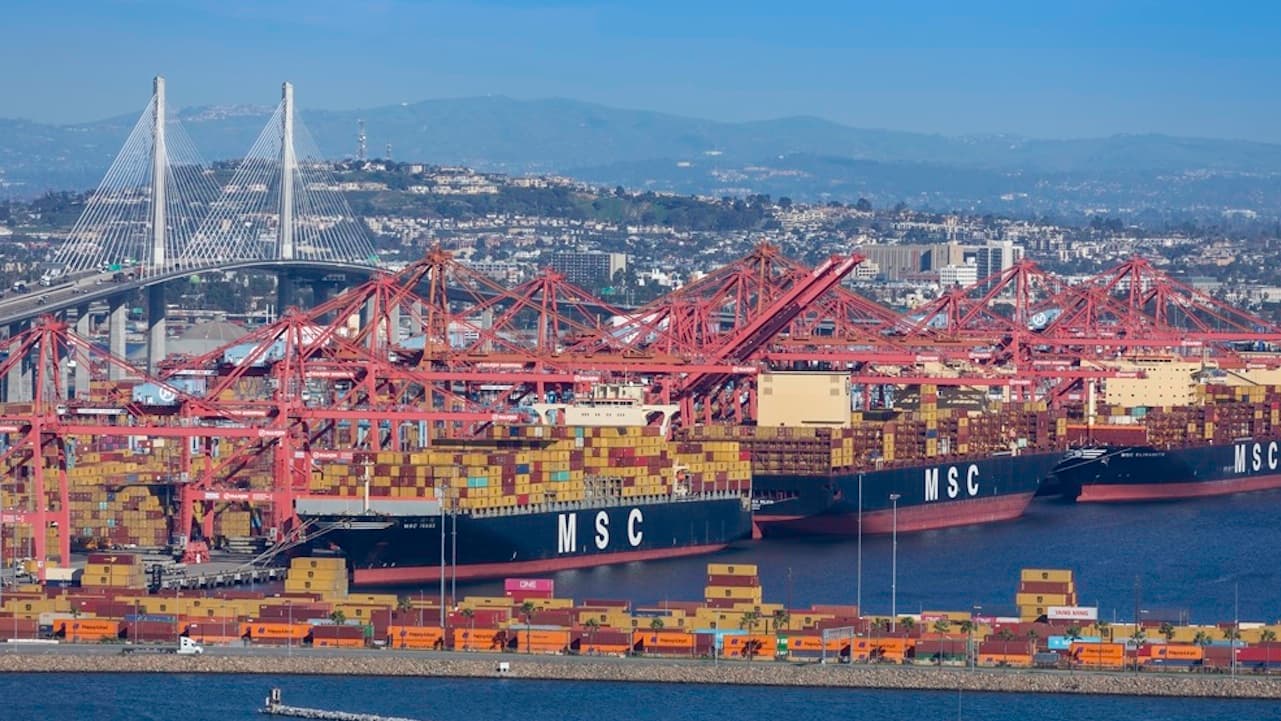
The Port of Long Beach achieved its third-busiest June despite economic uncertainty and war-related supply chain pressures. The post NEW: Trade turbulence turns to record volume for top U.S. port appeared first on FreightWaves.
Source Lens
Industry Context
Useful background context, but lower-priority than direct platform, community, or operator intelligence.
Impact Level
medium
Use this briefing to decide whether your team needs an immediate workflow, policy, or reporting change.
Key Stat / Trigger
No single quantitative trigger surfaced in this report.
Focus on the operational implication, not just the headline.
Full Coverage
The Port of Long Beach delivered its third busiest June on record, moving 779,000 twenty foot equivalent units (TEUs), a 10. 6% increase compared with the same period a year ago. The strong performance marks the second consecutive month of year-over-year gains, bringing year-to-date volume to more than 4.
8 million TEUs, nearly 2% ahead of the first half of 2025’s record-setting pace. Dr. Noel Hacegaba, wrapping up the first half of his inaugural year as chief executive, in an online briefing framed the results as a testament to supply chain resilience amid tariffs and geopolitical uncertainty.
Imports rose 11% to over 387,000 TEUs, while exports dipped 1% to more than 86,000 TEUs. Empty containers increased 14% to nearly 306,000 TEUs as ocean carriers work to clear docks and create terminal capacity for incoming cargo. window. googletag = window. googletag || {cmd: []}; googletag. cmd. push(function() {googletag.
defineSlot('/21776187881/FW-Responsive-Main_Content-Slot1', [[300, 100], [320, 50], [728, 90], [468, 60]], 'div-gpt-ad-1709668545404-0'). defineSizeMapping(gptSizeMaps. banner1). addService(googletag. pubads()); googletag. pubads(). enableSingleRequest(); googletag. pubads(). collapseEmptyDivs(); googletag. enableServices(); }); googletag. cmd.
push(function() {googletag. display('div-gpt-ad-1709668545404-0'); }); Sourcing shifts and peak season front-loading The traditional peak shipping season has become obsolete. According to Hacegaba, what once characterized a concentrated holiday rush has been replaced by year-round waves of cargo arriving in different spurts.
“Flexibility has become the supply chain’s greatest competitive advantage,” he said, “but it now signals peak season is no longer a season. It’s a year-round strategy.”
Shippers are front-loading goods to get ahead of the July 24 tariff deadline, when temporary 10% tariffs are set to automatically expire without clarity from the Trump administration on what policy may follow. Fall and holiday merchandise that typically arrives in October, November, and December began appearing at the port as early as spring.
The National Retail Federation announced that import volumes are projected to hit an all-time record at major container ports. Ocean carriers have responded by adding services and deploying extra loaders – unscheduled ships – to import more cargo and remove empty containers.
“It may be July, but for the supply chain, the holiday shipping season has already started,” Hacegaba said. “Retailers are intent on restocking shelves while keeping prices as low as possible.”
Beyond seasonal consumer goods, the port is seeing strong imports of AI data center hardware and infrastructure materials, reflecting sustained year-round demand for technology investments.
Intermodal activity has surged, with approximately 28% of containers now leaving port terminals by train, requiring intensive daily coordination with Class I railroad partners. Data shows that the increase has slowed intermodal transportation by rail. window. googletag = window. googletag || {cmd: []}; googletag. cmd. push(function() {googletag.
defineSlot('/21776187881/fw-responsive-main_content-slot3', [[728, 90], [468, 60], [320, 50], [300, 100]], 'div-gpt-ad-1665767553440-0'). defineSizeMapping(gptSizeMaps. banner1). addService(googletag. pubads()); googletag. pubads(). enableSingleRequest(); googletag. pubads(). collapseEmptyDivs(); googletag. enableServices(); }); googletag. cmd.
push(function() {googletag. display('div-gpt-ad-1665767553440-0'); }); Rail struggles with intermodal surge Intermodal activity has surged, with approximately 28% of containers now leaving port terminals by train, requiring intensive daily coordination with Class I railroad partners. Data shows that the increase has slowed intermodal transportation by rail.
“We’re handling more cargo than ever before, but we’re not seeing anywhere close to the congestion, the delays, the backlogs that characterized the supply chain crisis just a few years ago,” Hacegaba said in response to a question from FreightWaves about rail flows. “That requires a lot of coordination and communication with our Class I [railroad] partners.
We are in touch with them almost daily, making sure that we have adequate equipment, making sure that there’s coordination when it comes to pick-up and drop-offs, making sure that the terminals are communicating directly with the Class Is. Speed to market is a key to our success. Rail connectivity is a key to our future.
And currently, it’s a key to our success even today.” Geopolitical fractures and trade policy vulnerabilities Multiple external pressures are testing supply chain resilience. The Trump administration announced earlier this month that it will not renew the U. S.
-Mexico-Canada Agreement (USMCA) in its current form – a pact valued at $2 trillion in annual trade, with U. S. exports to both countries exceeding $670 billion. Negotiations may continue through the summer or longer, with the possibility of separate bilatera
Original Source
This briefing is based on reporting from Freightwaves. Use the original post for full primary-source context.
Style
Audience