

Poshmark unveils its first major app redesign in 15 years amid online thrifting boom
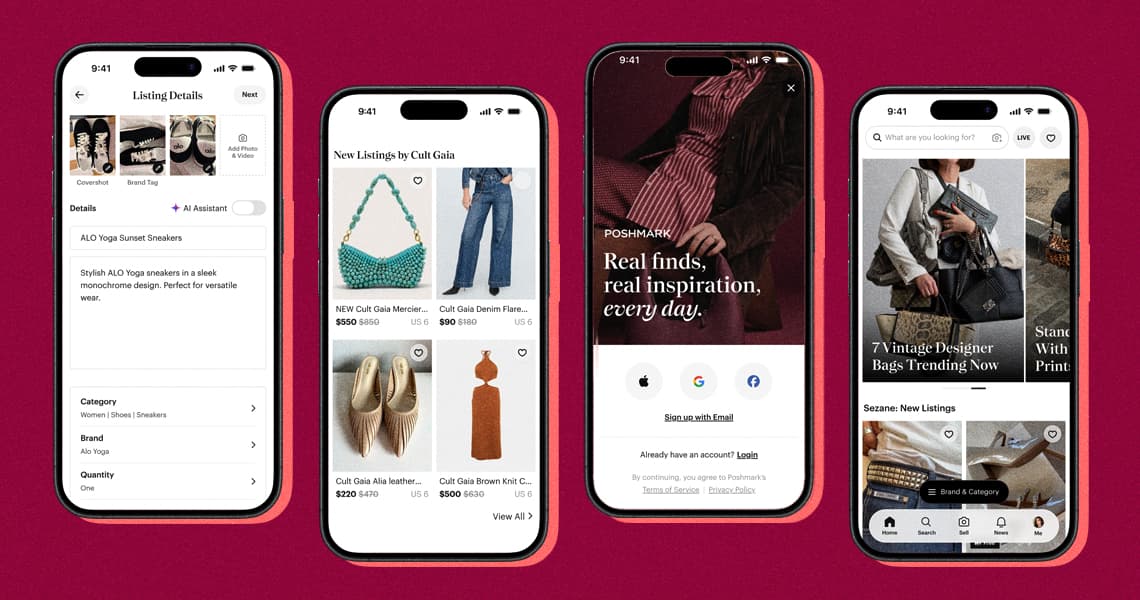
Poshmark launched its first app redesign in 15 years on March 25, 2026, adding an AI-powered 'For You' feed, vertical portrait-style listings, and a unified seller hub for analytics and order management across its 165 million users.
This signals resale platforms are closing the UX gap with Amazon and Walmart, making secondhand a more direct competitor for new goods — especially in apparel and accessories. Brands selling on traditional marketplaces should monitor if resale velocity in their categories accelerates post-redesign.
Resale platforms maturing their UX and AI personalization accelerates competitive pressure on new-goods sellers in apparel — this is AI disruption meeting the secondhand boom, compressing demand for full-price inventory.
Check your category's resale competition on Poshmark — if your brand appears heavily in resale search results, update your Amazon/Walmart listing images to vertical portrait format now to match consumer visual expectations being set by Poshmark's redesign.
In the next 30 days, run a price gap analysis between your marketplace listings and equivalent Poshmark resale prices in your category — if resale undercuts you by 30%+, adjust your value messaging or bundle strategy.
Bottom Line
Poshmark's AI upgrade makes resale a sharper competitor for apparel sellers.
Source Lens
Industry Context
Useful background context, but lower-priority than direct platform, community, or operator intelligence.
Impact Level
medium
Poshmark's AI upgrade makes resale a sharper competitor for apparel sellers.
Key Stat / Trigger
165 million buyers and sellers on Poshmark
Focus on the operational implication, not just the headline.
Full Coverage
Digital Marketing Redux // March 25, 2026 Poshmark unveils its first major app redesign in 15 years amid online thrifting boom By Allison Smith Ivy Liu Alex Mahl still remembers what it felt like to make her first sale on Poshmark. In 2015, when she was still in high school, Mahl was stuck at home during a snowstorm.
She downloaded the online thrifting app and listed nine Free People thermals to make some extra money. She sold all nine that day, earning $450. She started listing one new item a day, tearing through her own closet in search of inventory. What began as an experiment soon grew into something bigger.
Today, Mahl is one of the platform’s top power sellers, known as “Poshers” in the community. She has more than 240,000 followers and has generated over $500,000 in lifetime sales while selling part time. But success on Poshmark has also meant learning to work around its quirks.
Using the Poshmark app, Mahl said, became increasingly confusing as new features were layered onto the old design. “When you searched for something, everything but what you wanted came up,” Mahl said. “As they added more updates — like live selling and the different ways you can send offers and share items — that was a little harder to find.”
Now, Poshmark is introducing its first major app redesign in 15 years, aimed at making the platform easier to use for its 165 million buyers and sellers.
To Heather Friedland, Poshmark’s chief product officer, the redesign was about putting the company in a more advantageous position at a time when both price-conscious and younger shoppers are giving the broader resale industry a boost, to modernize the app’s selling and shopping experience.
“We’re taking a step back to evaluate where we are in the industry, to ensure that we’re staying in lockstep with technology and what our customers’ expectations are,” Friedland said. “It’s a really unique time to take advantage of our position [in the market].”
The redesigned app includes a new personalized, AI-powered “For You” page on the home feed that recommends items, trends and styles based on users’ browsing and purchase history.
A user who regularly searches for luxury accessories, for example, may be shown a feature like “Seven Vintage Designer Bags Trending Now,” alongside rows of listings from brands they’ve previously searched for or similar styles. Someone who frequently browses contemporary labels may instead see fresh arrivals from brands like Sézane or Cult Gaia.
Poshmark relies on in‑house machine learning and AI teams that mine customer behavior and preference data to decide which items, trends and styles to surface on each person’s “For You” page.
“We’re really trying to move away from that hunting and pecking experience where you have to use the search box and be really explicit with your terms, toward being smarter about what we can suggest to people, so that the experience feels magical, like the right thing was put in front of me at the right time,” Friedland said.
Listings themselves will take up more visual space. Product photos are now larger and in a vertical, portrait-style format, paired with a cleaner layout designed to make browsing feel less cluttered. Previously, the app relied on a square-image format that didn’t map cleanly to how people shoot on photos.
Sellers were anxious their items wouldn’t stand out, according to Friedland. “[Sellers] wanted to make sure their images stand out,” Friedland said. Now, the portrait imagery “matches what the mobile device enables” and makes it very easy for our sellers to quickly take pictures and list their items,” she added.
The company is also introducing a new hub for sellers that brings listing tools, analytics and order management into one place, an attempt to make the app easier to navigate for the small-business owners who rely on it as a source of income. Poshmark, for its part, has invested heavily in upgrading its seller experience over the years.
Last year, for example, Poshmark rolled out an AI listing tool to expedite the traditional listing process, which involves manually entering product details. But as Poshmark introduced new features, navigating those tools wasn’t always intuitive for users.
“We heard feedback from sellers that it can be confusing sometimes, especially to newer sellers on the platform, to know how to best manage their inventory in their closet,” she said.
“What we’re trying to do is take that administrative burden off of their shoulders and use technology and a cleaned up user experience to enable them to spend more time curating and growing the inventory they have, versus having to do management or overhead.”
Jon Anthony and Brad Schwibner, known on social media as “The Posh Kings,” are top Poshmark merchants who have
Original Source
This briefing is based on reporting from Modern Retail. Use the original post for full primary-source context.
Style
Audience