Prime Big Deal Days 2026: 3P grew twice as fast as 1P, and discounted less
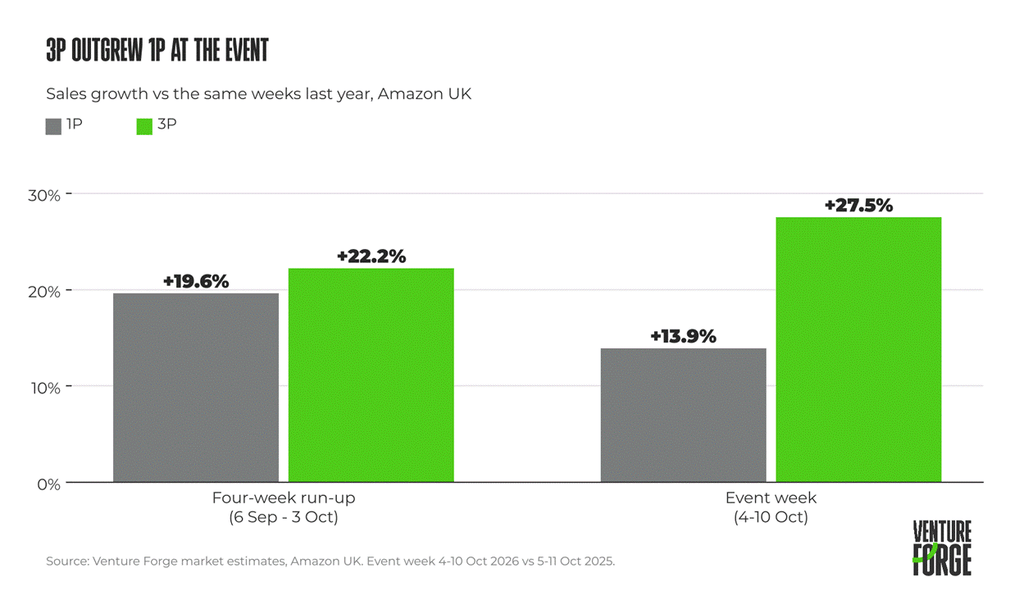
During Prime Big Deal Days 2026 (Oct 6-7, UK), 3P sellers grew 27.5% vs. 1P vendors at 13.9% -- despite 3P cutting prices less aggressively than 1P. 3P outpaced 1P in 8 of 10 categories, with 1P share dropping from 39.4% to 36.7% of event-week sales.
Amazon's vendor channel is losing its deal-event advantage, accelerating the platform's shift toward seller-controlled inventory -- brands clinging to pure 1P models face compounding margin and share risk at every major event.
Vendors losing ground during deal events -- their supposed stronghold -- signals structural erosion, not a one-off blip. Hybrid brands and pure 3P sellers should audit their deal strategy before Black Friday: price control and inventory ownership beat vendor deal subsidies.
Operational Impact
This story may require teams to revisit workflows, monitoring, or platform assumptions.
Bottom Line
3P sellers outgrew vendors 2:1 on Prime Big Deal Days without deeper discounts.
Source Lens
Industry Context
Useful background context, but lower-priority than direct platform, community, or operator intelligence.
Impact Level
medium
3P sellers outgrew vendors 2:1 on Prime Big Deal Days without deeper discounts.
Key Stat / Trigger
3P sales up 27.5% vs. 1P up 13.9% during Prime Big Deal Days 2026 UK
Focus on the operational implication, not just the headline.
Full Coverage
3P (Amazon Seller) grew twice as fast as 1P (Amazon Vendor) over October’s Prime Big Deal Days on Amazon UK. Here, Venture Forge CEO Andy Banks uses data covering 1.
6 million products to show it wasn’t down to a few big brands or deeper discounts, and explains what that means for brands planning for Black Friday: Deal events are usually where 1P is strongest, with 1P taking a bigger share of Amazon UK sales in the event week than in the weeks around it. That happened again this year, but by less.
In this year’s Prime Big Deal Days on Amazon UK (4-10 October 2026, with the deals running on 6 and 7 October), estimated 3P sales were up 27. 5% on the same week of last year’s event, while 1P sales were up 13. 9%.
As part of running Vendor, Seller and hybrid accounts for established brands, we track the whole Amazon UK market by category, brand and product, around 1. 6 million products in the event week, and this was the biggest change we saw between this October and last. It wasn’t a few big brands having a bad week, and 3P didn’t win by cutting prices harder.
The brands that grew fastest were the ones already selling their own stock, with control over their price, availability and deals. Same size event, different winners Amazon UK took an estimated £1. 06bn in the event week, against £864m in the same week of last year’s event.
That’s up 22%, but most of that is the underlying market rather than the event itself. In the four weeks before Prime Big Deal Days, Amazon UK was already running 21% ahead of the same weeks last year. The event lifted sales 38% above that run-up, close to the 37% it managed last year.
In relative terms the event was a similar size to last year, but who sold through it changed. 3P sales went from £523. 9m to £667. 7m, up 27. 5% 1P sales went from £340. 3m to £387. 6m, up 13. 9% 1P’s share of event-week sales fell from 39. 4% to 36. 7% In the four weeks before the event, 1P and 3P were growing at almost the same rate (19. 6% and 22.
2%), and 1P’s share of sales barely moved, from 32. 1% to 31. 6%, so the gap opened up in the event week itself. 1P sales in the event week were 60% above their normal weekly level, down from 68% at last year’s event. For 3P it went the other way, from 22% to 27%.
It isn’t one or two brands The obvious question is whether a handful of big brands had a weak event on the 1P side. Apple sold a lot less this year, for example. The 11-inch iPad sold around 1,500 units in the event week, at an average of about £386, against around 12,300 at about £307 last year. We tested it three ways.
Taking out Apple, Amazon’s own devices, Samsung, HP and Lenovo, 1P grew 18% and 3P grew 28%. Looking only at the 795 brands in the top 1,000 in both years, 1P grew 11% and 3P grew 27%. Looking only at the 3,235 products in the top 10,000 in both years, 1P sales fell 8% and 3P sales grew 21%.
Where it happened 3P grew faster than 1P in eight of the ten categories we looked at. The biggest gaps were in DIY & Tools (3P up 36%, 1P up 12%), Toys & Games (26% against 10%) and Beauty (34% against 24%). Computers & Accessories was the extreme case.
1P sales in the category fell 37%, while 3P grew 3%, and 1P’s share of the category during the event dropped from 57% to 45%. Computers was also the only major category to shrink overall, down 20%, mostly in tablets and laptops.
The two exceptions were Electronics & Photo, where 1P grew 21% against 10% for 3P, and Sports & Outdoors, where 1P grew 56% against 41%. So 1P didn’t lose ground everywhere, it varied by category, which is why it’s worth knowing which side of it your own category sits on.
1P still did the discounting You might expect 3P to have won by cutting prices harder, but they cut less. We compared the price paid for each product in the event week with the price paid for the same product in the four weeks before. On products sold mostly through 1P, the average cut was 6. 3%, and 32% of their event sales came from cuts of 10% or more.
On products sold mostly through 3P, the average cut was 3. 5%, and 17% of sales came from cuts of 10% or more. Both groups sold around one and a half times their normal weekly volume. The 3P growth came from which brands grew, rather than from 3P out-discounting 1P on the same products.
Splitting the same 795 brands by how they sold at last year’s event: Brands selling mostly through 3P (over 80% of sales) grew 41% Brands selling mostly through 1P (over 80% of sales) grew 15% Brands with a mix of the two grew 5% Among those brands, three-quarters of all the 3P growth came from brands that were already mainly selling their own stock, and it wasn’t just the biggest names.
Taking out the ten largest brands in each group, 3P-led brands still grew 36% against 18% for 1P-led brands. The brands behind it medicube is the clearest example. The Korean skincare brand went from £0. 2m in last year’s event week to £4. 2m this year, and is now a top 10 brand across the whole of Amazon UK, with around 95% of it sold through 3P. Other Kor
Pull your Brand Analytics 'Deal Performance' report for October -- if your 3P ASINs underperformed 27.5% growth benchmarks, your deal setup (Lightning Deal vs. Coupon vs. Prime Exclusive) needs restructuring before BFCM.
If you run a hybrid 1P/3P account, shift key BFCM SKUs to 3P fulfillment now -- vendor lead times and PO constraints will cost you event-week share if you wait until November.
Original Source
This briefing is based on reporting from Tamebay. Use the original post for full primary-source context.
Style
Audience