

The Feds rescheduled marijuana. What happens in trucking?
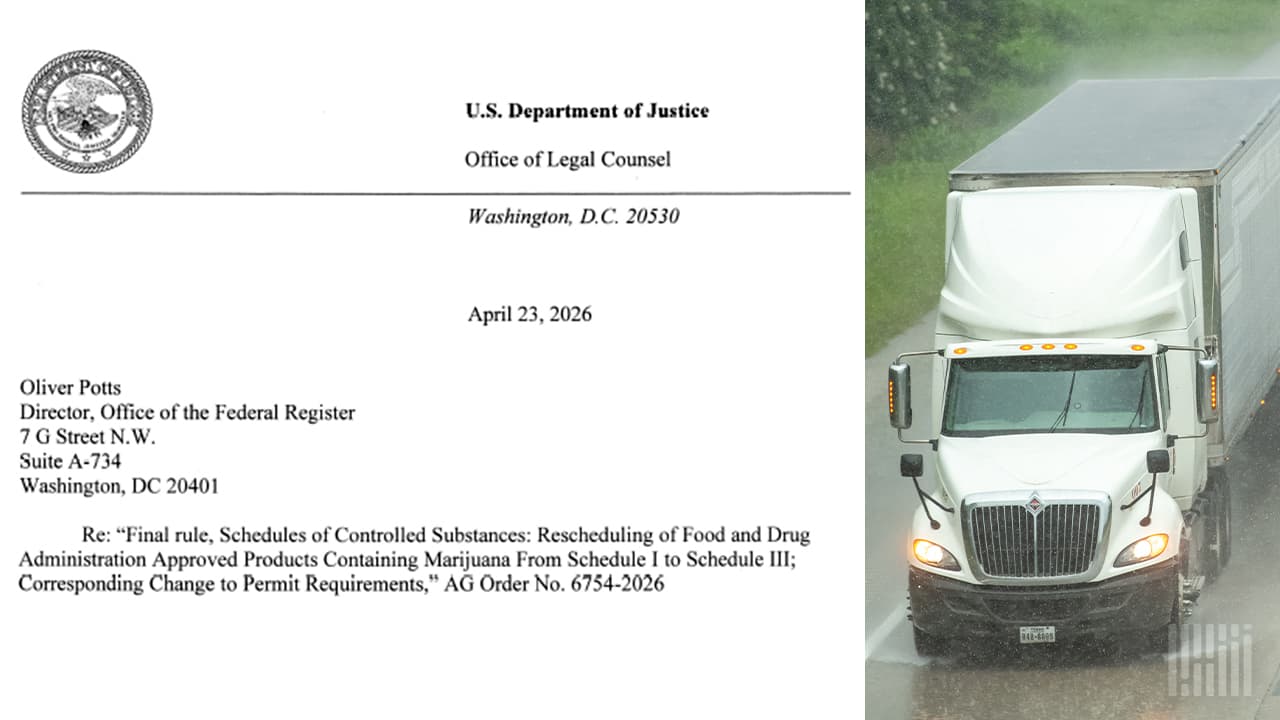
Trump administration moved state-licensed medical marijuana from Schedule I to Schedule III on April 23, 2026, creating legal uncertainty around DOT's authority to require marijuana testing for 3.8 million CDL holders. The change doesn't affect recreational marijuana or current testing requirements, but challenges the legal foundation for mandatory trucking industry drug testing.
Supply chain disruptions could emerge if trucking companies face driver shortages due to testing program uncertainty. Sellers should diversify shipping carriers and monitor delivery performance metrics more closely as the transportation industry navigates potential regulatory gaps.
Transportation regulatory shifts create supply chain vulnerabilities that could affect inventory flow and customer delivery expectations across all marketplace channels.
Monitor shipping performance dashboards daily -- if delivery delays spike above normal baselines, activate backup carrier relationships immediately.
Review carrier contracts in next 30 days to ensure service level guarantees remain intact during potential trucking industry disruption.
Bottom Line
Trucking drug testing uncertainty could disrupt seller supply chains.
Source Lens
Industry Context
Useful background context, but lower-priority than direct platform, community, or operator intelligence.
Impact Level
medium
Trucking drug testing uncertainty could disrupt seller supply chains.
Key Stat / Trigger
3.8 million CDL holders affected by testing authority uncertainty
Focus on the operational implication, not just the headline.
Full Coverage
Yesterday, an order signed by Acting Attorney General Todd Blanche on April 22 and effective April 23 moves two categories of marijuana from Schedule I to Schedule III of the Controlled Substances Act. The first category is FDA-approved drug products containing marijuana.
The second is marijuana, subject to a state-issued license to manufacture, distribute, or dispense for medical purposes. That second category is the one that matters for the conversation about trucking, because it covers the dispensary down the road from your terminal that a driver with a state medical marijuana card can legally walk into in 40 states.
Everything else stays exactly where it was. Recreational marijuana remains Schedule I. Any marijuana that is neither in an FDA-approved product nor covered by a state medical marijuana license remains Schedule I. The guy smoking a joint in a state where adult use is legal is still in Schedule I territory.
The driver who tested positive last week is still in the Clearinghouse. None of that changed. What changed is the legal underpinning for DOT’s ability to require marijuana testing at all.
This is the part that most coverage of the rescheduling action either glosses over or gets wrong, and it is the part that Brandon Wiseman at Trucksafe has been raising since the Trump executive order dropped in December and has now put plainly in writing following yesterday’s order.
The foundation for DOT’s mandatory testing authority flows through the Department of Health and Human Services. HHS issues the Mandatory Guidelines for Federal Workplace Drug Testing Programs. Those guidelines authorize regulated employers to test only for substances listed in Schedules I and II of the Controlled Substances Act.
The Omnibus Transportation Employee Testing Act of 1991, the statute that gives DOT its testing authority in the first place, requires DOT to follow HHS scientific and technical guidelines. window. googletag = window. googletag || {cmd: []}; googletag. cmd. push(function() {googletag.
defineSlot('/21776187881/FW-Responsive-Main_Content-Slot1', [[300, 100], [320, 50], [728, 90], [468, 60]], 'div-gpt-ad-1709668545404-0'). defineSizeMapping(gptSizeMaps. banner1). addService(googletag. pubads()); googletag. pubads(). enableSingleRequest(); googletag. pubads(). collapseEmptyDivs(); googletag. enableServices(); }); googletag. cmd.
push(function() {googletag. display('div-gpt-ad-1709668545404-0'); }); If state-licensed medical marijuana is no longer a Schedule I or Schedule II substance, HHS’s statutory authority to include THC in the mandatory federal testing panel is at a minimum an open question.
DOT’s 49 CFR Part 40 names marijuana specifically rather than referencing it by schedule, which some have argued insulates the testing program from a scheduling change. That argument has always been legally optimistic.
If HHS cannot authorize testing for a Schedule III substance without new rulemaking, then Part 40 has to conform to that, whether it names the substance or not.
The most likely resolution is a congressional or administrative carve-out that explicitly preserves mandatory marijuana testing for safety-sensitive transportation workers regardless of scheduling status. That carve-out does not exist yet.
The DEA order itself acknowledges the potential for significant economic impacts from the rescheduling action while simultaneously stating that its notice-and-comment exemption under the treaty-obligations pathway means it was not required to take public input before this went into effect.
The trucking industry did not get a comment period on a rule that has direct implications for its drug testing program. ODAPC’s most recent guidance on marijuana is dated December 19, 2025, written before rescheduling occurred, and states that marijuana remains unacceptable for safety-sensitive employees subject to DOT testing.
That guidance is now technically pre-rescheduling guidance and has not been updated. The controlling practical answer for every fleet, every driver, and every MRO today is that 49 CFR Parts 40 and 382 have not changed, zero tolerance remains in effect, and a positive test still results in a driver being placed in the Clearinghouse. Do not use marijuana.
That has not changed. There is a difference between the practical answer and the structural answer, and the trucking industry needs both. The conversation about marijuana and trucking has been almost entirely about CDL holders and the FMCSA Clearinghouse. The Clearinghouse currently shows 184,337 commercial vehicle drivers in prohibited status.
Marijuana accounts for roughly 60 percent of all positive tests since the database launched. Those numbers are real and they are significant. What the conversation has not addressed is the much larger and much murkier population of CMV operators who are not CDL holders.
Federal regulations under 49 CFR Part 391 cover drivers of commercial motor vehicles that require a CDL. But there is a separate and considerably larger pop
Original Source
This briefing is based on reporting from Freightwaves. Use the original post for full primary-source context.
Style
Audience