Norfolk Southern profits rise on higher volume and revenue
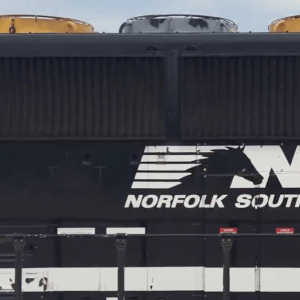
Norfolk Southern posted record revenue in Q3 on higher volumes and rates, and substantial fuel surcharge The post Norfolk Southern profits rise on higher volume and revenue appeared first on FreightWaves.
Source Lens
Industry Context
Useful background context, but lower-priority than direct platform, community, or operator intelligence.
Impact Level
medium
Use this briefing to decide whether your team needs an immediate workflow, policy, or reporting change.
Key Stat / Trigger
No single quantitative trigger surfaced in this report.
Focus on the operational implication, not just the headline.
Full Coverage
Norfolk Southern’s third-quarter profits rose as higher volume and rates, and fuel surcharges, produced record revenue. “Our third quarter was strong with steady execution, making notable improvements to our network while delivering solid results,” Chief Executive Mark George said on the railroad’s earnings call.
“We have an outstanding team of thoroughbreds who remain focused on the fundamentals: operating a safe, reliable railroad, serving our customers, growing the business, and improving productivity across the network.” Operating income increased 5% to $1. 15 billion, as revenue grew 14% to $3. 52 billion.
Fuel surcharge revenue was responsible for 8 of the 14 points of revenue growth. Earnings per share rose 7%, to $3. 37. The railroad’s (NYSE: NSC) operating ratio was 67. 4%, up 2. 8 points from a year ago largely due to higher fuel costs.
Adjusted for the impact of ongoing costs related to the February 2023 derailment and hazardous materials release in East Palestine, Ohio, and expenses related to the proposed merger with Union Pacific (NYSE: UNP), the operating ratio was 65. 4%. window. googletag = window. googletag || {cmd: []}; googletag. cmd. push(function() {var gptSlot = googletag.
defineSlot('/21776187881/FW-Responsive-Main_Content-Slot1', [[300, 100], [320, 50], [728, 90], [468, 60]], 'div-gpt-ad-1709668545404-0'). defineSizeMapping(gptSizeMaps. banner1). addService(googletag. pubads()); googletag. pubads(). enableSingleRequest(); googletag. pubads(). collapseEmptyDivs(); googletag. enableServices(); setInterval(function() {if (!
document. hidden) {googletag. pubads(). refresh([gptSlot]); } }, 60000); }); googletag. cmd. push(function() {googletag. display('div-gpt-ad-1709668545404-0'); }); Overall volume was up 3% for the quarter, with merchandise, intermodal, and coal volume all up 3%.
“Demand for rail service is growing with encouraging trends in areas such as domestic intermodal and chemicals,” George said. “The current macro environment is tightening the truck market, and that helps rail be more competitive. And what you saw in the quarter is us capturing the increased customer demand.”
Chief Commercial Officer Ed Elkins said NS is broadly optimistic for the rest of 2026. High fuel prices tied to the Middle East conflict are boosting energy-related traffic. But NS is watching whether prolonged high gas prices eventually soften consumer demand.
A tight truck market and high fuel costs favor highway-to-rail conversions in forest products, consumer products, and domestic intermodal, Elkins said. International intermodal remains weighed down by trade uncertainty.
Manufacturing has expanded nine straight months, industrial development is ahead of last year, and vehicle production looks modestly positive. Coal is expected to grow, led by exports and supported by utilities replenishing depleted stockpiles.
NS has rolled out new online customer tools that speed responses to rate requests and provide better shipment visibility. “The result is more accurate and more actionable shipment information, enabling customers to plan more effectively, operate more efficiently, and ultimately make decisions with greater confidence,” Elkins said.
“As these capabilities continue to scale, our goal is simple: Make Norfolk Southern the easiest railroad to do business with so that we win more freight in competitive markets.” Key operational metrics were down compared to a year ago but improved over the second quarter, when spot crew shortages led to congestion.
Terminal dwell improved 3% and train speed was up 5% compared to the second quarter. On-time train originations improved 18%. window. googletag = window. googletag || {cmd: []}; googletag. cmd. push(function() {var gptSlot = googletag.
defineSlot('/21776187881/fw-responsive-main_content-slot3', [[728, 90], [468, 60], [320, 50], [300, 100]], 'div-gpt-ad-1665767553440-0'). defineSizeMapping(gptSizeMaps. banner1). addService(googletag. pubads()); googletag. pubads(). enableSingleRequest(); googletag. pubads(). collapseEmptyDivs(); googletag. enableServices(); setInterval(function() {if (!
document. hidden) {googletag. pubads(). refresh([gptSlot]); } }, 60000); }); googletag. cmd. push(function() {googletag.
display('div-gpt-ad-1665767553440-0'); }); “Our railroaders managed another demanding quarter, overcoming significant weather and operating disruptions while remaining focused on serving our customers and operating safely,” Chief Operating Officer Brian Barr said. The intermodal service composite was 84%, down from 92% a year ago.
Merchandise trip plan compliance was 74%, down from 80% a year ago. Compared to the second quarter, merchandise plan compliance rose 6 points, while the intermodal metric declined by a point.
“We entered the quarter with a clear plan to recover network fluidity by improving originations, reducing dwell, increasing velocity, and getting the railroad back on schedule,” Barr said. “We delivered sequential improvement across those foundational measures.” The improvements
Original Source
This briefing is based on reporting from Freightwaves. Use the original post for full primary-source context.
Style
Audience