CAFE Standards Reset: Can Looser Fuel Economy Rules Restart Auto Freight?
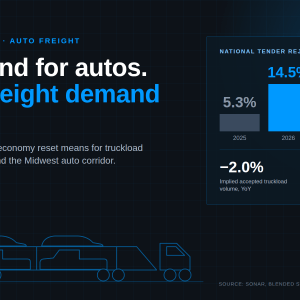
USDOT finalized looser CAFE standards on Sept. 28, 2026, targeting 34.5 mpg fleet average by 2031 vs. the prior 50.4 mpg target. Truckload tender rejections have nearly tripled in 2026, but volume is flat-to-down — this is a capacity crunch, not a demand surge.
This fits the broader margin compression story: sellers relying on spot truckload for inbound replenishment or direct shipping face rising costs from capacity leaving the market, independent of any regulatory tailwind to auto production.
Tripling tender rejections signal tightening carrier capacity, which raises spot freight rates and squeezes margins for sellers shipping big/heavy SKUs from Midwest and Southeast fulfillment nodes. Check your FBA inbound and 3PL freight invoices now — rate creep from capacity tightness hits before most sellers notice.
Operational Impact
This story may require teams to revisit workflows, monitoring, or platform assumptions.
Bottom Line
Carrier capacity crunch, not new auto rules, is what threatens your freight costs now.
Source Lens
Industry Context
Useful background context, but lower-priority than direct platform, community, or operator intelligence.
Impact Level
medium
Carrier capacity crunch, not new auto rules, is what threatens your freight costs now.
Key Stat / Trigger
Tender rejections nearly tripled in 2026
Focus on the operational implication, not just the headline.
Full Coverage
USDOT’s reset of the Corporate Average Fuel Economy (CAFE) standards is a modest tailwind for U. S. auto production, but it is unlikely to turn the truckload freight market into a demand story in the next 12 months. SONAR data shows 2026 truckload tightness is still being driven by capacity leaving the market, not by more freight. On Sept.
28, USDOT finalized its “Freedom Means Affordable Cars” rule resetting NHTSA’s CAFE standards. The department says it will cut the average new-vehicle price by $1,300 and save Americans $138 billion over five years (USDOT).
The question for freight: does cheaper, more flexible car-building translate into more loads out of Detroit, Toledo, Indianapolis and the Southeast auto corridor? Key takeaways Auto manufacturing: Mild positive. Automakers get product-mix flexibility, but the biggest financial lever (CAFE fines) was already zeroed out in 2025.
Consumer sentiment: Unlikely to move. Sentiment sits at 48. 1, weighed down by record diesel, rising gas and higher rates, not fuel economy rules. Freight demand: Small and slow. Our best estimate is a 0. 5%–2% lift in light-vehicle output by 2027–2028, worth well under 0. 1% of national truckload volume, concentrated in Midwest and Southeast auto markets.
The real story: SONAR data shows implied accepted truckload volume is roughly flat to down year over year, while tender rejections have nearly tripled. This is still a capacity story.
Regulatory design: Footprint-based CAFE and the 25% Chicken Tax both favor big domestic trucks, and statutory mandates such as the 2007 biofuel targets have repeatedly been waived down. A rule on paper is not a volume forecast. What the CAFE reset changes — and what it doesn’t The rule lowers the fuel economy bar automakers must hit through model year 2031.
It does not change the tariff, rate or fuel-price environment that is actually setting car prices today. What changes under the new CAFE standards Lower targets. The December 2025 proposal reset standards for MY 2022–2031 with increases of roughly 0. 25%–0. 7% per year, landing at a 34. 5 mpg fleet average by 2031 (USDOT proposal).
The prior rules targeted about 50. 4 mpg by 2031 (Reuters via Yahoo). No EV math. Standards are now set without assuming EV production or credit trading, following DOT’s June 2025 interpretive rule (Automotive News via Yahoo). Product planning flexibility. Automakers can plan more trucks, SUVs and ICE/hybrid volume without building EVs to offset them.
What doesn’t change for automakers Fines were already $0. The One Big Beautiful Bill Act set the CAFE civil penalty to zero in July 2025 (Sidley). Much of the cost relief is already priced in. Tariffs, rates and fuel. Import tariffs on vehicles and parts, elevated borrowing costs and record diesel remain the dominant cost drivers. Product cycles.
Vehicle programs take 2–4 years to change. Any mix or volume shift shows up mostly in MY 2027–2029, not this quarter. Legal risk. Expect litigation from states and environmental groups. Congressional Democrats have already argued the targets fall below what automakers achieved in MY 2024 (35. 4 mpg) (Rep. Matsui letter).
Why vehicles keep getting bigger: CAFE footprint rules and the Chicken Tax Two older rules shape the consumer vehicle fleet far more than the commercial one, and both push it toward larger, heavier trucks, which likely means heavier loads for the freight that builds and delivers them. One rewards making vehicles larger.
The other keeps small foreign-built trucks out of the U. S. market. Footprint standards reward size. Since model year 2011, CAFE targets have been set by vehicle footprint, so larger vehicles face lower mpg targets (Tax Policy Center).
A University of Michigan modeling study found that this design expands vehicle size by 2%–32% in 20 of 21 scenarios, eroding fuel economy gains by 1–4 mpg and raising CO2 emissions by 5%–15%, with the largest effect on light trucks (Whitefoot and Skerlos, Energy Policy, 2012).
Ito and Sallee document the same kind of distortion for Japan’s weight-based standards (NBER). Consumer vehicles bear the brunt. Light-duty CAFE covers vehicles up to 8,500 pounds gross vehicle weight rating, while heavier work trucks fall under separate medium- and heavy-duty rules (NHTSA).
The footprint incentive therefore operates on light-duty pickups, SUVs, and vans, and not on tractor-trailers or vocational trucks. Trucks have always been graded on a softer curve. Light trucks have had their own CAFE class since the program began, with an initial 17. 2 mpg standard in 1979 and 20. 7 mpg for years afterward, versus 27.
5 mpg for passenger cars (CRS). The Chicken Tax removes the low end. The 25% tariff on imported light trucks dates to 1964 and was retaliation for European duties on U. S. chicken. Trade rules required it to apply to all countries, and it has never been removed, while passenger cars pay 2. 5% (FEE).
In 2001, fewer than 7,000 pickups came from outside North America, or 0. 23% of nearly 3
Pull your freight cost-per-unit report in your 3PL or FBA shipment dashboard -- if spot rates are rising >5% month-over-month, lock in contract rates before Q4 peak tightens capacity further.
In the next 30 days, audit any heavy or oversized SKUs shipping out of Midwest/Southeast DCs -- these lanes face the most exposure to truckload capacity constraints heading into peak season.
Original Source
This briefing is based on reporting from Freightwaves. Use the original post for full primary-source context.
Style
Audience