

Why K-Beauty Is Dominating Amazon Right Now (2026)
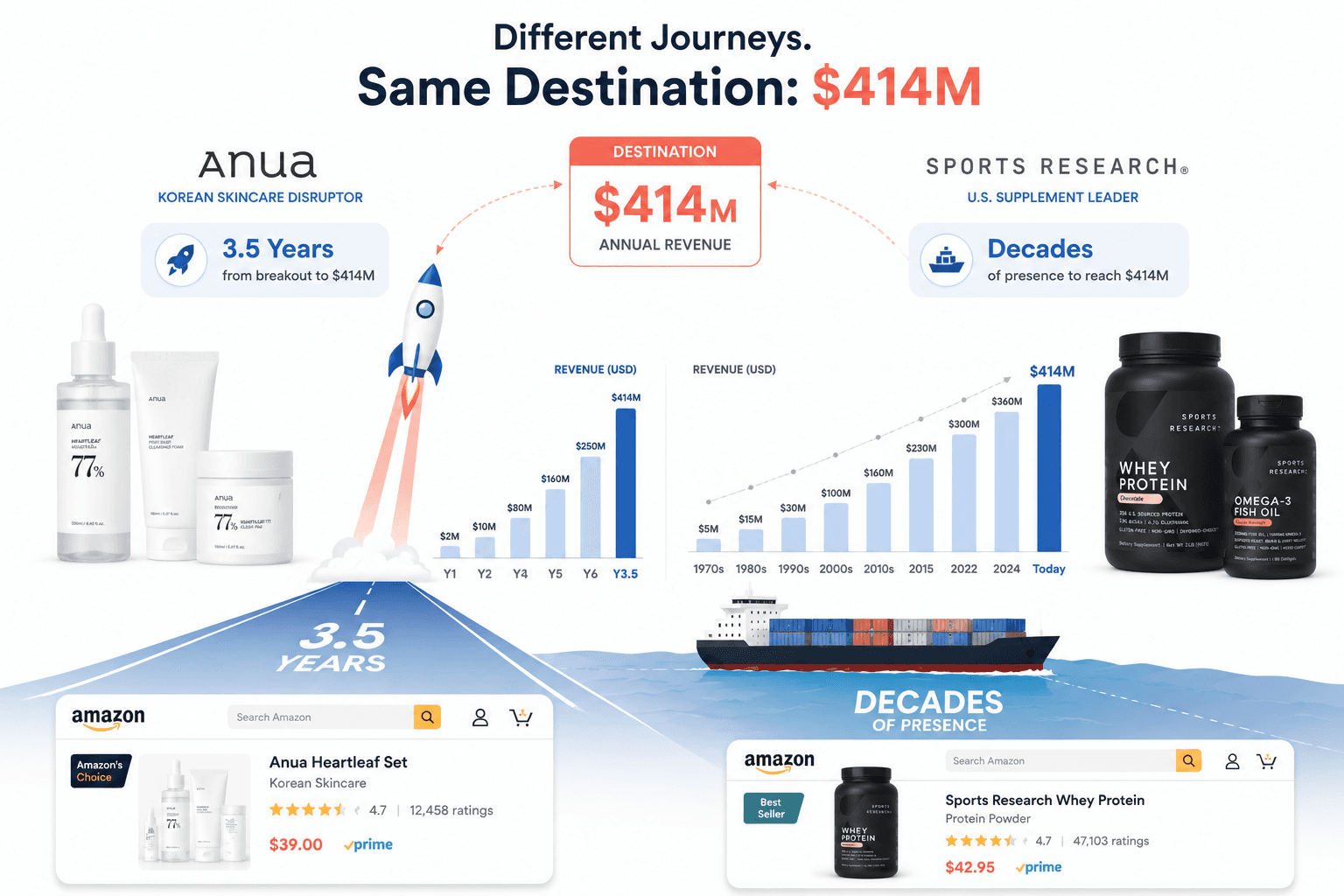
Anua launched in the U.S. through Amazon in December 2022. Three and a half years later, the brand pulled in $414 million in trailing twelve-month revenue, with an 82 percent month-over-month jump in May 2026 alone. Sports Research, a U.S. supplement brand with decades of established Amazon presence, sits below them on the leaderboard. Three … The post Why K-Beauty Is Dominating Amazon Right Now (2026) first appeared on EcomCrew.
Source Lens
Operator Tactics
Tactical content that tends to be strongest when tied to workflow, process, or execution.
Impact Level
medium
Use this briefing to decide whether your team needs an immediate workflow, policy, or reporting change.
Key Stat / Trigger
No single quantitative trigger surfaced in this report.
Focus on the operational implication, not just the headline.
Full Coverage
Anua launched in the U. S. through Amazon in December 2022. Three and a half years later, the brand pulled in $414 million in trailing twelve-month revenue, with an 82 percent month-over-month jump in May 2026 alone. Sports Research, a U. S. supplement brand with decades of established Amazon presence, sits below them on the leaderboard.
Three and a half years against decades. You'd think Anua has some massive marketing budget powering this. Or a celebrity endorsement. Or some unfair advantage you don't have access to. None of the above. And what makes this even stranger is that Anua is doing this against real headwinds. A 15 percent tariff on Korean imports took effect in August 2025.
The de minimis exemption for low-value shipments ended later the same month. Korean cosmetic exports to the U. S. dropped 37 percent in the first ten days of August 2025 alone, per trade data from KED Global. The K-beauty cohort kept climbing anyway. Want to know why? The reasons go deeper than viral TikTok videos or a trendy ingredient.
Here's the full picture. The Numbers Are Bigger Than One Brand Look at the leaderboard and you'll notice Anua isn't the lone k-beauty brand up there. COSRX comes in at $255M trailing twelve-month revenue. SaynBeauty pulled $283M. Add the three together and you're looking at $950 million in Amazon revenue from Korean-origin brands.
For context, more than the entire pet supplies top five on Amazon combined. So the question isn't whether K-beauty has won on Amazon. The brand cohort has already won. The question is how, and what you should do next. A Quick Note on COSRX The company was founded in Seoul in 2013 but operates through a U. S. -registered Amazon entity.
SellerSnooper's data classifies the brand as a U. S. seller because of the registration. Some reports describe Anua as “the first Korean brand” in Amazon's D2C top five. Technically accurate under SellerSnooper's framework. The more useful read: two Korean-origin brands hold spots in the top six D2C earners, with a third running close behind.
The registration detail is paperwork. The market position is real. How They Win the Searches You Thought Were Yours Open Amazon Brand Analytics, pull the Top Search Terms report, and you'll see something likely to make any beauty brand operator a little nervous. Korean brands aren't winning their own branded searches alone.
They're also winning the generic ones. Search “korean skincare” on Amazon. The term sits at search rank 16,899. Top three clicked brands: Medicube, Anua, JiYu. No legacy U. S. brand in sight. Search “heartleaf toner.” No brand name, no aesthetic, no Korean modifier, it's just the ingredient. Anua captures 54. 22 percent of clicks and 66.
09 percent of conversions. More than half of shoppers typing a generic ingredient term end up clicking one brand. The next two on the list (JMsolution and numbuzin) are also Korean. On Anua's own branded searches, the dominance compounds. “Anua heartleaf 77 soothing toner” shows 81. 6 percent click share and 83. 74 percent conversion share.
“Anua heartleaf toner” shows 75. 52 percent and 81. 69 percent. Branded conversion at those levels tells you the shopper arrived already decided. You see the same pattern with Medicube, BIODANCE, and Round Lab across “korean glass skin care,” “korean skincare set,” and “korean cleanser.” The cohort isn't sharing the leaderboard. They're crowding U. S.
brands out. The Three-Stage Capture Behind the click share numbers, the mechanism works in three stages, in this order. Stage one is branded search. A shopper sees a TikTok video about Anua, opens Amazon, types “anua heartleaf toner,” and the brand converts above 75 percent. Standard branded behavior. Stage two is ingredient search.
A few weeks later, the same shopper searches “heartleaf toner” without specifying a brand because they remember the ingredient rather than the brand name. Anua appears first because Amazon's algorithm preferences proven conversion data. The shopper clicks the familiar product. Captured. Stage three is aesthetic search.
A different shopper, having seen TikTok content about “glass skin,” types the aesthetic into Amazon. Anua's products, already positioned through stage one and stage two, sit at the top. Captured. By the time a competitor notices what's happening, Amazon's algorithm has been reinforcing the position for months.
Outspending an algorithm on a position the algorithm already prefers is expensive, slow, and usually pointless. The K-Beauty Manufacturing Advantage South Korea hosts the most concentrated cosmetic ODM and OEM ecosystem in the world. Cosmax, Kolmar Korea, and Cosmecca manufacture for thousands of brands worldwide.
Cosmax alone produces for over 600 brands and counts 15 of the 20 largest global cosmetic companies as clients, including L'Oréal. Why does this matter? Because a new Korean skincare brand has access to clinical-grade formulation, scaled manufacturing, and ingredient sourcing at a cost structure most U. S. founders w
Original Source
This briefing is based on reporting from EcomCrew. Use the original post for full primary-source context.
Style
Audience