

Amazon to scale up drone delivery in 2025, CEO says
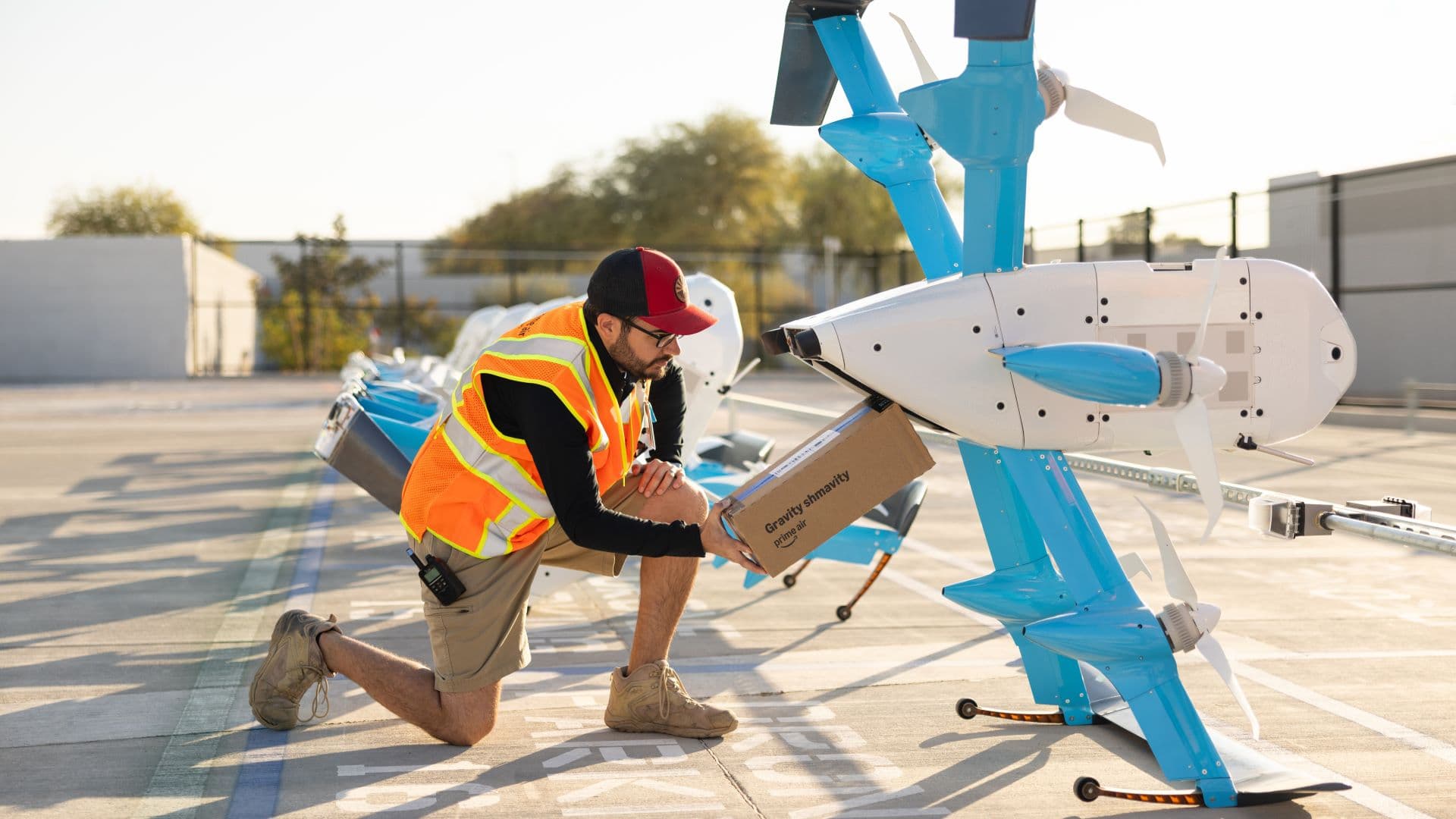
Amazon will scale Prime Air drone delivery to serve 30 million customers by end of 2025, targeting 500 million packages annually by 2030 with 30-minute delivery. The service launches in Chicago suburbs this spring/summer with 12-20 drones per fulfillment center.
Faster delivery expectations will pressure sellers to use Amazon's premium fulfillment services and stock inventory closer to customers. Monitor your delivery promise metrics in Seller Central - customers increasingly abandon carts when delivery times exceed expectations.
Amazon's logistics arms race forces all sellers into faster fulfillment models, potentially increasing FBA dependency and costs while making independent fulfillment less competitive.
Check your delivery promise performance in Seller Central Reports > Fulfillment > Shipping Performance - if below 95% on-time, switch to FBA for drone-eligible products under 5 pounds.
Review your top-selling items under 5 pounds and ensure they're enrolled in FBA at same-day fulfillment centers in major metro areas.
Bottom Line
30-minute drone delivery means higher customer expectations for all sellers.
Source Lens
Industry Context
Useful background context, but lower-priority than direct platform, community, or operator intelligence.
Impact Level
medium
30-minute drone delivery means higher customer expectations for all sellers.
Key Stat / Trigger
30 million customers served by drone delivery end of 2025
Focus on the operational implication, not just the headline.
Full Coverage
Amazon will significantly ramp up Prime Air drone capacity this year as part of a multi-pronged initiative to move beyond same-day delivery and deliver e-commerce orders within hours, or even minutes, CEO Andy Jassy said in an annual letter to shareholders on Thursday.
Speed is the driving force for Amazon’s (NASDAQ: AMZN) logistics operation because management says customers are more likely to complete online orders when faster delivery is promised.
At the same time, there is a counter movement in retail away from ultra-fast delivery based on concerns about the unsustainable cost of service and whether consumers really expect quick fulfillment turnaround.
Jassy said Prime Air service will be able to serve communities with 30 million customers by the end of the year, with a much wider catalog of goods to choose from, and is expected to annually deliver 500 million packages by the end of the decade in under 30 minutes.
The ability to scale up drone deliveries is possible now because of more than 85 same-day fulfillment centers that carry Amazon’s top 90,000 products and serve as launch pads for the autonomous delivery vehicles.
The more streamlined fulfillment centers have already enabled Amazon to deliver more than 500 million same-day packages in 2026 so far, according to the CEO. Amazon is scheduled to begin serving customers in the south Chicago suburbs out of two fulfillment centers by late spring or early summer. Each site will have 12 to 20 drones.
Prime Air’s flagship MK30 drone weighs 83 pounds and can carry items weighing up to 5 pounds. The drones cruise at about 73 mph and 200 to 300 feet high. Six vertical propellers provide lift, with staggered tandem wings supporting cruise flight. They can fly in light precipitation and winds faster than 20 mph.
Parcels are stored in a shoebox-sized fuselage and dropped to the ground from about 13 feet up. Prime Air in recent months has launched in parts of Kansas City, Kansas; San Antonio and Waco, Texas; the suburbs of Detroit, Dallas-Fort Worth; Tampa, Florida; and Tolleson, Arizona, west of Phoenix.
Ultra-fast delivery Amazon will continue to focus on ultra-fast ground delivery within 20 minutes, which it is testing in India and the United Arab Emirates. The service, called Amazon Now, is also available in parts of Seattle and Philadelphia, and is expanding to Europe.
It leverages strategically located, urban micro-fulfillment centers where on-demand workers pick up packaged groceries and household items and deliver them.
In India, where Amazon has more than 360 micro-fulfillment centers (and more on the way), Amazon Now orders are increasing 25% month-over-month, with Prime members tripling their shopping frequency once they start using it, Jassy said. Prime Air will deliver a much larger selection of items than Amazon Now, which is limited to several thousand products.
Jassy said fulfillment centers are able to rapidly churn out orders because of extensive deployment of more than 1 million robots that help stow, pick, sort and transport merchandise within facilities. Meanwhile, Amazon is aggressively expanding its delivery network into rural areas under a $4 billion investment campaign initiated last year.
The average number of monthly same-day customers in rural areas has nearly doubled in 2025 compared to the prior year. Once the expansion is complete, Amazon will be able to deliver more than 1 billion more packages each year to customers in more than 13,000 zip codes across the nation, the CEO said.
Amazon opened two small fulfillment centers in West Virginia to improve delivery times across the state, Gov. Patrick Morrisey announced on April 1. It is also opening a new facility in Reno, Nevada. The push into rural areas is one of the key reasons behind Amazon’s decision to reduce by 20% the amount of parcels tendered to the U. S.
Postal Service under a new contract agreement reached this week, according to industry analysts. Once Amazon has built out its rural delivery infrastructure there will be little need to use the Postal Service for last-mile delivery. “Ultra-fast delivery is the new table stakes.
Amazon running three parallel speed programs simultaneously means the delivery expectation floor is dropping.
If you operate in grocery, pharmacy, convenience, or everyday essentials, the competitive benchmark will move from same-day to sub-hour within three years in major metros,” said Nikhil Varshney, a Wayfair supply chain manager who writes a Substack newsletter called the “Silk Road Nexus.” Is fast shipping critical?
And yet, as the Wall Street Journal recently reported, a growing number of online retailers are increasingly reluctant to absorb the cost of fast shipping as delivery prices have risen. Many offer “no rush” shipping options that can take several days after realizing that not all customers are looking for fast delivery.
And, it turns out, customers who wait are less likely to return purchases. Same-day delivery economics typically ope
Original Source
This briefing is based on reporting from Freightwaves. Use the original post for full primary-source context.
Style
Audience