

JBS axes 2040 net-zero goal, citing ‘immense’ execution challenges
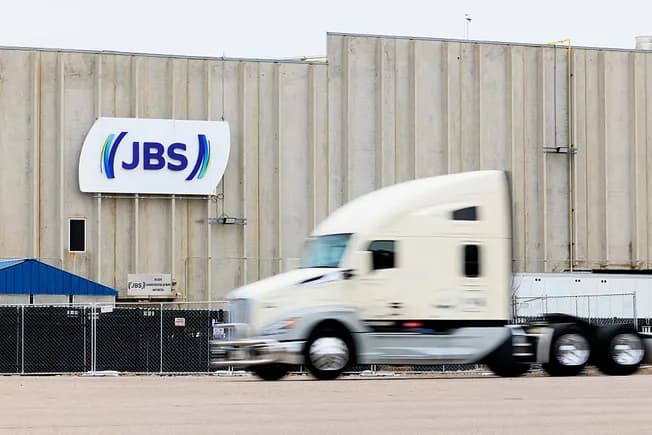
The meat giant will no longer aim to achieve net-zero greenhouse emissions across its supply chain by 2040 and has also dropped scope 3 reduction targets.
Source Lens
Industry Context
Useful background context, but lower-priority than direct platform, community, or operator intelligence.
Impact Level
medium
Use this briefing to decide whether your team needs an immediate workflow, policy, or reporting change.
Key Stat / Trigger
No single quantitative trigger surfaced in this report.
Focus on the operational implication, not just the headline.
Full Coverage
An article from Dive Brief JBS axes 2040 net-zero goal, citing ‘immense’ execution challenges The meat giant will no longer aim to achieve net-zero greenhouse emissions across its supply chain by 2040 and has also dropped scope 3 reduction targets.
Published July 21, 2026 Zoya Mirza Editor Share Copy link Email / Print License Add us on Google A truck drives past the JBS meatpacking plant on March 16, 2026 in Greeley, Colorado. Michael Ciaglo via Getty Images First published on Listen to the article 3 min This audio is auto-generated. Please let us know if you have feedback.
Dive Brief: JBS, the world’s largest beef and poultry producer, will no longer aim to achieve net-zero greenhouse gas emissions across its supply chain and global operations by 2040. The meat giant announced the cut in its latest sustainability report released on July 8.
The company’s updated sustainability strategy also no longer includes reduction goals for scope 3 emissions, which include all the indirect GHG emissions produced in its supply chain. Instead, JBS will now focus on cutting scope 1 and 2 or direct emissions, which account for barely 3% of the company’s overall carbon footprint.
Scope 3 emissions are responsible for the bulk of its emissions: the company generated over 184 million metric tons of carbon dioxide equivalent in scope 3 emissions last year.
Dive Insight: In a statement accompanying the sustainability report, JBS Global Chief Sustainability Officer Jason Weller said the company was “not walking away from challenges and opportunities” presented by a changing climate, but was “sharpening its climate goals.”
The company has a near-term goal of reducing scope 1 and 2 emissions by 30% across its core operations by 2030, and a long-term goal of reducing scope 1 and 2 emissions by 70% by 2050 — both against a 2019 baseline.
The company considers direct operational emissions to be those generated by energy and fuel use, refrigerants and waste across its facilities and plants globally. Weller said in his statement that implementing JBS’ 2040 net-zero goal, which it established five years ago, came with a number of challenges.
“The further we got into execution, the clearer it became that a Net Zero goal spanning hundreds of thousands of independent agricultural producers across tens of millions of hectares in dozens of countries — each with different practices, different baselines, and no standardized measurement infrastructure — is an immense challenge,” Weller said.
“Delivering a system-wide ambition at that scale depends on data, producer adoption, technology, and measurement infrastructure that are still developing across global agriculture.” JBS’ 2040 net-zero goal and its broader emissions reduction strategy have also faced legal scrutiny in the past.
In 2024, JBS was sued by New York’s attorney general who accused the meatpacker of misleading consumers about its efforts to reduce greenhouse gas emissions and alleged JBS had “no viable plan” to meet its goal of net-zero greenhouse gas emissions by 2040.
At the time, New York AG Letitia James said the company had deceived consumers by touting its environmental commitments in major advertising campaigns. The Brazil-based meat producer settled those claims in November 2025, with an agreement to invest $1. 1 million in climate-smart agriculture in the state.
Under the settlement, JBS also agreed to frame the now-retired 2040 target as a “goal,” rather than a pledge or commitment. Recommended Reading JBS invests $1.
1M to boost climate-smart agriculture, settle lawsuit with New York ESG Dive New York sues JBS over ‘misleading’ climate claims ESG Dive Add us on Google Share Copy link Email / Print License Filed Under: Risk and Resilience, Procurement, Manufacturing
Original Source
This briefing is based on reporting from Supply Chain Dive. Use the original post for full primary-source context.
Style
Audience