Commerce Data Enrichment for BigCommerce and Feedonomics to Power Agentic Commerce
As AI reshapes how products are discovered and purchased, the quality of a merchant’s product data is becoming a decisive competitive advantage. Commerce the open commerce ecosystem built to help merchants win as AI reshapes how customers discover and buy, have announced Feedonomics Enrichment and BigCommerce Catalog Enrichment. These new capabilities help B2C and B2B […]
Source Lens
Industry Context
Useful background context, but lower-priority than direct platform, community, or operator intelligence.
Impact Level
medium
Use this briefing to decide whether your team needs an immediate workflow, policy, or reporting change.
Key Stat / Trigger
No single quantitative trigger surfaced in this report.
Focus on the operational implication, not just the headline.
Full Coverage
As AI reshapes how products are discovered and purchased, the quality of a merchant’s product data is becoming a decisive competitive advantage. Commerce the open commerce ecosystem built to help merchants win as AI reshapes how customers discover and buy, have announced Feedonomics Enrichment and BigCommerce Catalog Enrichment.
These new capabilities help B2C and B2B merchants transform their catalogs into richer, AI-ready product intelligence at scale.
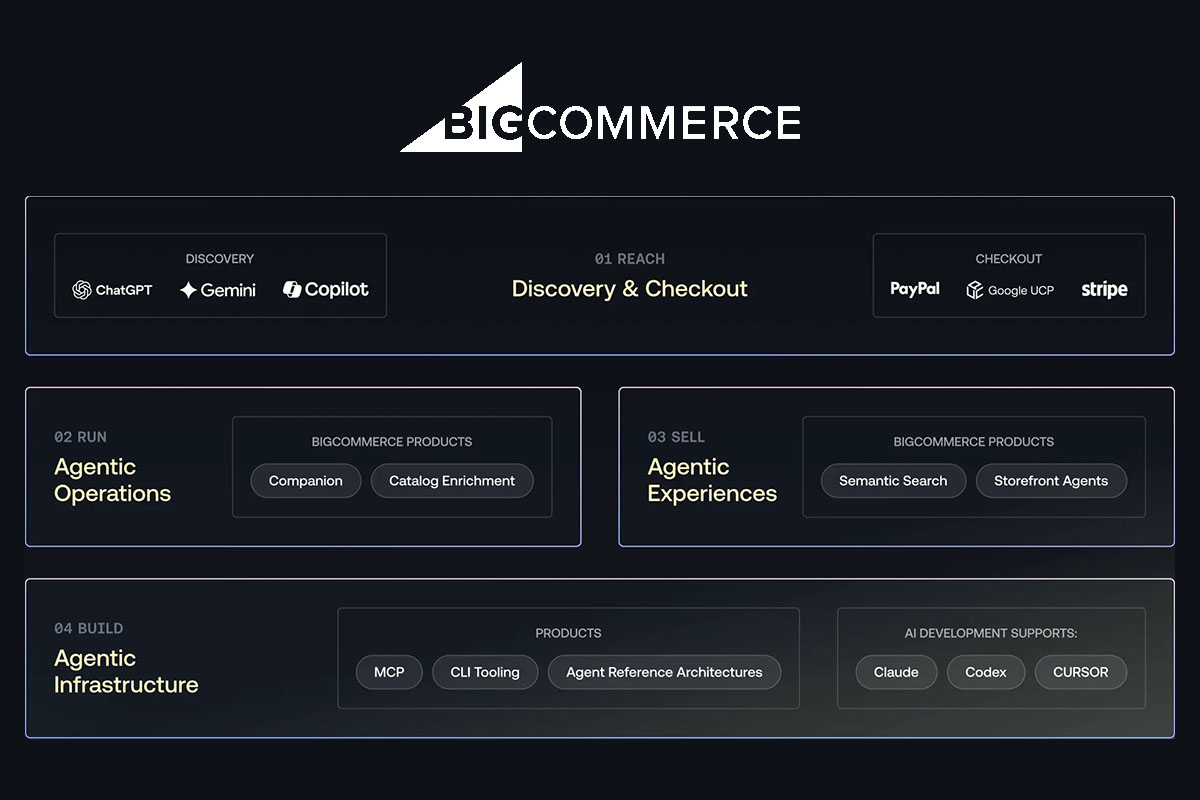
The new enrichment capabilities form the cornerstone of Commerce’s agentic commerce solutions, a growing collection of products and capabilities designed to help merchants prepare their product data for agent-powered discovery, connect AI tools securely to their businesses and enable new shopping and store management experiences.
Product data has always been an operational requirement, but in an AI-driven market, it becomes the deciding factor. If an AI answer engine can’t access the relevant information about a product, it won’t surface the product in response to a user’s question.
Shoppers and B2B buyers alike are already asking AI apps to compare products, answer questions and, increasingly, complete purchases. Those experiences depend on product data that’s contextually rich and brand-aligned, so buyers are matched with the brands, manufacturers and distributors best suited to them.
Traditionally, catalogs have been written for humans browsing a website, not for AI agents parsing and interpreting product data at scale. Enrichment closes that gap by improving the quality and structure of that data. It also gives merchants and their teams a governed way to put AI to work inside their own business.
AI agents can only answer questions about your products as well as your data allows. Whether you’re a marketer driving AEO or a product leader building shopping agents, better data is the foundation for better agentic experiences.
Feedonomics Enrichment and BigCommerce Catalog Enrichment give brands on any platform a data pipeline that lifts performance everywhere agents meet shoppers from Google to OpenAI and on their own sites and agents.
– Sharon Gee, senior vice president of product for AI, Commerce Commerce’s enrichment solutions turn the product information a brand already has into more robust, consistent data. Both Feedonomics Enrichment and BigCommerce Catalog Enrichment generate product titles, descriptions, feature bullets, FAQs and SEO metadata.
They also produce the structured facts, snippets and Q&A fields that generative experiences use to interpret what a product is, who it is for and why it’s a relevant match. Feedonomics Enrichment extends that foundation to the product fields used across marketplace and advertising destinations, while mapping content to a brand’s own taxonomy.
Because the same enriched foundation travels with the data, the effect compounds across four parts of a merchant’s business: Reaching customers.
Consistent, complete records give shoppers and agents the detail they need to find and match products across storefronts, advertising channels, marketplaces, social platforms and answer engines, so a product is represented the same way, wherever discovery happens. Running the storefront.
Enrichment removes the need for CSV exports, third-party tools and agency projects that take hours to maintain, so catalog quality stays current without the manual upkeep, with merchants still in control of what goes live. Selling products. AI can only recommend what it can understand.
Contextual product content lets a conversational experience take a shopper’s question, match it to a specific product and provide a credible reason to choose it. Building experiences. Structured, machine-readable product data is what developers build on. It makes a catalog usable by the assistants, storefronts and agent-facing experiences.
Feedonomics Enrichment Feedonomics Enrichment helps enterprise and multichannel brands transform complex product catalogs into consistent, channel-ready content at scale. Its data model supports storefront, search and answer-engine content across destinations such as Google, Meta, Amazon and eBay, as well as agentic surfaces like Gemini, ChatGPT and CoPilot.
Available through both self-managed and managed-service models, Feedonomics Enrichment enables merchants or their Feedonomics teams to configure and run enrichments through a native self-serve integration.
The offering includes a merchant-facing quality scorecard that evaluates accuracy, consistency and brand adherence, with an explainable issue list for anything that may require attention.
A new analytics experience also gives brands visibility into performance signals across onsite traffic and paid media, helping them evaluate how enriched product information performs across the customer journey. An additional conversational reporting agent experience is planned to make those insights easier to explore using natural-language questions.
Feedonomics Enrichment is currently av
Original Source
This briefing is based on reporting from Tamebay. Use the original post for full primary-source context.
Style
Audience