

Google’s AI Is Only as Good as the Data You Give It
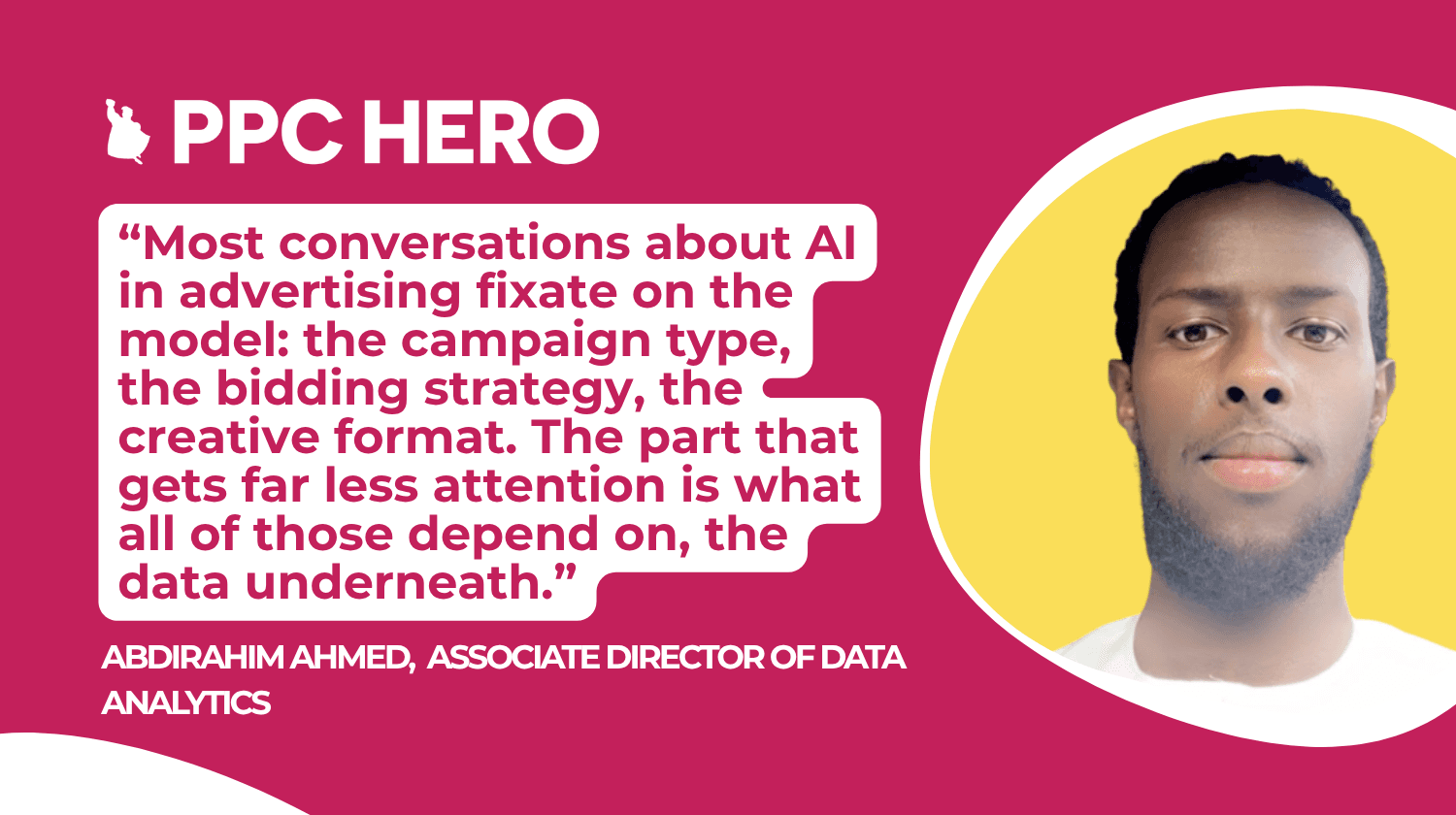
Google's AI is only as good as the data you feed it. Data Strength is how you recover the lost conversion signals that Smart Bidding needs to keep performing. The post Google’s AI Is Only as Good as the Data You Give It first appeared on PPC Hero.
Source Lens
Industry Context
Useful background context, but lower-priority than direct platform, community, or operator intelligence.
Impact Level
medium
Use this briefing to decide whether your team needs an immediate workflow, policy, or reporting change.
Key Stat / Trigger
No single quantitative trigger surfaced in this report.
Focus on the operational implication, not just the headline.
Full Coverage
By Abdirahim Ahmed - Thursday July 2, 2026 Share (Twitter) WhatsApp Summarize ChatGPT Perplexity Grok Google AI Most conversations about AI in advertising fixate on the model: the campaign type, the bidding strategy, the creative format. The part that gets far less attention is what all of those depend on, the data underneath.
Google’s automation runs entirely on conversion signals. Smart Bidding, Performance Max, and Demand Gen all learn from the conversions you report, and when those signals are thin, the system optimizes toward the wrong things, or toward nothing at all.
The Measurement Gap Most Advertisers Can’t See The erosion has been gradual, which is why it is easy to miss. Safari and Firefox have already clamped down on third-party cookies, and together they account for around 21% of global traffic, a slice that is now measured far less accurately than it was a few years ago.
Apple’s App Tracking Transparency launched with plenty of noise and landed with an opt-in rate somewhere between 15 and 25%, which leaves most Apple users effectively invisible to standard in-app tracking.
Add ad blockers that strip tags before they fire, and a default Google Tag that loads from a third-party domain privacy tools are built to intercept, and the gap widens further. The damage is not just messy reporting.
Smart Bidding learns from conversion data, so when that data is incomplete it cannot tell which clicks, audiences, or placements actually drove results. It bids in the dark. Campaigns that should be your strongest start to drift, and the budget you have handed to automation underperforms what it is capable of.
Defining Data Strength If you have sat through a Google session in the past year, you have probably heard the term, usually wrapped in acronyms: GTG, ECW, ECL, Customer Match. Data Strength is Google’s way of pulling those products together under one idea. Think of it as fuel. The automation is the engine, and conversion signals are what it burns.
The stronger and more complete the signal, the better the engine runs. What sets it apart from earlier first-party data messaging is the emphasis on completeness. One product on its own does not move much.
The point is to connect every source you have, online and offline, into a single input that gives Google’s AI the fullest possible view of the customer journey. There is a competitive edge to it too.
Google’s automation optimizes for whoever feeds it the best data, so if a rival has stronger measurement than you do, their campaigns learn faster and pull ahead over time. Your data is a moat. They cannot see yours, and you cannot see theirs.
Google’s own figures put the prize at 10 to 20% more observed conversions for advertisers who build strong foundations. The Components That Do the Work The framework breaks into a few components, and they stack.
The foundation is the Google Tag, but the tag has a structural weakness: it loads from a third-party domain that ad blockers and browser settings increasingly distrust. Google Tag Gateway fixes that by serving the tag from your own domain, so to the browser it looks like a first-party request and is far more likely to load.
Google puts the average uplift at 14% more observed conversions, and for sites on Cloudflare it can be switched on in a handful of steps with no re-tagging. Above: Google Tag is available for Google Ads accounts. Taken from the Google Ads and eCommerce blog.
Enhanced Conversions for Web handles the next gap, when a conversion fires but no cookie is present to identify the user. It captures consented first-party data at the point of conversion, usually a hashed email, and uses that to attribute the conversion when a cookie match fails.
The data is hashed in the browser before it leaves, so Google only ever sees an encrypted identifier. Google reports an 8. 5% lift on Search conversions and 15% on YouTube, which has always been the harder channel to attribute.
Enhanced Conversions for Leads does the same job for the offline half of the journey, which is where the real value sits for lead generation. Standard offline conversion import leans on the GCLID alone, is click-based, and will not survive link decoration deprecation.
ECL adds hashed first-party data alongside the GCLID, so Google can match on more than one identifier when you upload offline conversions later. Google’s figure is a 10% lift on Search and 22% on YouTube over standard import. Customer Match shifts from measurement into activation.
You upload consented customer data, hashed, and Google matches it to signed-in users across Search, Shopping, YouTube, Gmail, and Display, so you can reach those people, suppress them from prospecting, or build lookalikes from your best customers. Data Manager is where these pieces come together.
It is Google’s hub for connecting website, app, store, and CRM data into one place, and Google
Original Source
This briefing is based on reporting from PPC Hero. Use the original post for full primary-source context.
Style
Audience