

What Meta’s AI Connectors Change About Running Paid Social
For as long as most of us have run paid social, the work has lived inside Ads Manager. You logged in to check performance, you logged in to make a change, and any AI tool you used sat off to the side, helpful for interpretation but cut off from the campaigns themselves. Meta has just broken that pattern. With the launch of Meta Ads AI Connectors, advertisers can now create, manage, and analyze campaigns from inside the AI tools they already work in. The post What Meta’s AI Connectors Change A
Source Lens
Industry Context
Useful background context, but lower-priority than direct platform, community, or operator intelligence.
Impact Level
medium
Use this briefing to decide whether your team needs an immediate workflow, policy, or reporting change.
Key Stat / Trigger
No single quantitative trigger surfaced in this report.
Focus on the operational implication, not just the headline.
Full Coverage
By Michelle Wiltz - Tuesday June 30, 2026 Share (Twitter) WhatsApp Summarize ChatGPT Perplexity Grok Google AI For as long as most of us have run paid social, the work has lived inside Ads Manager.
You logged in to check performance, you logged in to make a change, and any AI tool you used sat off to the side, helpful for interpretation but cut off from the campaigns themselves. Meta has just broken that pattern.
With the launch of Meta Ads AI Connectors, advertisers can now create, manage, and analyze campaigns from inside the AI tools they already work in. There is no API project to set up, no developer credentials to chase, and no engineering dependency to wait on.
Through Meta’s MCP server, those tools connect securely to live campaign data, so everything from reporting to campaign creation can happen through natural language. That is the mechanics. The more interesting question is what it does to how paid social actually gets run.
Execution Leaves The Platform For years, optimization has been tied to the platform itself. If you wanted to read performance, you opened Ads Manager. If you wanted to act on it, you worked inside its constraints. AI tools could interpret whatever you showed them, but they could not reach back into the account and change anything.
Connectors remove that wall. The same environment you use to analyze a campaign can now act on it, which means the lag between spotting a problem and fixing it starts to close. Instead of exporting data, reading it somewhere else, and applying changes by hand, you move from question to action in one place.
Decisions Move to Where the Data Already Sits There is a second shift underneath the first. By letting AI tools reach Meta’s campaign data directly, Meta is accepting something the industry has known for years: nobody runs paid social in isolation. Performance on Meta only makes sense next to search, retail media, and the wider business picture.
When an AI tool can pull and act on Meta data alongside everything else, it becomes the layer where decisions are actually made. That opens up the cross-channel view teams have spent years struggling to build. Rather than optimizing Meta in a vacuum, you can weigh it inside the whole system and act without switching tools.
Lower Friction Changes Who Does the Work The third change is about friction, and it carries a knock-on effect for skills. Tasks that used to mean clicking through the platform, coordinating across teams, or waiting on a technical setup can now be handled in plain language. That makes execution faster, but it also changes who is able to execute.
As the barrier drops, platform fluency stops being the thing that sets people apart. What matters instead is how well a team frames its inputs, reads what comes back, and steers the system toward the right outcome. The Part That Still Needs a Human It is tempting to read all of this as an efficiency story, all faster workflows and simpler setup.
Those gains are real, but they are not the part that will separate strong teams from the rest. The opportunity is to treat connectors as a new workflow layer rather than another reporting shortcut. The value is not in asking an AI tool to pull a Meta report.
It is in folding Meta data into a wider decision-making process that already accounts for other channels, business metrics, and testing. The teams that benefit will redesign how the work gets done, not bolt AI onto the old routine. It also raises the stakes on judgment.
When campaigns can be built and changed through a single instruction, the importance of defining the right inputs, signals, and guardrails only grows. The system will act quickly. It still needs pointing in the right direction, and that direction is a human call.
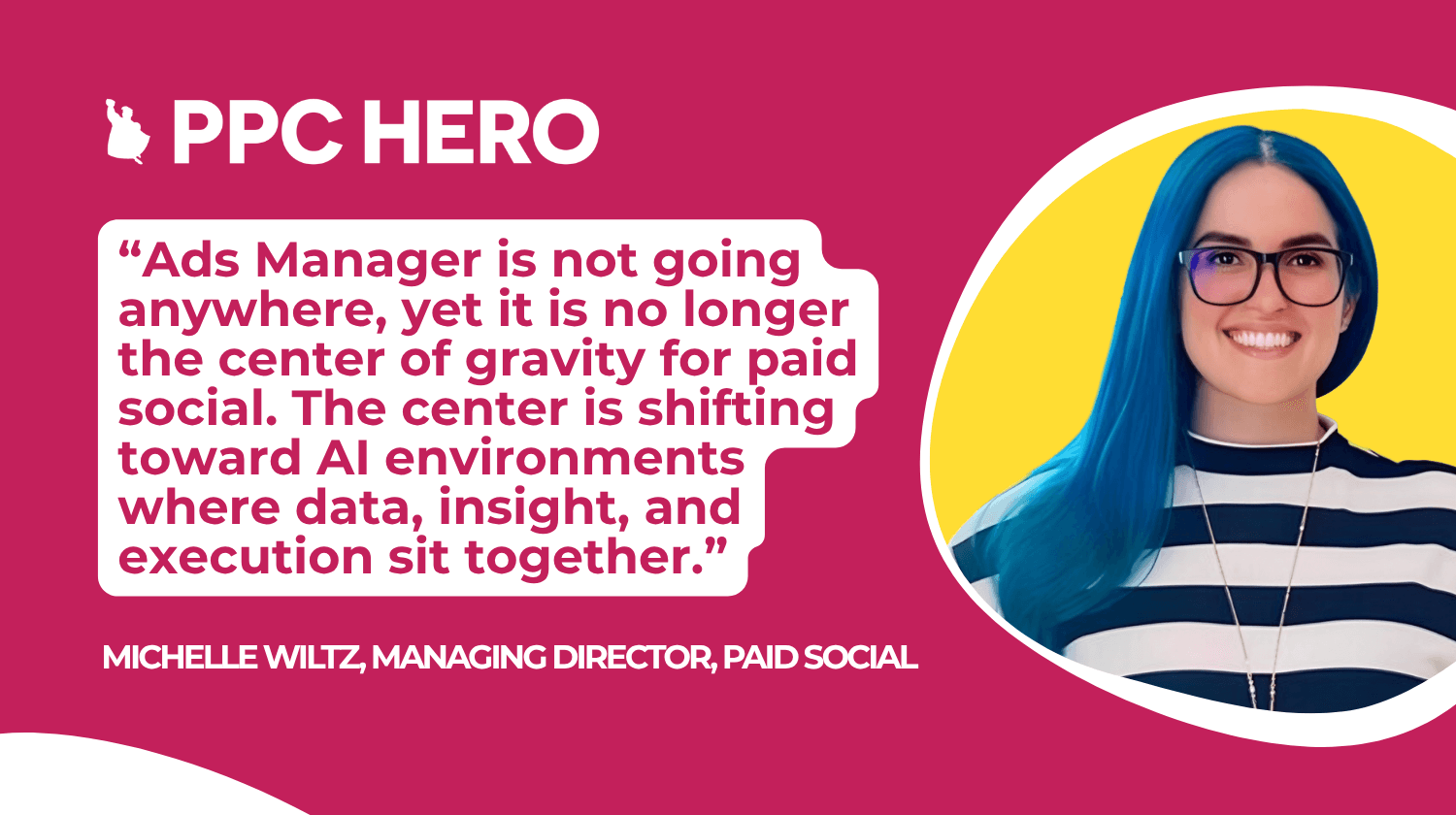
Where this leaves us Meta Ads AI Connectors are easy to file under “another AI feature,” but that undersells what is happening. The launch is less about making campaign management easier and more about moving where that management lives. Ads Manager is not going anywhere, yet it is no longer the center of gravity for paid social.
The center is shifting toward AI environments where data, insight, and execution sit together. The teams that adjust to that will move faster and decide better. The ones that do not will still be logging in, pulling reports, and wondering why everything feels a step behind.
Original Source
This briefing is based on reporting from PPC Hero. Use the original post for full primary-source context.
Style
Audience