FMCSA’s Elison: ‘weeks’ away from fixing Motus user experience
FMCSA's Motus carrier registration system, launched May 14, remains broken; deputy administrator projects a 'weeks' timeline for front-end fixes as of October 1, 2026. Enforcement of biennial registration and DOT number deactivations is suspended for carriers with requirements after June 1.
This is a regulatory bottleneck in freight infrastructure that increases carrier supply instability — sellers relying on spot or contracted trucking face elevated disruption risk until Motus stabilizes, compounding existing logistics margin pressure.
Carriers unable to complete biennial registration via Motus are operating on borrowed time — when enforcement resumes, expect sudden DOT deactivations that could disrupt your 3PL, freight broker, or FTL carrier relationships. Audit your active carrier partners now to confirm their DOT status is current before the suspension lifts.
Operational Impact
This story may require teams to revisit workflows, monitoring, or platform assumptions.
Bottom Line
Motus chaos means carrier DOT deactivations could hit your freight network without warning.
Source Lens
Industry Context
Useful background context, but lower-priority than direct platform, community, or operator intelligence.
Impact Level
medium
Motus chaos means carrier DOT deactivations could hit your freight network without warning.
Key Stat / Trigger
Enforcement suspended for carriers with biennial registration requirements after June 1, 2026
Focus on the operational implication, not just the headline.
Full Coverage
Long Beach, California–Fixing the user front-end experience attached to the beleaguered Motus system rolled out earlier this year by the Federal Motor Carrier Safety Administration will “hopefully” be measured in weeks, according to a top administrator of the agency.
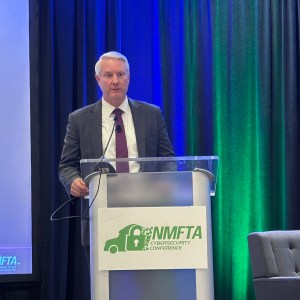
Jesse Elison, the deputy administrator at FMCSA, told the cybersecurity conference of the National Motor Freight Traffic Association here that “behind the scenes, there’s a lot of attention to timelines and schedules.”
In response to a question, he made his forecast that the user experience with Motus, the federal registration system operated by FMCSA, and whose rollout is generally seen in the market as bordering on disastrous, will be fixed in an unspecified number of weeks.
But as far as the back end of the Motus, Elison said bringing those features into a smooth operation “will be ongoing for some time.”
Elison said FMCSA under the direction of administrator Derek Barrs had more aggressively tackled bringing Motus on line than preceding administrations, even though the need to do so has been a “decade-long statutory obligation of FMCSA.” “It’s a huge challenge, but we were not going to punt that responsibility,” Elison said.
“The industry deserved that FMCSA followthrough, and so we went after it.” Elison said the launch on May 14 found the agency with a “high level of confidence” that the process would be successful.
But despite that, he said, “those following weeks were really really tough, because what we had built wasn’t working, and every time we tried to fix it, it worked less.” Elison said in the “last couple of months, we’ve made really great strides to stabilize it a little bit.” He added, however, “it is not where it needs to be.”
Motus needs to have “data that our industry can rely upon.” The user experience, which is what he said would be fixed in a timeline counted in weeks, “needs to be seamless for somebody to come into the system.” “We’re going to get there,” Elison added.
The most recent change in FMCSA policy in reaction to the issues with Motus was to temporarily suspend enforcing the registration for biennial updates and the concurrent deactivation of Department of Transportation numbers for carriers that had not completed that requirement. The break on registration was announced September 10.
It is in effect for carriers that had a requirement for biennial registration after June 1. Despite the issues with the system, Elison said “we’re much better off today than we were yesterday.” One of the benefits of Motus is expected to tighten a channel for entry into FMCSA records that are exploited by perpetrators of freight fraud.
“We know that it is a point of entry that we have to get right in order to combat the bad actors, and we’re going to do that,” Elison said.
More articles by John Kingston Another aspect of Montgomery: it might make human brokers more valuable Daimler Truck: concerned about using cash to avoid new NoX rules For transportation cybersecurity, AI isn’t helping fight.. so far The post FMCSA’s Elison: ‘weeks’ away from fixing Motus user experience appeared first on FreightWaves.
Verify your freight carriers' DOT numbers at safer.fmcsa.dot.gov -- any carrier with 'inactive' or pending biennial status is a compliance risk when the suspension ends.
In the next 30 days, ask your 3PL and freight brokers to confirm all carrier partners have resolved Motus registration to avoid shipment disruptions when FMCSA resumes enforcement.
Original Source
This briefing is based on reporting from Freightwaves. Use the original post for full primary-source context.
Style
Audience