

Kawasaki Engines USA grows B2B ecommerce sales AOV by 500%
For manufacturer Kawasaki Engines USA, growing B2B ecommerce sales in the past decade started with unifying data from legacy systems. Kawasaki Engines USA manufactures products tied to motorcycles, jet skis, robotics, aerospace and more. Anthony Gondick, senior manager of IT business strategy at Kawasaki Engines USA, explained how the manufacturer upgraded its B2B ecommerce experience […] The post Kawasaki Engines USA grows B2B ecommerce sales AOV by 500% appeared first on Digital Commerce 360.
Source Lens
Analyst Intelligence
Research or editorial analysis that adds market context beyond the official announcement.
Impact Level
medium
Use this briefing to decide whether your team needs an immediate workflow, policy, or reporting change.
Key Stat / Trigger
No single quantitative trigger surfaced in this report.
Focus on the operational implication, not just the headline.
Full Coverage
For manufacturer Kawasaki Engines USA, growing B2B ecommerce sales in the past decade started with unifying data from legacy systems. Kawasaki Engines USA manufactures products tied to motorcycles, jet skis, robotics, aerospace and more.
Anthony Gondick, senior manager of IT business strategy at Kawasaki Engines USA, explained how the manufacturer upgraded its B2B ecommerce experience and offerings. Gondick spoke in a session called “Drive Manufacturing Growth with AI-Powered B2B Commerce” at Salesforce Connections 2026 in Chicago in early June.
It focused on how Kawasaki Engines USA is using artificial intelligence (AI) to enhance customer experience, increase average order value (AOV) and revenue, and strengthen adoption among its customers.
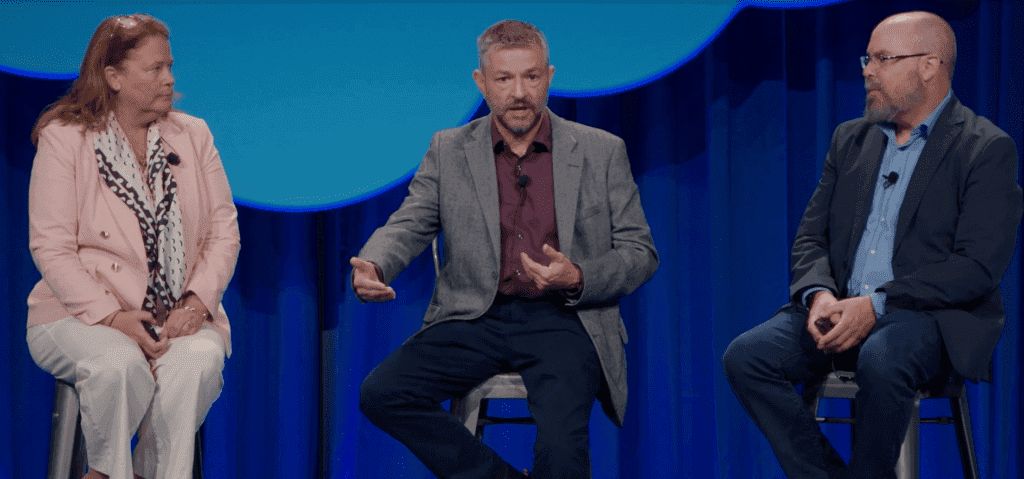
Anthony Gondick (center), senior manager of IT business strategy at Kawasaki Engines USA, speaks with Salesforce representatives Cynthia Turner and Tony Kratovil about how the manufacturer has grown its B2B ecommerce sales.
| Salesforce Plus video screenshot In the session, Gondick discussed the successes Kawasaki Engines USA experienced in its B2B ecommerce sales, including redesigning its portal for buyers. Since completing its B2B ecommerce portal redesign in November 2025, Kawasaki Engines USA has seen AOV “increase by 5x,” Gondick said.
He added that more customers are ordering, and they’re purchasing larger quantities of product. “We started in sales and service because we needed to have a way to gather all of our customer information,” Gondick said.
“We had the desire to centralize all of that because we were looking at legacy systems where this information was scattered all over the place. There was no centralization.” That situation led to complications. “There was no maintaining that information or administration,” he explained.
“It was filled with a lot of human error and a lot of unnecessary data — was not usable in a lot of situations for business processes.”
News Nippon Sanso Matheson unifies platforms in digital transformation process Abbas Haleem | Jun 5, 2026 Kawasaki Engines USA’s digital transformation journey Gondick said Kawasaki Engines USA began using Salesforce’s Manufacturing Cloud in 2019.
It then expanded its use of Salesforce in 2023 and 2024 before making its “commerce transformation” in 2024 and 2025. As of 2025, Kawasaki Engines USA is also using Agentforce AI Pilots. In the past eight years, Gondick said, Kawasaki Engines USA transitioned from what it called “disjoined legacy systems” into a unified, AI-powered platform.
The new platform supports real-time data exchange, smoother order processing and personalized customer interactions, according to the company. Kawasaki Engines USA also uses Salesforce’s MuleSoft and Heroku offerings. The manufacturer said those helped to modernize its operations and enhance its B2B ecommerce experience.
Gondick said Manufacturing Cloud “brought our OEM [eriginal equipment manufacturer] sales into the 21st century, off of legacy systems, onto a cloud technology, allowing them to do demand and forecast planning.” He said Kawasaki Engines USA tried using Salesforce’s commerce offering in 2020.
But “the B2B technology just wasn’t mature enough that we were able to connect to our ERP” (enterprise resource planning system) and system of record. Kawasaki Engines USA set that aside and gave Salesforce time and recommendations, he said. Those recommendations included what the manufacturer needed and how it could use the technology.
News Sonos elevates dealer experiences within B2B buyers' portal Abbas Haleem | Jun 4, 2026 How Kawasaki Engines USA grew B2B ecommerce sales Kawasaki Engines USA has about 40 different global divisions, Gondick said. Many of them operate separately. Gondick said the manufacturer had a choice of how it could approach connecting its various units.
“We could resort to the same CSV file exchange to get the data moving around,” he said. “Or we could use a more automated, 24/7-type of solution.” He referred to Salesforce offerings Process Builder, Flow and MuleSoft as tools that enabled smoother data exchange than what the manufacturer had before.
“As we talk to our OEMs, they all have different systems — different EDI and file exchanges,” Gondick said. “We can really tap into those very easily and have a reduction in error as we exchange data back and forth. But it’s more in real time. It’s less batch processing and near-real-time visibility into our business.”
Kawasaki Engines USA also has about 7,700 B2B customers across its dealer channel in the U. S. , according to Gondick. He said that doesn’t include exporters, distributors or resellers that operate on a global scale.
“It’s important for our customers, those B2B dealerships who have their own customers, to be able to trust and operate within the Kawasaki environment,” Gondick said. “If we cause them any type of pain or delay, that’s a delay in their revenue stream — in their profit. So we want to create tools that reduce or remove th
Original Source
This briefing is based on reporting from Digital Commerce 360. Use the original post for full primary-source context.
Style
Audience