

Best month in years marks broad US rail recovery
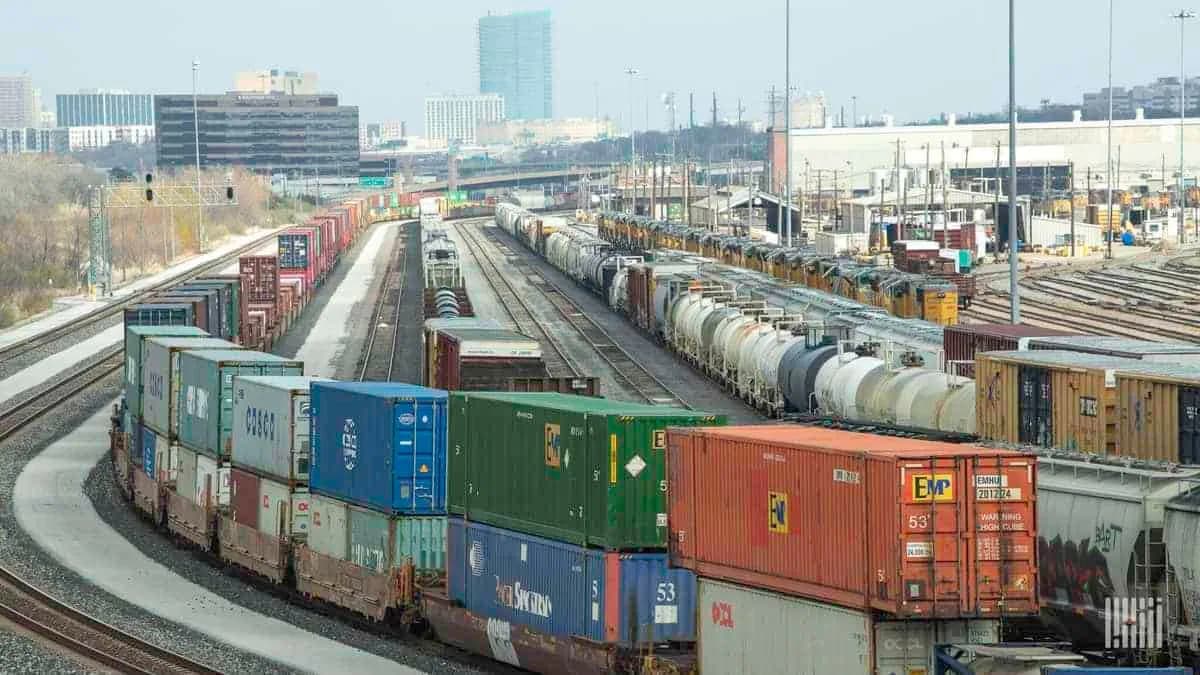
U.S. rail freight volumes hit their strongest March performance since 2019, with carloads up 1.7% year-over-year and intermodal traffic rising 1.4%. The broad recovery across 12 of 20 commodity categories signals sustained economic improvement after extended uneven performance.
Rising rail volumes indicate stronger domestic production and import flows, which could mean tighter inventory availability and longer lead times for popular categories. Monitor your key product categories' supply chain performance as this freight recovery may create capacity constraints.
This freight recovery reflects broader economic stabilization that could drive increased competition for shipping capacity and potentially higher logistics costs as demand normalizes post-pandemic.
Check inventory levels for grain-based, chemical, and petroleum-derived products -- these categories saw 5-12% rail volume increases indicating potential supply tightness.
Review Q2 inventory planning for any products dependent on intermodal shipping as capacity utilization increases with sustained freight recovery.
Bottom Line
Rail freight recovery signals supply chain tightening ahead.
Source Lens
Industry Context
Useful background context, but lower-priority than direct platform, community, or operator intelligence.
Impact Level
medium
Rail freight recovery signals supply chain tightening ahead.
Key Stat / Trigger
230,401 weekly rail carloads in March 2026
Focus on the operational implication, not just the headline.
Full Coverage
Data from U. S. railroads in March signaled that the goods economy is finding solid footing after an extended period of uneven performance. A broad recovery takes shape Analysis by the Association of American Railroads showed March 2026 delivered the strongest monthly performance for U. S. freight rail in years. Total U. S.
rail carloads averaged 230,401 per week, representing the highest March result since 2019 and the strongest monthly average since October 2022. Year-over-year, carloads rose 1. 7%, marking the third consecutive month of gains and extending a recovery trend that began at the start of the year. First quarter carloads reached 2. 68 million units, climbing 4.
2% from the same period a year ago. It’s the strongest first-quarter performance since 2019, suggesting that the improvement in rail volumes is not a temporary blip but rather a sustained shift in underlying economic activity.
Broad improvement saw 12 of the 20 major carload categories post year-over-year gains in March, continuing a pattern established in January.
This widespread improvement indicates that the goods economy is stabilizing across multiple sectors simultaneously, rather than experiencing isolated rebounds driven by temporary restocking or concentrated activity in a single industry. Intermodal traffic shows signs of stabilization Intermodal, linking U. S.
consumers and global supply chains, demonstrated renewed strength in March. Originations averaged 280,076 units per week, the second-highest March level on record and a 1. 4% increase y/y. It also was the second consecutive monthly increase for intermodal traffic after an extended lull.
While year-to-date intermodal volumes remain slightly below last year’s unusually strong levels, March’s improvement highlights the resilience of consumer-linked freight flows.
The intermodal network continues to play an essential role in long-haul domestic logistics, and the easing of downside pressure suggests that the extended normalization period following pandemic-era disruptions may finally be drawing to a close. Commodities showing strong growth Grain emerged as the single largest contributor to March’s volume growth. U. S.
railroads originated more than 97,000 carloads, a 10. 3% increase over March 2025. First-quarter volumes reached their highest level for any first quarter since 1993, driven by robust export demand and steady global consumption despite the off-and-on changes in U. S. tariff policy. Grain mill products climbed 6.
2%, with biofuel production playing a central role in driving grain processing, supporting rural investment and generating rail-dependent co-products that move over long distances. Chemical shipments continued to outperform, reaching a record weekly average of 35,580 carloads in March, up 5. 5% year-over-year.
First-quarter volumes set a new record as producers benefited from domestic natural gas prices that provide both energy and feedstock. As global manufacturers reassess their supply chain strategies, chemicals moving by rail point to sustained domestic production capacity and strong export demand. Petroleum and petroleum improved by 7.
7%; waste and nonferrous scrap recorded one of the strongest percentage gains at 12. 6%. Coke shipments similarly surged, increasing 12. 3%, while motor vehicles and parts added 2. 6%. Stone, clay, and glass products gained 2. 7%, and iron and steel scrap rose 2.
6%, continuing the steady transition toward electric-arc furnace steelmaking that relies more heavily on recycled inputs. Food products increased 1. 3%; lumber and wood products edged up 1. 4%, while farm products excluding grain gained 1. 3%. Commodities facing headwinds Not all categories shared in the recovery. Primary metal products declined 8.
7%, reflecting reduced long-haul movements tied to sharply lower steel imports rather than a fundamental deterioration in domestic industrial activity. Metallic ores fell 12% consistent with shifts in domestic steel production patterns. Crushed stone and sand declined 3. 8%; pulp and paper products retreated 4. 6%, and primary forest products dropped 6. 9%.
Carloads not elsewhere classified fell 3. 3% while nonmetallic minerals slipped 1. 9%. Coal remained the largest drag on total carloads but displayed signs of stabilization. March loadings totaled 236,000 carloads, down 1. 5% y/y. However, average weekly volumes reached their highest level in six months, and year-to-date coal volumes are actually up 3.
3% compared to the same period last year. Coal accounted for 16. 6% of U. S. electricity generation in 2025, and rail continues to move more than 70% of coal shipments. Core signal: Carloads excluding coal In March, carloads excluding coal averaged 171,338 per week, the strongest March level since 2008 and the highest monthly level since August 2019.
The year-over-year increase reached 2. 9%. Year-to-date volumes are up 4. 5% and stand at their highest level since 2015. These numbers point to genuine stabilization and renewed momentum, conditions
Original Source
This briefing is based on reporting from Freightwaves. Use the original post for full primary-source context.
Style
Audience