

Sustainability goals: New analysis shows 31% emissions gap between ocean carriers on same trade lane
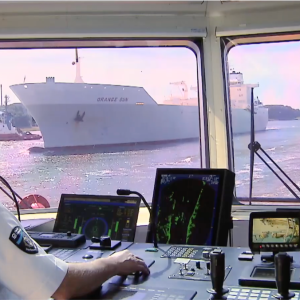
Global container shipping emissions intensity rose in Q2 but five of six vessel-size segments actually improved efficiency. The post Sustainability goals: New analysis shows 31% emissions gap between ocean carriers on same trade lane appeared first on FreightWaves.
Source Lens
Industry Context
Useful background context, but lower-priority than direct platform, community, or operator intelligence.
Impact Level
medium
Use this briefing to decide whether your team needs an immediate workflow, policy, or reporting change.
Key Stat / Trigger
No single quantitative trigger surfaced in this report.
Focus on the operational implication, not just the headline.
Full Coverage
Global container shipping’s average emissions intensity rose 1. 5% year over year in the second quarter of 2026, but that masked widespread efficiency gains across most vessel segments and stark operational differences between carriers running comparable services.
Athens-based VesselBot analyzed 86,389 voyages completed by 6,523 container vessels, finding that fleet-wide and trade-lane averages commonly used by shippers and regulators can obscure significant variations in individual voyage performance. Fleet-wide average worsens despite segment-level gains Overall Well-to-Wake emissions intensity climbed to 231.
7 grams of CO2 equivalent per TEU-kilometer in Q2 2026, up 1. 5% from the prior-year quarter. However, five of the six vessel-size categories tracked in the report posted efficiency improvements over the same period, ranging from a 0. 9% gain for Panamax vessels to a 10. 6% gain for Very Large Container Ships (VLCS).
Only feeder vessels, which accounted for 63. 9% of all Q2 voyages, became less efficient, and that single segment’s decline was sufficient to pull the fleet-wide average in the wrong direction.
“That is the risk of managing to an average: It can point you in the opposite direction of what is actually happening,” said Constantine Komodromos, chief executive and founder of VesselBot, in a release. Large ships do disproportionate work with fewer emissions The report highlighted the outsized role of mega-ships in global container trade.
Neo-Panamax and VLCS vessels ran just 7. 4% of all voyages in Q2 but generated 43. 5% of total transport work while accounting for only 27. 4% of emissions. Feeder and Panamax vessels showed the inverse pattern, operating 80% of voyages, generating just 26% of transport work, and producing 45. 6% of total emissions.
The report is based on AIS-tracked voyage data and VesselBot’s vessel-specific digital twin models, measuring Well-to-Wake emissions intensity at the individual voyage level rather than relying on carrier-reported averages or industry benchmarks.
The four major fronthaul trades — China/East Asia to Northern Europe, the Mediterranean, and the North America West Coast, plus Northern Europe to the North America East Coast — accounted for only 1. 2% of all Q2 voyages but generated 21. 7% of total quarterly transport work while producing just 12. 3% of emissions.
On the Northern Europe-North America East Coast trade, where the quarterly average Well-to-Wake emissions intensity reached 138 grams CO2e per TEU-km, Hapag-Lloyd and Mediterranean Shipping Co. outperformed the route average but with markedly different results. Hapag-Lloyd recorded an average emissions intensity of 80.
7 grams CO2e per TEU-km, 59% below the trade average, while MSC posted 117. 5 grams, 15% below. The comparison revealed a 31. 3% efficiency gap between the two carriers despite similar voyage distances and port pairs, highlighting how vessel deployment, utilization, and voyage execution drive emissions outcomes.
“A trade lane average tells a shipper what a route looks like on paper. It does not tell them what happened on their shipment,” Komodromos said. “Distance alone cannot explain that spread. The difference is in how those voyages were executed.”
Utilization emerges as key efficiency driver Vessel utilization emerged as one of the strongest predictors of voyage-level emissions intensity, the report found. Voyages in the most efficient emissions-intensity category averaged 80% utilization, compared to 31% for the least efficient. The most efficient voyages also carried close to 9,000 TEUs on average.
Read more articles by Stuart Chirls here.
Read more: Fuel, congestion push trans-Pacific ocean rates near $9,500 Jones Act service gets new 10-year port deal Maersk unfurls new sail power for container ship New data shows on-time container shipping suffers biggest drop in 5 years Port inspection leads to $10M counterfeit Nike, Adidas seizure in California The post Sustainability goals: New analysis shows 31% emissions gap between ocean carriers on same trade lane appeared first on FreightWaves.
Original Source
This briefing is based on reporting from Freightwaves. Use the original post for full primary-source context.
Style
Audience