First look: J.B. Hunt’s Q3 earnings
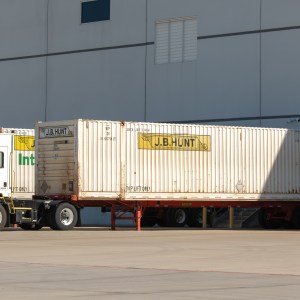
Following an earnings warning issued a month ago, J.B. Hunt Transport Services posted third-quarter results that modestly exceeded lowered analyst expectations. The post First look: J.B. Hunt’s Q3 earnings appeared first on FreightWaves.
Source Lens
Industry Context
Useful background context, but lower-priority than direct platform, community, or operator intelligence.
Impact Level
medium
Use this briefing to decide whether your team needs an immediate workflow, policy, or reporting change.
Key Stat / Trigger
No single quantitative trigger surfaced in this report.
Focus on the operational implication, not just the headline.
Full Coverage
J. B. Hunt Transport Services’ third quarter slightly surpassed analysts’ lowered expectations following the company’s earnings warning issued in September. J. B. Hunt (NASDAQ: JBHT) reported third-quarter revenue of $3. 68 billion Thursday after the market closed. The result was ahead of a $3. 59 billion consensus estimate. Earnings per share of $1.
82 were 1 cent higher than analysts’ revised expectations. (A higher tax rate was a 4-cent EPS headwind in the quarter, partially offset by a 2-cent decline in net interest expense.) Click for full report: “J. B.
Hunt experiences growing pains in Q3” The result was slightly better than its September update, calling for a 5% to 10% sequential decline in EPS, implying $1. 77 at the midpoint of the range.
At the time, the company flagged near-term cost pressures—a sharp runup in diesel prices ($10 million), driver-related costs ($25 million) and elevated cargo claims ($10 million)—as headwinds. The actual impact in the quarter was over $50 million. The third quarter marked a fifth straight quarter of year-over-year improvement in operating income and EPS.
The company’s earnings turnaround started in the 2025 third quarter, well ahead of peers. Table: J. B. Hunt’s key performance indicators Intermodal revenue increased 20% y/y to $1. 83 billion as loads were up 8% and revenue per load increased 11%. Higher fuel prices pushed revenue higher in the period. Excluding fuel, revenue per load was up 2% y/y.
Volumes increased 18% y/y in the East and 1% on transcontinental lanes. A 3% decline in length of haul, due to a mix shift to the East, was a modest headwind to revenue per load. The unit booked a 91. 9% operating ratio (inverse of operating margin), which was 15 basis points worse y/y.
Higher costs (driver personnel, equipment and employee benefits) were a drag in the quarter. The dedicated OR deteriorated 360 bps y/y to 91. 5%. Revenue was up 11% y/y, almost entirely due to higher revenue per truck per week (inclusive of fuel). Revenue per truck was up just 3% excluding fuel.
Average trailers in service increased 11% even though load counts grew just 3%. Higher driver costs, group medical claims, insurance premiums and new account startup costs were among the culprits. Click for full report: “J. B. Hunt experiences growing pains in Q3” The brokerage unit booked a second straight operating profit after 13 quarters in the red.
The company’s asset-light truckload unit swung to a $7-million operating profit after a modest second-quarter loss. Shares of JBHT were down 2. 4% in after-hours trading on Thursday. The stock fell 14% from its mid-September earnings update to the Thursday close. J. B. Hunt will host a call at 5 p. m. EDT on Thursday to discuss third-quarter results.
Why it matters? J. B. Hunt’s quarterly results serve as a bellwether for the intermodal, trucking and logistics industries. The company’s third quarter was a modest slowdown after four quarters of strong recovery. However, some of the incremental costs that plagued the period were likely transitory in nature.
More FreightWaves articles by Todd Maiden: LTL rates hit new high in Q3, moving higher in Q4 Cass: TL linehaul rates up 10% in September, shipment counts remain positive Yellow Corp. , Teamsters settle on WARN Act claims The post First look: J. B. Hunt’s Q3 earnings appeared first on FreightWaves.
Original Source
This briefing is based on reporting from Freightwaves. Use the original post for full primary-source context.
Style
Audience