
Pros and cons of selling on Etsy: What No One Tells You Before You Start Selling
Every week, someone opens an Etsy shop full of optimism and closes it six months later without analyzing the pros and cons of selling on Etsy. And every week, someone else quietly crosses $10,000 in monthly revenue by selling in the same profitable Etsy categories because they know the Etsy pros and cons list. Contrary… The post Pros and cons of selling on Etsy: What No One Tells You Before You Start Selling appeared first on SellerApp Blog.
Source Lens
Industry Context
Useful background context, but lower-priority than direct platform, community, or operator intelligence.
Impact Level
medium
Use this briefing to decide whether your team needs an immediate workflow, policy, or reporting change.
Key Stat / Trigger
No single quantitative trigger surfaced in this report.
Focus on the operational implication, not just the headline.
Full Coverage
Every week, someone opens an Etsy shop full of optimism and closes it six months later without analyzing the pros and cons of selling on Etsy. And every week, someone else quietly crosses $10,000 in monthly revenue by selling in the same profitable Etsy categories because they know the Etsy pros and cons list.
Contrary to popular belief, the difference is not negligible and almost never comes down to luck or product quality. It comes down to whether the seller understood the game they were playing before they started. This guide is for sellers who want to know what selling on Etsy pros and cons include.
Not the version that hypes Etsy up, not the one that tears it apart, but the unfiltered version based on our clients’ experience that tells you what’s actually true, what the real trade-offs are, and what experienced sellers know that first-timers usually find out the hard way.
Quick Guide The Pros of Selling on Etsy The Cons of Selling on Etsy What Our Clients Wish They’d Known Before They Began Selling on Etsy Best Tips Before You Open Your Etsy Shop Final thoughts: So, is selling on Etsy worth it? The Pros of Selling on Etsy Let us begin with the pros and cons of selling on Etsy.
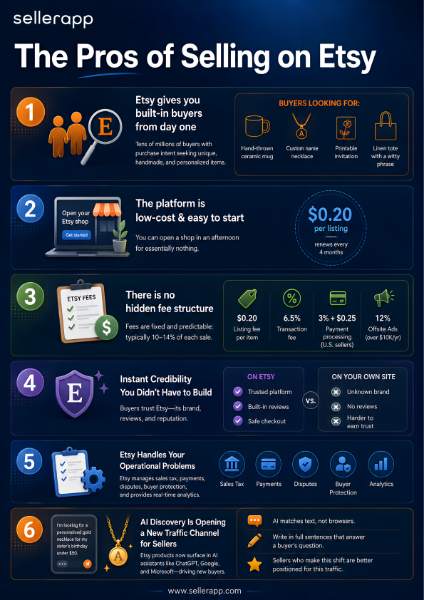
Here are the six pros that you need to know before you start selling: 1. Etsy gives you built-in buyers from day one This is the biggest reason sellers choose Etsy, and it holds up. Building your own Shopify store, running Google Ads from scratch, and growing Instagram from zero, those paths work, but they take months before you see consistent sales.
Etsy puts you in front of tens of millions of buyers immediately. But here’s what makes Etsy different from Amazon, eBay, or any other marketplace with a built-in audience: the type of buyer. Etsy buyers aren’t price-comparison shopping. They’re looking for a hand-thrown ceramic mug that doesn’t look factory-made. A custom name necklace in 14k gold-fill.
A printable birthday invitation with a specific aesthetic they’ve been searching for. A linen tote with a witty phrase that actually makes them laugh. These are buyers with purchase intent that’s hard to manufacture elsewhere. They leave detailed reviews, they come back, and they tell their friends. Amazon gives you volume.
Etsy gives you the right kind of customer to build a brand around, and that’s a meaningful difference. 2. The platform is low-cost & easy to start You can open an Etsy shop in an afternoon for essentially nothing. The listing fee is $0. 20 per item with no monthly subscription required.
Compared to building a website from scratch, including domain, hosting, design, and payment setup, Etsy is the clear winner for anyone starting on a tight budget or someone with commitment issues. The setup is guided from start to finish. You don’t need much technical knowledge.
For makers who’d rather spend their time in the studio than in a website backend, that simple entry matters. 3. There is no hidden fee structure Here’s the thing about Etsy’s fees: they’re not hidden, but they’re not front-and-center either. Many sellers open a shop without realizing the 6. 5% transaction fee. Here’s the full picture: Listing fee: $0.
20 per item; renews every 4 months Transaction fee: 6. 5% of the total sale price, including shipping Payment processing: 3% + $0. 25 per transaction (U. S. sellers) Etsy Plus (optional): $10/month Offsite Ads: 12% on resulting sales, mandatory once you earn over $10,000/year Add it all up, and you’re typically handing over 10–14% per sale to Etsy.
That’s higher than it used to be; the transaction fee jumped from 5% to 6. 5% in 2022. But it’s still under Amazon Handmade’s 15% referral fee. The real advantage here is predictability. Unlike running paid ads with variable ROI or building a site with unpredictable hosting costs, Etsy’s fee structure is fixed.
You can build it into your pricing from day one and know exactly what you’re working with. One thing to watch is that the $0. 20 listing fee looks trivial on a small catalog. On a catalog of 500+ SKUs, it stacks up fast: $100 every four months just to keep listings live, before a single sale.
If you’re planning to scale your catalog significantly, factor this in early. 4. Instant Credibility You Didn’t Have to Build When a buyer lands on your Etsy shop, they’re already on a platform they trust. Etsy has spent years on brand recognition, national ad campaigns, a clear identity, and a reputation for real makers selling real things.
New sellers inherit all of that trust on day one. You don’t have to convince a stranger that your checkout is safe or that you’ll actually ship the order. Compare that to a brand-new standalone website with zero reviews. Getting someone to hand over their card information to a site they’ve never heard of is genuinely hard.
On Etsy, that barrier is already gone. 5. Etsy Handles Your Operational Problems By operational problems, we mean sales tax calculation, payment processing, dispute resolution, and buyer protection. Etsy manages all of it.
Original Source
This briefing is based on reporting from SellerApp Blog. Use the original post for full primary-source context.
Style
Audience