
What AWS's chief AI and technology officer told employees about the future of AI
At the AWS Global Meeting, Matt Wood drew a parallel between AI today and cloud's early days—and brought a live demo to prove the future is already here.
Source Lens
Official Platform Update
Direct platform communication. Highest-value for policy, product, and operational changes.
Impact Level
medium
Use this briefing to decide whether your team needs an immediate workflow, policy, or reporting change.
Key Stat / Trigger
No single quantitative trigger surfaced in this report.
Focus on the operational implication, not just the headline.
Full Coverage
Key takeaways AWS is building the foundational tools for AI the same way it built them for cloud computing. Odyssey unveiled Agora-2, an AI that simulates shared worlds with no game engine. From world models to code synthesis, frontier startups are building on AWS Trainium.
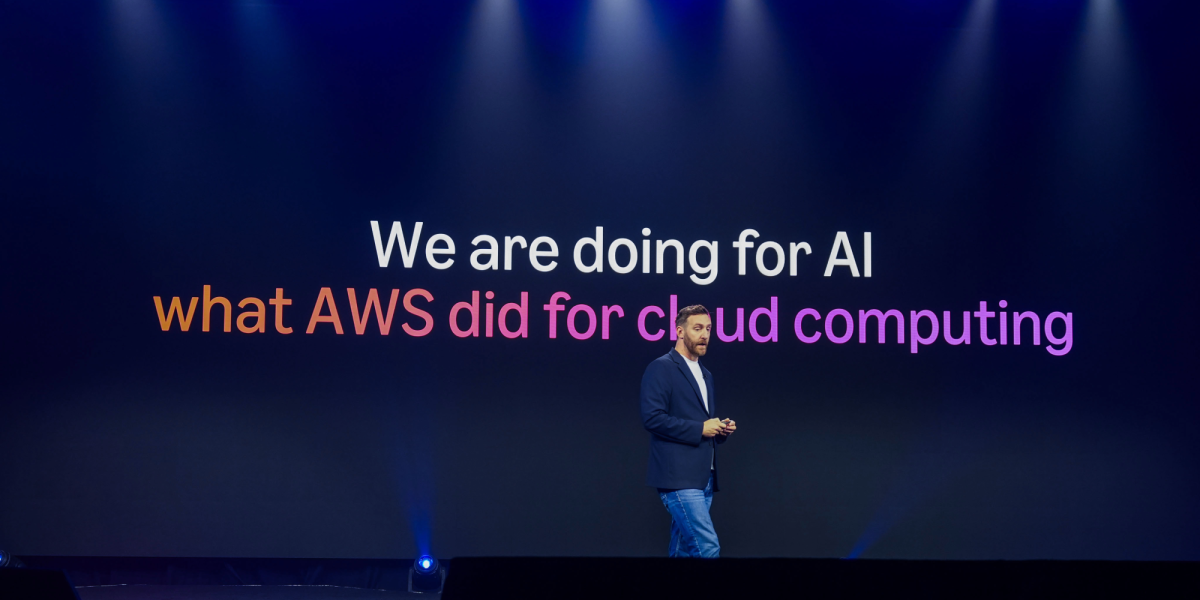
At the AWS Global Meeting on September 17, AWS Chief AI and Technology Officer Matt Wood laid out a vision for where AI is heading—and brought a live demo on stage to prove it’s already arriving.
“What we are doing today at AWS for AI is exactly what we did for cloud computing, to make this technology broadly distributed and democratized for everybody,” Wood told the audience. Then he named the building blocks: Trainium for compute, Bedrock for inference, AgentCore for agents—and brought the startups already building on them to prove it.
How the next generation of AI researchers is using Amazon chips to accelerate discovery University researchers are using Amazon’s Trainium chip to push the boundaries of their work—and making the chip better for all developers in the process.
A startup demonstrates its most realistic world simulator yet The centerpiece of the meeting was a live demonstration from Odyssey, a startup building foundation world models—a new kind of AI that learns physics by watching massive amounts of video rather than relying on hand-coded rules.
“A language model learns to predict the next most likely word in a sentence. A world model learns to predict the next most likely future of a world,” explained Oliver Cameron, CEO of Odyssey.
World models learn how the world works—from physics and cause-and-effect to human behavior—providing a foundational intelligence that can be applied across many industries.
A world model draws on extensive learned knowledge of the world to automate physical systems, train AIs in interactive environments, and much more across robotics, autonomous driving, science, healthcare, education, gaming, defense, energy, and beyond.
AWS commits more than $500 million to student cloud and AI training Through a new Student Rewards program on AWS Builder Center, university students worldwide can earn credits, premium training, and certification vouchers. On stage Cameron introduced Odyssey-3, Odyssey's most advanced foundation world model yet, which is trained and runs on Trainium3.
Odyssey-3 is trained on vast observations of the world, giving it a learned grasp of physics, cause-and-effect, and human behavior. The same model can control robots, power humanoids, drive vehicles, pilot drones, train other AIs, and play video games.
Because Odyssey-3 already understands how the world works, it can learn new tasks quickly, with far less task-specific data than previous systems. Additionally, Cameron unveiled Agora-2, a multi-agent world model—the first to hold multiple intelligences inside the same simulated world at the same time.
Cameron and Wood each picked up controllers and entered Agora-2 in real time. The audience watched on a split screen as both navigated, interacted, and fought within the same AI-generated environment, each from their own perspective. Agora-2 supports up to 20 participants in a single simulation, with no game engine underneath.
Cameron, who spent a decade working on autonomous vehicles before founding Odyssey, said the implications go well beyond gaming. “I believe we are on the cusp of a GPT-3 moment for world models,” he said. “This is the moment where we see an explosion of applications for world models, and their adoption into every industry imaginable.”
OpenClaw creator Peter Steinberger on AI's next chapter The meeting also featured a fireside chat between Peter Steinberger, the creator of OpenClaw and now at OpenAI, and AWS Vice President Francesca Vasquez.
Steinberger discussed how the tools and infrastructure available to AI developers are evolving, a conversation that underscored Wood's broader argument that the biggest names in AI are building on and alongside AWS. Steinberger has become one of open source's biggest recent success stories.
His OpenClaw project, which Vasquez called "the fastest growing open source project in GitHub history," has drawn more than 388,000 GitHub stars and 3. 2 million active users. The bigger shift, he argued, is in how software itself gets built. "It's no longer 'I write code.' It's more, how can I design a system so my agent can do its best work?"
As he put it, "We're all moving a little bit up the ladder. We're not just coders anymore." Millions of students can now get access to a free year of Kiro from AWS AWS is giving students at 132 universities across 18 countries a full year of free access to Kiro, so they enter the workforce ready to build with AI from day one.
Why frontier AI startups are choosing AWS Trainium A common thread across the meeting was the role of AWS Trainium in powering frontier AI workloads that demand sustained compute over weeks—a prof
Original Source
This briefing is based on reporting from About Amazon. Use the original post for full primary-source context.
Style
Audience