

Amazon’s LTL gap has a name: Forward Air
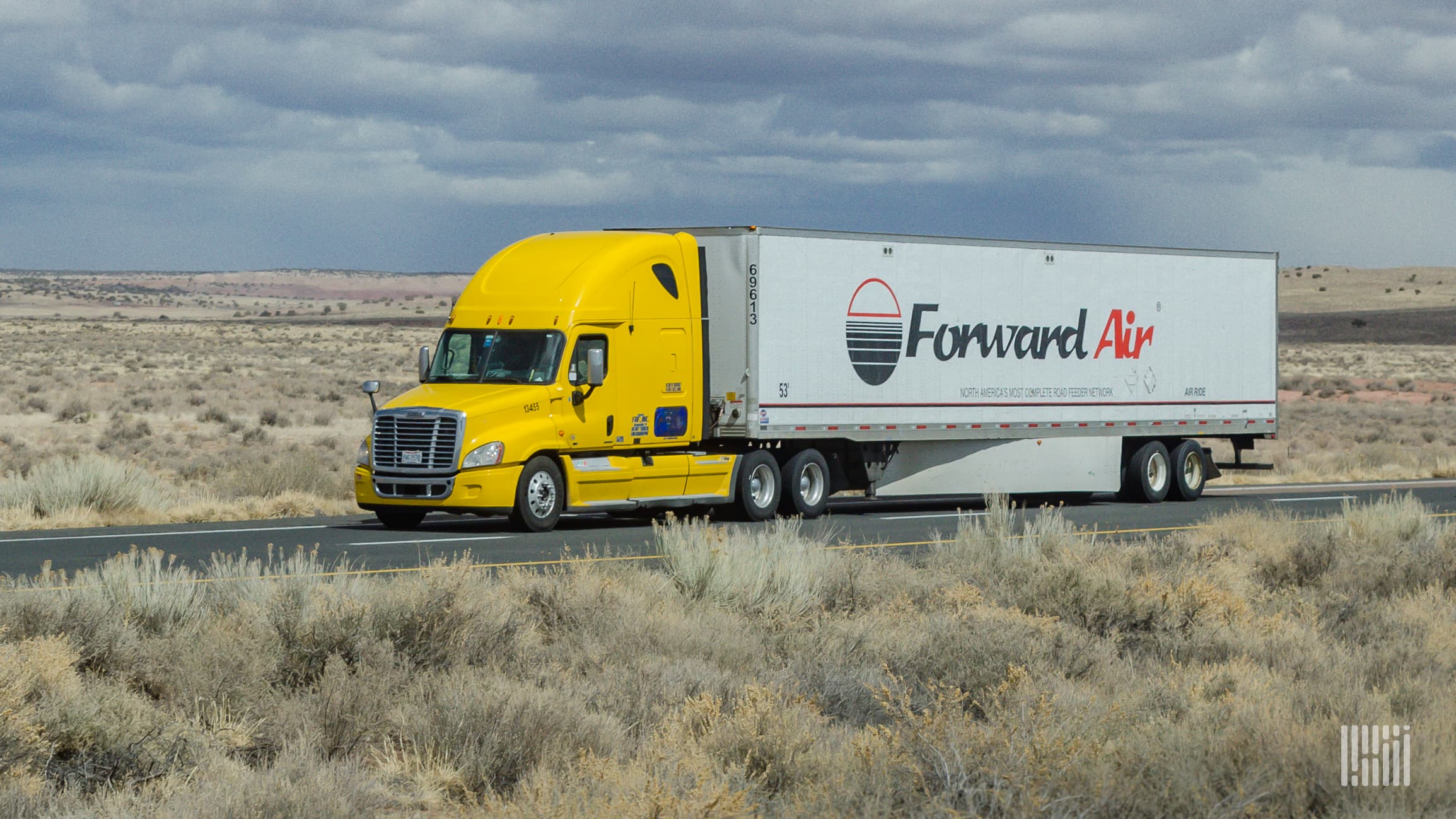
The fastest way for Amazon to add a premium expedited tier to its new national LTL network is to buy the one carrier already built for it — and already on the auction block Amazon (NASDAQ: AMZN) opened its less-than-truckload network to all businesses this week, and the market reaction was muted. Shares of the […] The post Amazon’s LTL gap has a name: Forward Air appeared first on FreightWaves.
Source Lens
Industry Context
Useful background context, but lower-priority than direct platform, community, or operator intelligence.
Impact Level
medium
Use this briefing to decide whether your team needs an immediate workflow, policy, or reporting change.
Key Stat / Trigger
No single quantitative trigger surfaced in this report.
Focus on the operational implication, not just the headline.
Full Coverage
The fastest way for Amazon to add a premium expedited tier to its new national LTL network is to buy the one carrier already built for it — and already on the auction block Amazon (NASDAQ: AMZN) opened its less-than-truckload network to all businesses this week, and the market reaction was muted.
Shares of the publicly traded LTL carriers slipped about 5% on the day — a modest move for a group that has run more than 60% year to date — and the analyst notes that followed were, with one exception, reassuring to incumbents.
The consensus read: this is a strong economy-tier offering, but not yet a hub-and-spoke carrier in the mold of Old Dominion (NASDAQ: ODFL) or FedEx Freight (NYSE: FDFX). That consensus is right about where Amazon’s network stands today. It misses where Amazon could take it next.
The launch gives Amazon a real national economy LTL platform; what it doesn’t yet include is a premium expedited tier on top. The fastest way to add one is a company that is mid-strategic review, trading at a depressed equity value, with a motivated seller: Forward Air (NASDAQ: FWRD).
What Amazon actually rolled out Amazon’s new LTL service is purpose-built for one part of the market. The expanded offering covers shipments of one to six pallets — 150 to 15,000 pounds — picked up, transferred at a nearby terminal, and delivered intact at what Amazon pitches as a lower cost than legacy carriers.
It runs on an asset-light model across roughly 30 terminals stitched into a package-delivery network, with real density in the Eastern U. S. and a growing set of Western metros. For the economy, cost-sensitive end of LTL, that’s a credible national entry on day one. window. googletag = window. googletag || {cmd: []}; googletag. cmd.
push(function() {googletag. defineSlot('/21776187881/FW-Responsive-Main_Content-Slot1', [[300, 100], [320, 50], [728, 90], [468, 60]], 'div-gpt-ad-1709668545404-0'). defineSizeMapping(gptSizeMaps. banner1). addService(googletag. pubads()); googletag. pubads(). enableSingleRequest(); googletag. pubads(). collapseEmptyDivs(); googletag.
enableServices(); }); googletag. cmd. push(function() {googletag. display('div-gpt-ad-1709668545404-0'); }); What it isn’t yet is a premium expedited network. A full national LTL carrier runs 200 to 300 service centers reaching nearly every U. S. ZIP code; FedEx Freight alone operates a 365-terminal network.
Amazon’s 30-terminal footprint is the right size for where it’s competing today, and the analyst community read it that way. Deutsche Bank’s Richa Harnain told investors Amazon’s footprint isn’t yet that of a “formidable full-fledged nationwide asset-based operator,” and characterized the current service as more akin to what brokers offer.
TD Cowen’s Jason Seidl, pointing to Amazon’s reliance on an intermodal container pool, argued the offering will mostly compete in the economy three-to-four-day sub-segment and take share “on the margins.” Those are observations about the entry point, not the ceiling. One analyst dissented.
Morgan Stanley’s Ravi Shanker warned that even an asset-light model could be a disruptor, because Amazon “has repeatedly demonstrated an ability to gain traction in transportation markets through a flexible and iterative operating model” — potentially capturing meaningful share even without best-in-class service, and striking at the real-estate-and-service “moat” that anchors the entire LTL bull thesis.
Shanker is right about the ambition and the iterative playbook. The question is just timing.
Building the expedited tier organically — a national network of cross-dock terminals, a fleet with multiple truck and trailer types, and the dock-and-linehaul optimization that separates the best carriers from the rest — is a multiyear undertaking even for Amazon, because legacy carriers have spent decades reinvesting service into a flywheel: better service drives better yields, which fund better service.
Amazon can build it. The faster move is to buy a flywheel that’s already spinning. You don’t out-iterate a decades-long flywheel. You buy one. Why expedited is the right tier — and why Forward Air owns it The “Amazon won’t shake LTL — yet” framing misses a key point. Amazon doesn’t need to win the whole $60 billion LTL market.
It needs to win the tier where its existing advantages — visibility, technology, reliability, density of demand — compound fastest. Amazon’s own pitch leans entirely on those attributes: real-time GPS tracking, automated appointment scheduling, electronic proof of delivery, a sensor-equipped fleet.
Director of Amazon Freight Jim Ruiz framed the entire launch around closing the gap between LTL and the reliability and visibility shippers already get on full-truckload moves. That is, almost word for word, the value proposition of expedited LTL — time-definite, high-intact-rate, premium-service freight.
And the purest national expedited LTL franchise in the market is Forward Air. Forward built its network airport-to-airport, serving the time-sensitiv
Original Source
This briefing is based on reporting from Freightwaves. Use the original post for full primary-source context.
Style
Audience