86% of UK manufacturers say AI is essential for customer growth
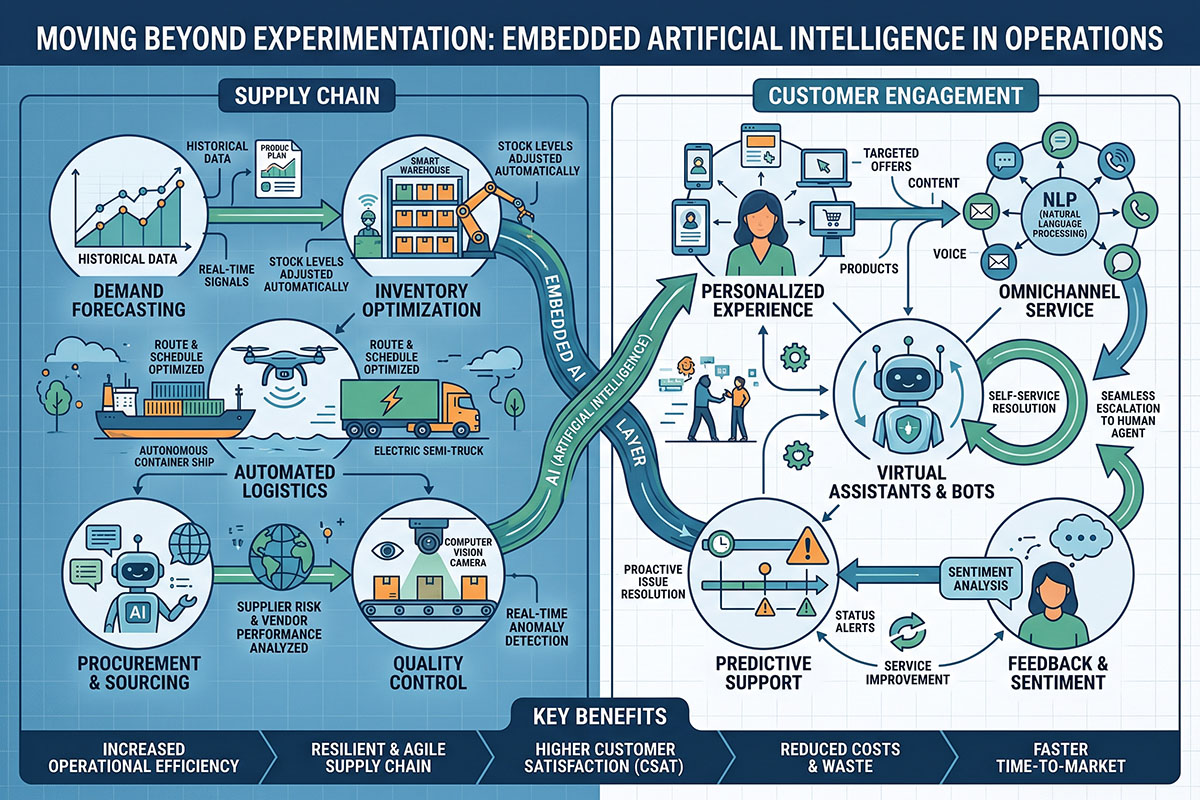
Insights from SAP’s 2026 Engagement Index reveal that 86% of manufacturing decision makers believe AI will be essential for acquiring and retaining customers over the next year. Having invested accordingly, more than four in five (82%) manufacturers now report that AI is embedded into business workflows rather than operating as a standalone solution. The same proportion (82%) say AI is increasing […]
Source Lens
Industry Context
Useful background context, but lower-priority than direct platform, community, or operator intelligence.
Impact Level
medium
Use this briefing to decide whether your team needs an immediate workflow, policy, or reporting change.
Key Stat / Trigger
No single quantitative trigger surfaced in this report.
Focus on the operational implication, not just the headline.
Full Coverage
Insights from SAP’s 2026 Engagement Index reveal that 86% of manufacturing decision makers believe AI will be essential for acquiring and retaining customers over the next year. Having invested accordingly, more than four in five (82%) manufacturers now report that AI is embedded into business workflows rather than operating as a standalone solution.
The same proportion (82%) say AI is increasing human productivity without reducing human control, suggesting manufacturers are accelerating from isolated AI initiatives towards enterprise-wide adoption. The findings also highlight a growing competitive advantage for organisations able to connect customer and operational data across the business.
With AI increasingly dependent on real-time context, manufacturers are using connected data to turn insights into actions that improve both customer engagement and operational performance. Manufacturers depend upon thousands of micro-signals every day, from inventory updates to fulfilment and service interactions.
When trusted data is connected across an organisation, customer engagement becomes an integral part of how the business operates, rather than something that sits alongside it.
When AI understands context and what’s happening across the entire business, insight turns into action, enabling every interaction to become more personal, relevant and grounded in what the business can actually deliver.
– Sara Richter, CMO, SAP Engagement Cloud Cybersecurity concerns remain, but adoption continues While 40% of manufacturers identify cybersecurity and privacy as the biggest barrier to scaling AI, the research suggests organisations are establishing the governance frameworks needed to move forward with confidence.
More than four in five decision makers (82%) say their organisations have established clear AI guardrails covering data lineage, personally identifiable information (PII) and human approval points.
Despite ongoing concerns around security and compliance, manufacturers continue to accelerate AI adoption, indicating growing confidence in their ability to govern AI responsibly while realising its business value.
This balance between innovation and governance is helping organisations move beyond isolated AI pilots and towards AI embedded across day-to-day operations. As a result, businesses are gaining greater confidence to automate repetitive tasks while maintaining accountability for business-critical decisions. For manufacturers, this is particularly significant.
Every personalised customer experience begins long before a customer places an order, relying on accurate production schedules, inventory availability, supplier coordination and fulfilment. As AI becomes more deeply embedded across the enterprise, the ability to connect these operational signals with customer data is becoming increasingly important.
Companies such as DAW, Europe’s largest privately owned manufacturer of paints for the construction industry and thermal insulation materials, recognise that the ability to connect operational and customer data is becoming a competitive advantage.
As part of its customer engagement transformation, DAW set out to unify fragmented data sources, create a 360-degree view of customers and establish a foundation for future AI-driven products, services and decision-making.
We wanted to tailor our offering to the needs of different professional target groups, and to design the digital customer experience for painters in such a way that they are supported in their everyday lives. In order to further develop our product and service offering in a targeted manner, we had to make better use of our data sets.
– Alexander Kuhl, Head of Data, DAW In manufacturing and beyond, the principle is the same. Organisations often think about AI first, but competitive advantage starts with connected data.
When AI has access to trusted, real-time information across the enterprise, businesses can move beyond isolated marketing activity and towards meaningful, coordinated engagement across every customer touchpoint. – Sara Richter, CMO, SAP Engagement Cloud
Original Source
This briefing is based on reporting from Tamebay. Use the original post for full primary-source context.
Style
Audience