

Operation Safe Driver Week Hits July 12. The Ticket You Get That Week Follows You Long After the Week Is Over.
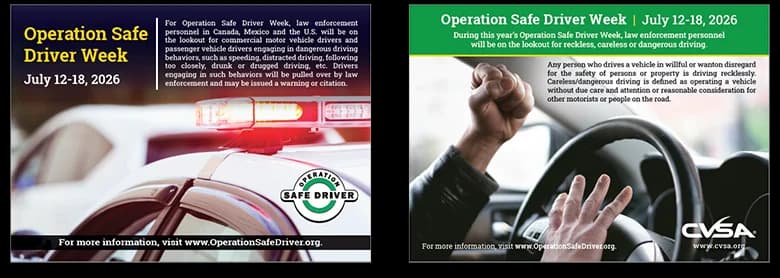
From July 12 to July 18, 2026, the Commercial Vehicle Safety Alliance runs Operation Safe Driver Week across the United States, Canada, and Mexico, and for those seven days the number of officers watching for unsafe driving goes up sharply. CVSA announced the dates and the focus on April 30. The official area of emphasis […] The post Operation Safe Driver Week Hits July 12. The Ticket You Get That Week Follows You Long After the Week Is Over. appeared first on FreightWaves.
Source Lens
Industry Context
Useful background context, but lower-priority than direct platform, community, or operator intelligence.
Impact Level
medium
Use this briefing to decide whether your team needs an immediate workflow, policy, or reporting change.
Key Stat / Trigger
No single quantitative trigger surfaced in this report.
Focus on the operational implication, not just the headline.
Full Coverage
From July 12 to July 18, 2026, the Commercial Vehicle Safety Alliance runs Operation Safe Driver Week across the United States, Canada, and Mexico, and for those seven days the number of officers watching for unsafe driving goes up sharply. CVSA announced the dates and the focus on April 30.
The official area of emphasis for 2026 is reckless, careless, or dangerous driving, the third consecutive year the alliance has chosen that theme. If you run a truck for a living, the right way to think about this week is not as a test you cram for.
It is a checkpoint that briefly makes visible something that is true every single week of the year: the way you drive generates a record, and that record follows you. The operators who come out of Safe Driver Week clean are not the ones who drove carefully for seven days.
They are the ones who drive that way all the time, because the behaviors officers are looking for in July are the same ones that quietly run up CSA scores, insurance rates, and inspection exposure in every other month. What “Reckless and Careless” Actually Means at the Roadside CVSA defines its focus precisely.
Reckless driving is operating a vehicle in willful or wanton disregard for the safety of people or property, the most serious of the three because the behavior is treated as intentional. Careless or dangerous driving is operating without proper attention or reasonable consideration for others, and unlike reckless driving it does not require intent.
Inattention or distraction is enough. Here is the part that matters for how the week actually plays out, and it is the single most useful thing to understand about Safe Driver Week. Officers rarely write a ticket that says “reckless driving,” because reckless driving is a judgment call that is hard to charge cleanly at the roadside.
Look at what the enforcement actually produced last year. During the 2025 campaign, officers in the U. S. and Canada stopped 8,739 vehicles and issued 2,504 citations and 3,575 warnings.
The official focus area that year was the same as this year, reckless and careless driving, and that specific category produced only 20 citations and 53 warnings across the entire continent over seven days. Speeding, by contrast, produced 917 citations and 1,249 warnings, making it the top infraction by a wide margin.
Commercial drivers picked up another 79 citations and 107 warnings for texting or handheld device use, and 248 citations and 204 warnings for failing to wear a seat belt. None of those fall under the “reckless driving” line in the report. In practice, all of them are the focus area. The reckless, careless, and dangerous theme is the banner.
Speeding, distraction, following too close, and no seat belt are the tickets. That distinction is the whole game. If you brace for Safe Driver Week by telling yourself you are not a reckless driver, you are watching for the violation officers almost never write.
The behaviors that actually generate citations are the small, everyday ones that a driver in a hurry commits without thinking, and those are exactly the ones a clean operator has already trained out of the cab.
The Tickets Officers Will Be Writing The full list of behaviors CVSA has named for enforcement this week is worth knowing plainly, because each one is both a roadside citation and a CSA data point.
Officers across North America will be watching for speeding, distracted driving, following too closely, improper or unsafe lane changes, failure to wear a seat belt, fatigued or drowsy driving, impaired driving, and disregarding traffic control signals. The reason CVSA keeps returning to these specific behaviors is in the crash data.
Speeding was a factor in 11,288 U. S. traffic deaths in 2024, about 29% of all roadway fatalities. Distracted driving killed 3,208 people that year. Nearly half of the passenger vehicle occupants killed in 2024 were not wearing seat belts. The U. S. recorded 36,640 traffic fatalities in 2025.
CVSA’s position, backed by federal data, is that driver behavior contributes to roughly 94% of all crashes, which is why the program targets the driver rather than the equipment.
This is the one CVSA enforcement week that is about how you drive, not what you are driving, which makes it fundamentally different from Brake Safety Week or International Roadcheck. Why a Safe Driver Week Ticket Outlasts the Week The reason this matters well beyond seven days in July is the Safety Measurement System.
A citation written during Safe Driver Week does not stay contained to that week. Driver-side violations feed the Unsafe Driving BASIC in FMCSA’s Safety Measurement System, and that score shapes how often your trucks get pulled in for inspection going forward. This is the compounding mechanism that owner-operators and small fleets cannot afford to ignore.
A speeding ticket in July is not a one-time cost of the fine. It is a data point that raises your Unsafe Driving score, which increases the probability that the system flags you fo
Original Source
This briefing is based on reporting from Freightwaves. Use the original post for full primary-source context.
Style
Audience