Pump price is trucking’s #1 concern: ATRI survey
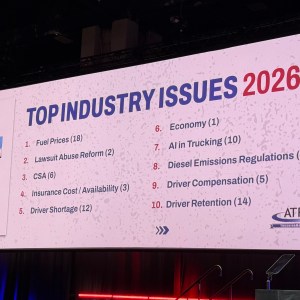
Diesel hit a record $6.529/gallon in September 2026, making fuel prices the #1 concern in trucking's ATRI survey for the first time since 2022. Carriers confirm fuel surcharges aren't fully offsetting costs, signaling freight rates and shipping costs are rising.
This fits the ongoing margin compression trend hitting marketplace sellers from multiple sides — rising ad costs, platform fees, and now freight. Brands without locked-in carrier rates heading into Q4 are most exposed.
When carriers absorb fuel pain despite surcharges, they pass costs downstream through rate hikes, slower capacity, and tighter lane coverage — squeezing seller margins on inbound and outbound freight. Audit your 3PL and carrier contracts now for fuel surcharge caps before Q4 peak pricing locks in.
Operational Impact
This story may require teams to revisit workflows, monitoring, or platform assumptions.
Bottom Line
Record diesel at $6.53/gal means higher inbound freight costs for sellers this Q4.
Source Lens
Industry Context
Useful background context, but lower-priority than direct platform, community, or operator intelligence.
Impact Level
medium
Record diesel at $6.53/gal means higher inbound freight costs for sellers this Q4.
Key Stat / Trigger
Record diesel price of $6.529/gallon on September 22, 2026
Focus on the operational implication, not just the headline.
Full Coverage
This year’s study of the top issues facing trucking undertaken by the American Transportation Research Institute (ATRI) had a number one concern that didn’t even crack the top 10 in the prior two years: fuel prices. That issue was number one in the responses submitted by drivers and number two for carriers, finishing in the top slot overall.
The carriers’ rating is particularly notable, because it undercuts the idea that fuel surcharges are able to effectively move the cost of fuel on to the shipper with little impact on the carrier, or that higher prices and the fuel surcharges that come with are a positive for carriers. The results in the survey suggest otherwise, at least to some degree.
window. googletag = window. googletag || {cmd: []}; googletag. cmd. push(function() {var gptSlot = googletag. defineSlot('/21776187881/FW-Responsive-Main_Content-Slot1', [[300, 100], [320, 50], [728, 90], [468, 60]], 'div-gpt-ad-1709668545404-0'). defineSizeMapping(gptSizeMaps. banner1). addService(googletag. pubads()); googletag. pubads().
enableSingleRequest(); googletag. pubads(). collapseEmptyDivs(); googletag. enableServices(); setInterval(function() {if (! document. hidden) {googletag. pubads(). refresh([gptSlot]); } }, 60000); }); googletag. cmd. push(function() {googletag.
display('div-gpt-ad-1709668545404-0'); }); Although fuel prices didn’t make the list the last two years, ATRI, the research arm of the American Trucking Associations (ATA), said 2026 was the fourth time in the 22 years of its top 10 survey that fuel prices were the number one overall concern.
ATRI revealed its top 10 list Sunday at the ATA’s annual Management Conference & Exhibition meeting in Charlotte.
Not since 2023 Prior to appearing again on the ATRI list of “critical concerns in the trucking industry,” which is what the group calls its annual survey, fuel prices were most recently number 3 on the list for drivers in 2023, when diesel at that point had set an all-time record for prices. It was number five on the list that year for carriers.
But the issue was nowhere to be found in 2024 and 2025. The highest average weekly retail diesel price reported by the Energy Information Administration in 2022 was $5. 341/g on October 24. While the price was down in 2023, it remained above $4/gallon until May and then climbed back above $5 for most of August into November.
The highest EIA weekly level this year was $6. 529 on September 22, which also was the highest in the data series’ history. The AAA’s daily average fuel price hit a record in September as well. Best practices post-Montgomery window. googletag = window. googletag || {cmd: []}; googletag. cmd. push(function() {var gptSlot = googletag.
defineSlot('/21776187881/fw-responsive-main_content-slot3', [[728, 90], [468, 60], [320, 50], [300, 100]], 'div-gpt-ad-1665767553440-0'). defineSizeMapping(gptSizeMaps. banner1). addService(googletag. pubads()); googletag. pubads(). enableSingleRequest(); googletag. pubads(). collapseEmptyDivs(); googletag. enableServices(); setInterval(function() {if (!
document. hidden) {googletag. pubads(). refresh([gptSlot]); } }, 60000); }); googletag. cmd. push(function() {googletag. display('div-gpt-ad-1665767553440-0'); }); The case of Montgomery vs. Caribe Transport II could be seen in the high rankings for several categories.
For example, motor carrier Compliance Safety Accountability (CSA) scores were fourth in 2025 and fifth this year for motor carriers, third overall.
One observation made by brokers is that in the post-Montgomery world where they are more likely to be held liable in a crash, what constitutes a best practice that in any subsequent litigation they can cite as having proved they did adequate due diligence in hiring a carrier? For example, the nuclear verdict in Lipe vs.
Lupus Superior involved a motor carrier with a Satisfactory rating from the Federal Motor Carrier Safety Administration. FMCSA officials have said they do not view their scores as a ratings tool. But that did not appear to be acknowledged in the ATRI list of strategies to deal with CSA scores. window. googletag = window. googletag || {cmd: []}; googletag.
cmd. push(function() {var gptSlot = googletag. defineSlot('/21776187881/fw-responsive-main_content-slot4', [[300, 100], [320, 50], [728, 90], [468, 60]], 'div-gpt-ad-1709668086344-0'). defineSizeMapping(gptSizeMaps. banner1). addService(googletag. pubads()); googletag. pubads(). enableSingleRequest(); googletag. pubads(). collapseEmptyDivs(); googletag.
enableServices(); setInterval(function() {if (! document. hidden) {googletag. pubads(). refresh([gptSlot]); } }, 60000); }); googletag. cmd. push(function() {googletag.
display('div-gpt-ad-1709668086344-0'); }); “Compliance Safety Accountability – FMCSA’s safety measurement system – has been a top 10 issue for 16 of the 17 years since CSA debuted on the list as the #2 overall concern in 2010,” the ATRI report said.
“This year, driven in large part by the SCOTUS ruling, CSA is back up to the industry’s #3 overall concern, its highe
Check your 3PL invoice line items for fuel surcharge percentages -- if above 20% of base rate, renegotiate or shop spot rates before November 1 peak season.
Build a 5-8% freight cost buffer into Q4 COGS calculations now to protect margin on Amazon FBA shipments and Walmart DSV replenishment orders.
Original Source
This briefing is based on reporting from Freightwaves. Use the original post for full primary-source context.
Style
Audience