

Trucking Capacity Tightness: Why It’s Here To Stay
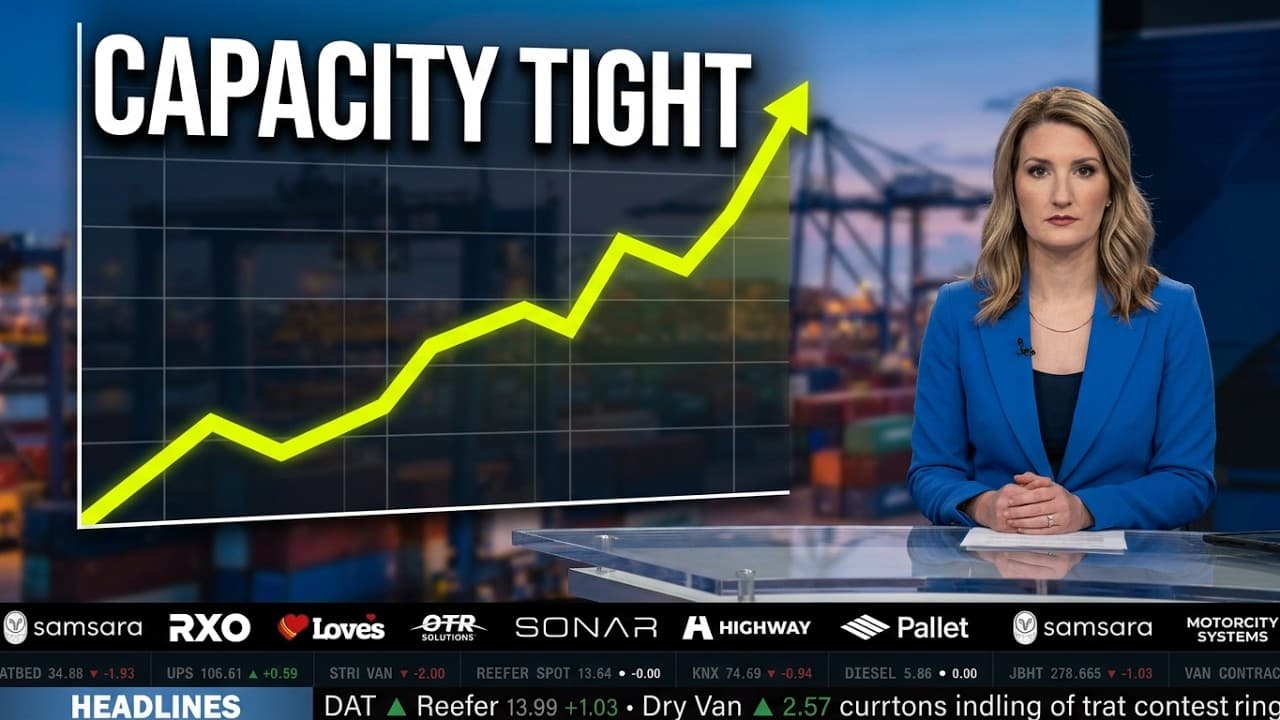
SummaryView Transcript The freight market is seeing a major shift: capacity is tightening due to regulatory pressures and driver challenges, not just demand. Discover how these factors, alongside diverging spot rates and diesel prices, are impacting carriers and the overall supply chain. This deep dive into Q2 earnings from major players like Knight-Swift, Werner, and […] The post Trucking Capacity Tightness: Why It’s Here To Stay appeared first on FreightWaves.
Source Lens
Industry Context
Useful background context, but lower-priority than direct platform, community, or operator intelligence.
Impact Level
medium
Use this briefing to decide whether your team needs an immediate workflow, policy, or reporting change.
Key Stat / Trigger
No single quantitative trigger surfaced in this report.
Focus on the operational implication, not just the headline.
Full Coverage
#fwtv_LaKtYeJKBLU. fwtv-tab{display:none}#fwtv_LaKtYeJKBLU input[type=radio]{position:absolute;left:-9999px}#fwtv_LaKtYeJKBLU.
fwtv-labels label{display:inline-block;padding:10px 18px;cursor:pointer;font-weight:600;border:1px solid #d0d0d0;border-bottom:none;margin-right:4px;border-radius:6px 6px 0 0;background:#f5f5f5}#fwtv_LaKtYeJKBLU #fwtv_LaKtYeJKBLU_s:checked~. fwtv-labels label[for="fwtv_LaKtYeJKBLU_s"],#fwtv_LaKtYeJKBLU #fwtv_LaKtYeJKBLU_t:checked~.
fwtv-labels label[for="fwtv_LaKtYeJKBLU_t"]{background:#0b3d91;color:#fff}#fwtv_LaKtYeJKBLU #fwtv_LaKtYeJKBLU_s:checked~#fwtv_LaKtYeJKBLU_summary{display:block}#fwtv_LaKtYeJKBLU #fwtv_LaKtYeJKBLU_t:checked~#fwtv_LaKtYeJKBLU_transcript{display:block}#fwtv_LaKtYeJKBLU. fwtv-panel{border:1px solid #d0d0d0;padding:18px;border-radius:0 6px 6px 6px;line-height:1.
6}#fwtv_LaKtYeJKBLU. fwtv-panel p{margin:0 0 12px}#fwtv_LaKtYeJKBLU. fwtv-transcript p{margin:0 0 12px}SummaryView TranscriptThe freight market is seeing a major shift: capacity is tightening due to regulatory pressures and driver challenges, not just demand.
Discover how these factors, alongside diverging spot rates and diesel prices, are impacting carriers and the overall supply chain. This deep dive into Q2 earnings from major players like Knight-Swift, Werner, and J. B. Hunt reveals a long-term trend. Learn more about the evolving dynamics of the trucking industry and what it means for the future of freight.
Truckload spot rates and diesel prices are moving in opposite directions, a divergence that supports the thesis that tight capacity — not fuel costs — is sustaining elevated freight rates. The Sonar NTI sat at $3. 51 per mile as of the latest reading, climbing back from a mid-to-late June low near $4. 90, while the diesel price at truck stops registered $3.
48 per gallon, down from a July high near $3. 80. The spread signals that carriers are holding rates even as fuel costs ease. Tender rejections remain well above historical norms across all modes, according to Sonar data. The Sonar Truckload Rejection Index, or STRI, stands at 14. 36%, above the six-month average of roughly 10. 9%.
Flatbed is the tightest mode at 23% rejections — down sharply from the 40% range seen in June and early July but still historically elevated. Reefer rejections sit at 19. 46%, or nearly one in five loads, while van rejections are running nearly 50% above year-ago levels. Recent carrier earnings are reinforcing the capacity-constraint narrative.
Knight-Swift reported that its truckload segment operating income rose 69% year over year, with the carrier noting that strategic pricing recovery accelerated in June as recent bids took effect. The company described rapid tightening in supply-driven dynamics and tender rejections reaching levels not seen since 2021.
“Werner talked about directly regulatory pressures removing shadow capacity as ELD providers exit the market alongside ongoing driver and CDL school removals — so impacting capacity and the quality of driver availability.” Werner CEO Derek Leathers said the company’s organic dedicated business is growing, and revenue in both Werner’s and J. B.
Hunt’s dedicated and truckload segments improved. The gains are coming from mode shift and share shift rather than a broad demand recovery, with J. B. Hunt reporting significant intermodal growth and strong intermodal results appearing across carrier earnings broadly. Rising nuclear verdict exposure is also reshaping shipper behavior.
Shippers are increasingly moving freight to well-established asset-based carriers to limit liability, fraud, and cargo risk — a dynamic expected to benefit carriers with large dedicated fleets through the remainder of 2024 and into 2025. Driver recruiting headwinds are intensifying the capacity squeeze.
A tight market gives drivers more options, and regulatory enforcement is raising barriers to entry and complicating retention efforts. With capacity continuing to exit the market and no significant fleet additions visible in large-carrier earnings, the market is expected to remain tight through fall and into the next year. Sonar’s STRI stands at 14.
36%, well above the six-month average of ~10. 9%, with flatbed rejections at 23% and reefer near 19. 46%. Knight-Swift truckload operating income jumped 69% year over year, driven by supply-side tightness rather than demand growth.
Regulatory pressures — including ELD provider exits and CDL school closures — are accelerating capacity attrition and driver recruiting challenges. Speaker 1 [0:06] All right. All right, for today’s Donor Update, I want to talk about a couple of things. First, I want to talk about spot rates and diesel prices at the pump diverging a little bit.
This is a really interesting and important thing because as we talked about earlier in the year, as spot rates were increasing, a lot of people attributed those increased spot rates to increased fuel and diesel price. Craig and I have disagreed with that and attributed spot rates increasing to lack of capa
Original Source
This briefing is based on reporting from Freightwaves. Use the original post for full primary-source context.
Style
Audience