

J.B. Hunt on Freight Recession & Rate Hikes: What’s Next?
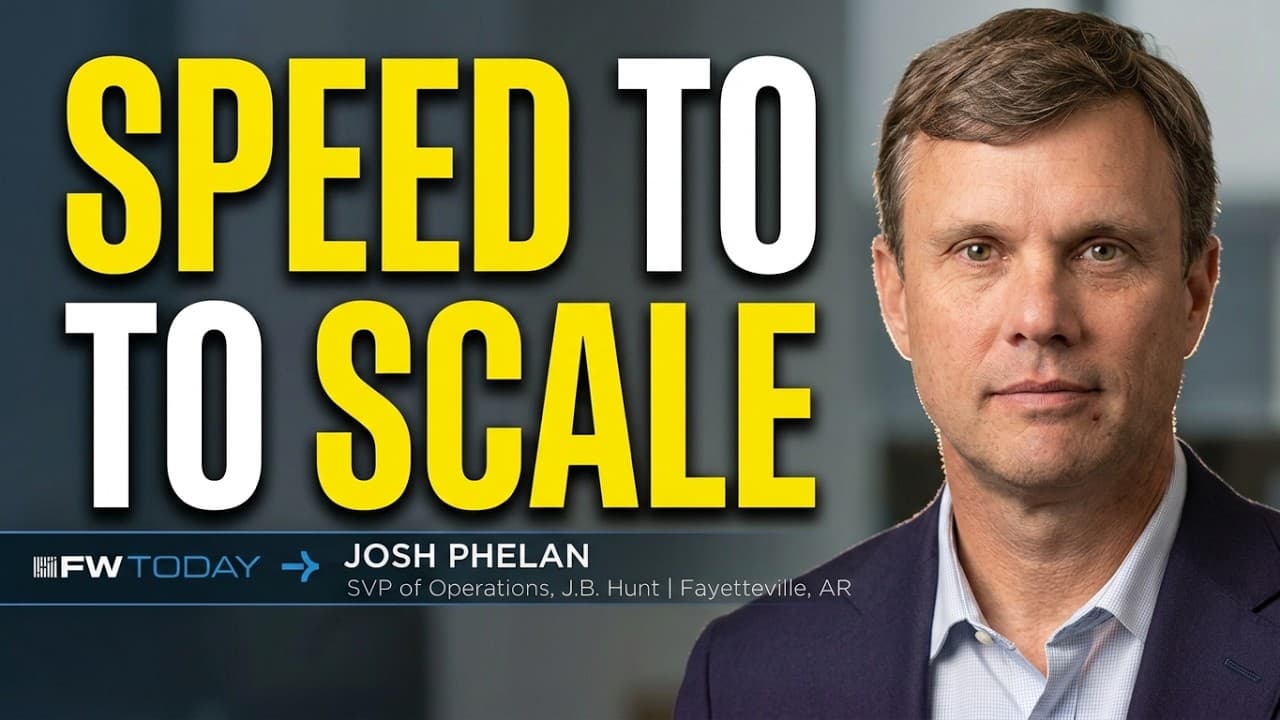
SummaryView Transcript The trucking market is undergoing significant changes, with spot capacity rates seeing a dramatic year-over-year increase. J.B. Hunt’s SVP of Operations, Josh Phelan, explains how supply-side pressures, cost inflation, and a tight driver market are driving these shifts. Learn why the industry needs higher rates to reinvest and what this means for the […] The post J.B. Hunt on Freight Recession & Rate Hikes: What’s Next? appeared first on FreightWaves.
Source Lens
Industry Context
Useful background context, but lower-priority than direct platform, community, or operator intelligence.
Impact Level
medium
Use this briefing to decide whether your team needs an immediate workflow, policy, or reporting change.
Key Stat / Trigger
No single quantitative trigger surfaced in this report.
Focus on the operational implication, not just the headline.
Full Coverage
#fwtv_EVVgBnFTzwg. fwtv-tab{display:none}#fwtv_EVVgBnFTzwg input[type=radio]{position:absolute;left:-9999px}#fwtv_EVVgBnFTzwg.
fwtv-labels label{display:inline-block;padding:10px 18px;cursor:pointer;font-weight:600;border:1px solid #d0d0d0;border-bottom:none;margin-right:4px;border-radius:6px 6px 0 0;background:#f5f5f5}#fwtv_EVVgBnFTzwg #fwtv_EVVgBnFTzwg_s:checked~. fwtv-labels label[for="fwtv_EVVgBnFTzwg_s"],#fwtv_EVVgBnFTzwg #fwtv_EVVgBnFTzwg_t:checked~.
fwtv-labels label[for="fwtv_EVVgBnFTzwg_t"]{background:#0b3d91;color:#fff}#fwtv_EVVgBnFTzwg #fwtv_EVVgBnFTzwg_s:checked~#fwtv_EVVgBnFTzwg_summary{display:block}#fwtv_EVVgBnFTzwg #fwtv_EVVgBnFTzwg_t:checked~#fwtv_EVVgBnFTzwg_transcript{display:block}#fwtv_EVVgBnFTzwg. fwtv-panel{border:1px solid #d0d0d0;padding:18px;border-radius:0 6px 6px 6px;line-height:1.
6}#fwtv_EVVgBnFTzwg. fwtv-panel p{margin:0 0 12px}#fwtv_EVVgBnFTzwg. fwtv-transcript p{margin:0 0 12px}SummaryView TranscriptThe trucking market is undergoing significant changes, with spot capacity rates seeing a dramatic year-over-year increase. J. B.
Hunt’s SVP of Operations, Josh Phelan, explains how supply-side pressures, cost inflation, and a tight driver market are driving these shifts. Learn why the industry needs higher rates to reinvest and what this means for the freight economy. J. B.
Hunt’s over-the-road business posted a loss in the second quarter even as spot capacity rates surged roughly 40% above year-ago levels, according to Josh Fellin, who oversees the carrier’s JBT over-the-road segment.
Fellin said the segment has grown double digits for five consecutive quarters, but was caught in the sharp inflection as spot costs overwhelmed its drop-trailer, contract-heavy model that relies on both company independent contractors and third-party capacity.
The direction of the rate rally is supply-driven, Fellin argued, but the magnitude reflects four years of margin erosion. He said operating costs per mile have risen 48% to 60% since 2019, while contract rates over the same period are up only 5% to 6% — a gap that starved the industry of the returns needed to reinvest in equipment.
“If you go back to ’19, you’ll see it quoted anywhere from 48% to 60% on a cost-per-mile basis to operate a truck. And the rate environment that we’ve been in inside the marketplace, same period comparison might be up 5% to 6%.” Fellin placed the current upcycle firmly in its early stages.
He said the NTI spot-rate index hit 60% above year-over-year levels as recently as June, but contract rates still lag. “To fix pricing at current cost levels, it’s going to take another bid season,” he said, adding that intermodal and dedicated contract economics tend to move later than the spot market.
On driver availability, Fellin said tightening in the third-party capacity pool has quickly spilled into J. B. Hunt’s own driver pipeline. He warned that driver pay — which took a step up in 2021 and 2022 but has seen only gradual increases since — is likely to see another significant move in 2025 and into 2027.
That added cost pressure, he noted, compounds the rate relief carriers still need to earn acceptable returns, creating a counterbalancing force that could limit how aggressively the industry expands capacity.
On fleet growth, Fellin said smaller carriers face two headwinds absent in prior upcycles: financing costs are far higher than they were in 2020, and tractor availability remains constrained. Large carriers, he said, will demand a clearer line of sight to sustainable returns before committing capital.
“We’re not going to just grow our top line for sake of our bottom line,” he said, echoing remarks attributed to J. B. Hunt’s broader leadership. J. B. Hunt’s preferred expansion targets remain dedicated contract services and intermodal rather than open-market over-the-road. Fellin was also asked about electric vehicles in long-haul trucking.
He said battery-electric trucks are not ready for high-utilization, long-haul applications and that meaningful adoption remains “quite a ways off,” though J. B. Hunt is actively testing zero-emission vehicles in specific, shorter-cycle use cases such as drayage and localized dedicated routes where charging infrastructure is more accessible. J. B.
Hunt’s OTR segment posted a Q2 loss despite five straight quarters of double-digit growth, as spot rates surged up to 60% year-over-year in June. Carrier cost-per-mile is up 48%-60% since 2019 while contract rates rose only 5%-6% in the same period, driving the magnitude — not just direction — of the current rate rally.
Fellin says the freight recovery is in ‘early innings,’ with full contract-rate repair requiring at least one more bid season and driver pay set for another significant step up in 2025-2027. Speaker 1 [0:00] Uh, we have Josh Fellin up here. Uh, Josh, how are you, sir? Speaker 2 [0:04] Good. How are y’all doing? Speaker 1 [0:06] Well.
So tell us, you run JB Hunt’s over-the-road business. We’ve been joking about the fact that you’re either the
Original Source
This briefing is based on reporting from Freightwaves. Use the original post for full primary-source context.
Style
Audience