

One Big Thing will solve rail’s growth problem, says NS CEO
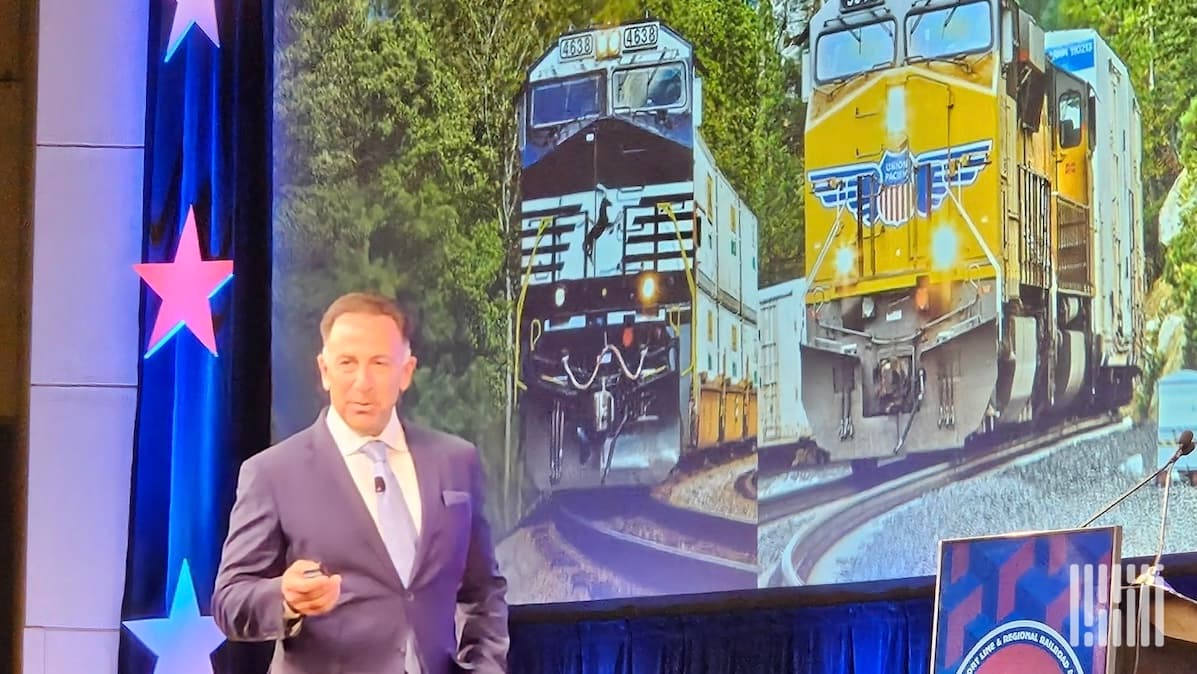
Norfolk Southern and Union Pacific propose a transcontinental railroad merger to solve freight handoff inefficiencies that cause shipping delays. The merger aims to replicate 1980s rail consolidation that drove volume growth and lower rates.
Improved rail reliability could reduce shipping costs for heavy/bulk products, but won't meaningfully impact standard ecommerce fulfillment that relies on parcel carriers. Monitor freight cost trends if you ship large items or raw materials to manufacturing partners.
Part of broader logistics consolidation trend that could eventually pressure parcel carrier pricing, though immediate ecommerce impact is minimal since most marketplace sellers use UPS/FedEx/USPS.
Review shipping costs for oversized items -- rail improvements may create truck pricing pressure in 12-18 months.
Track supplier lead times if they use rail freight, as service consistency could improve inventory planning.
Bottom Line
Rail merger may reduce freight costs for heavy goods sellers.
Source Lens
Industry Context
Useful background context, but lower-priority than direct platform, community, or operator intelligence.
Impact Level
medium
Rail merger may reduce freight costs for heavy goods sellers.
Key Stat / Trigger
NS freight volume declined 11% and UP declined 15% over past two decades
Focus on the operational implication, not just the headline.
Full Coverage
MINNEAPOLIS — Though he never worked in supply chain or dealt with hedge funds, German philosopher Friedrich Nietzsche still managed to originate the time-honored neologism,“What doesn’t kill me makes me stronger”. Norfolk Southern Corp.
survived the deleterious effects of the Covid pandemic, declining shipper demand, a catastrophic hazmat derailment, labor issues, a leadership scandal, and activist investors, says Chief Executive Mark George. It’s emerged as one-half of a proposed transcontinental railroad that, if approved, will be a mega-strong behemoth reshaping the U. S. rail industry.
The Atlanta-based carrier (NYSE: NSC) has seen “crisis after crisis after crisis” since George arrived from HVAC giant Carrier in 2019, “but we are for the past two years running really well,” George said in a keynote address Tuesday at the annual conference of the American Short Line and Regional Railroad Association.
“I’m really proud of that; the whole industry is operating well in terms of delivering good, consistent service, and I think that’s really important.” Important, but not nearly enough to shake off stagnant growth over the past two decades as Class I lines failed to recapture freight from trucks.
NS total freight volume decline 11% and UP (NYSE: UNP), 15%, in that time, said George, as railroads were forced to raise prices and lower costs in a bid to shore up earnings. Those measures saw the NS union workforce shrink by a third amid weaker freight levels.
“And that’s how we’ve been able to preserve operating income and grow it where you can, when you can,” he said. Relentlessly driven by Wall Street to run fewer, longer trains, the heavily-regulated, capital-intensive railroads regularly turn in operating ratios under 60%.
Even excluding coal’s sharp decline, railroads have seen their share of commodity freight such as grain, lumber and petroleum tumble even as demand for those products is steady and the overall economy continues to grow, as shippers choose to move goods by truck.
George laid that at the industry’s feet, saying shippers were forced to hedge against rail’s history of inconsistent, unreliable service. Conversely, George pointed out that Canada’s CN (NYSE: CNI) and CPKC (NYSE: CP) railroads have defied that shrinking trend, both transcontinental systems compared to a fragmented U. S.
rail network “that is frozen in time” in 2000. That’s the year before the Surface Transportation Board adopted tougher rules for mergers. A network of NS and CSX (NASDAQ: CSX) in the east and UP and BNSF (NYSE: BRK-B) in the west requires handoffs when railcars cross the Mississippi River watershed.
While the interchange process is as old as railroading, there are “very inconsistent service plans and frankly, a lack of visibility once you start having handoffs between two separate companies,” George said.
Shippers are affected as dwell time at interchanges leads to variability in car supply, and difficulty in scaling customer growth beyond regional footprints — a structural industry problem, George said.
UP and NS hope to replicate the post-deregulation 1980s, George said, when mergers drove volume growth, productivity improved, rates went down, and profits grew. The period, he said, before the STB froze merger activity after operational chaos following some integrations. One notable exception was the deal that saw CSX and NS split up Conrail.
That unique merger led to seven straight years of volume growth — “although I know it caused some pain and the integration got screwed up” — but George challenged skepticism over UP’s forecast of converting 1. 3 million truckloads to rail, pointing out that NS converted 1 million carloads in that stretch.
“We will get there when we do this acquisition,” he insisted, “whether it happens in three years, four years or five years as with Conrail, we will get there.” According to George the partners expect to save 95 hours — four days — on cars moving from southern California to the southeastern states, and competitive with trucks.
That’s an increase from some early reporting of the merger, when the savings was put at one to two days. George admitted that the partners have work to do. “It feels like we’ve lost a little momentum, that’s one of the things I’ve heard,” he said. “We’ll need to re-file a 7000-page application, that was a setback.
We’ll check the boxes and get there by the end of April.” George said that once the STB accepts the application, he expects the evaluation process to take a year or more. “And let me reassure you all our goal is to make sure we don’t repeat the mistakes of the past,” he said. “Our integration will be complicated.
We’re pretty confident not to mention this is end to end. It’s a lot less complicated than overlapping networks. So we’re going to do this in a very, very measured way. We’re putting a lot of thought into this.” Subscribe to FreightWaves’ Rail e-newsletter and get the latest insights on rail freight right in your inbox. Read more articl
Original Source
This briefing is based on reporting from Freightwaves. Use the original post for full primary-source context.
Style
Audience