eBay Promoted Listings Standard. Does it still work?
David Brackin, contributing editor to ChannelX and founder of StuffUSell takes a look at eBay Promoted Listings Standard seven years after he first reported on experiments to test their efficacy: When Promoted Listings first launched widely, I ran an experiment to test whether it made a difference. It was randomised and blind, it covered 15,000 listings […]
Source Lens
Industry Context
Useful background context, but lower-priority than direct platform, community, or operator intelligence.
Impact Level
medium
Use this briefing to decide whether your team needs an immediate workflow, policy, or reporting change.
Key Stat / Trigger
No single quantitative trigger surfaced in this report.
Focus on the operational implication, not just the headline.
Full Coverage
David Brackin, contributing editor to ChannelX and founder of StuffUSell takes a look at eBay Promoted Listings Standard seven years after he first reported on experiments to test their efficacy: When Promoted Listings first launched widely, I ran an experiment to test whether it made a difference.
It was randomised and blind, it covered 15,000 listings across several categories, and it found a 27% uplift in sell-through rate in eight weeks out of nine. That number has been quoted back at me ever since. Seven years on, and many changes to the programme later, it seemed only fair to find out whether it still holds.
Why this is hard to measure Three things make Promoted Listings unusually difficult to assess, and they are the reason most sellers have never done it properly. And yet we spend thousands of pounds on advertising. The first is the attribution trap.
eBay reports attributed sales and a return on ad spend, and both numbers come from the same system that sends you the bill. Since last year’s attribution change, a single click on a promoted item activates it for 30 days, and any sale of that item in the window is charged for, to any buyer, whether or not that buyer ever saw an ad.
A listing that was going to sell three times this month sells three times this month, one person clicks an ad, and all three sales attract a fee. Almost every sale on a promoted listing gets counted. Reported ROAS therefore tells you what eBay charged for, not what the advertising added. You pay for what you would have sold anyway. The second is data.
eBay gives you impressions and clicks per listing, which is useful, but no holdout, no experiment tools, and a set of exports that take real work to join up. If you want to know what would have happened without the ads, you have to build the comparison yourself. The third is the house message.
eBay’s line, in every seller update and every account manager call, is that Promoted Listings works. The dashboard is designed to agree with it. That is not dishonest, but it does mean the burden of proof sits with the seller, and the only way to carry it is to hold some listings back and not advertise them. So the design matters more than the result.
Here is what we worried about and what we did about each worry. The design The market moves from week to week. Weather, payday, a competitor’s sale and eBay’s own promotions all shift sales, so a before-and-after comparison confounds the ads with everything else that changed.
We ran promoted and unpromoted listings side by side over the same three weeks instead. The listings you promote may be the ones that were going to sell anyway. If you pick the popular items, or the algorithm already favours some, you will see an uplift that has nothing to do with the ads.
Every listing was sorted into a price band (under £25, £25 to £50, £50 to £100, over £100) crossed with whether it sat in the top or bottom half of the previous month’s impressions. Impressions are eBay’s own count of how often a listing surfaces in search, so this is matching directly on how desirable a listing already is.
Within each of the eight cells, listings were allocated at random between the arms. Random allocation can still produce unequal groups by chance, so we checked before starting. Baseline click-through rates across the three arms were within 0. 03 percentage points of one another. Is it the ads, or the rate?
Two promoted arms, one at 2% (the campaign minimum) and one at 5% (the account’s existing rate), plus an unpromoted control. The arms held 263, 259 and 125 listings. Relisting muddies the data. We relist stale listings, and campaign membership follows the SKU rather than the item number, so everything was tracked by SKU.
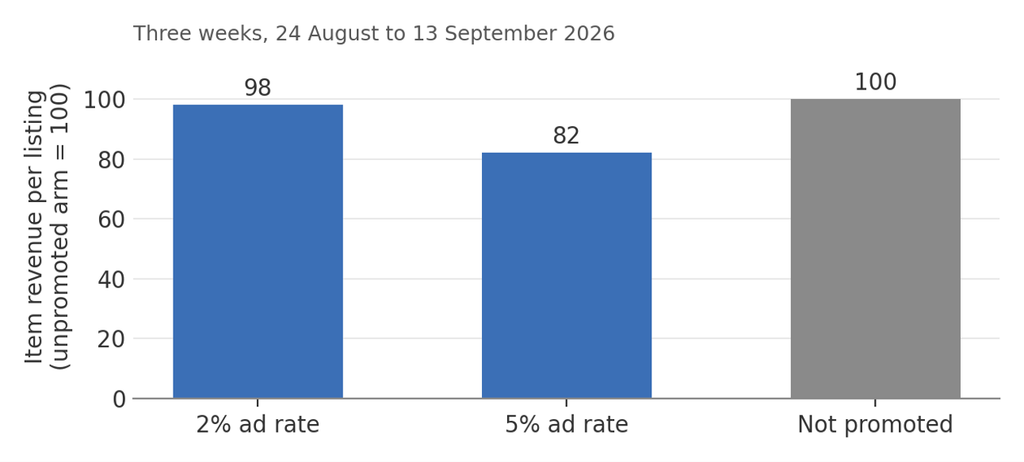
The account we ran this on belongs to a business I manage the eBay store for, which sells branded jewellery on consignment, around 650 listings, with a solid gross margin but not one that can be given away without thinking. The effect Three weeks, 24 August to 13 September 2026, 100 units sold.
ArmListingsUnits per 100 listingsRevenue per listing, control = 100Fee per listing, 2% arm = 1002% ad rate26316. 7981005% ad rate25913. 982253Not promoted12516. 01000 item revenue per listing by arm, indexed to the unpromoted arm The arm that spent nothing earned the most per listing. The arm that spent the most earned the least.
The two promoted arms were attributed almost identical sales, for fees that differed by a factor of two and a half. Measured against the control, the 2% arm sold 4. 4% more units per listing and the 5% arm sold 15. 1% fewer. None of this reaches statistical significance. The tests give p values of 0. 40 for 2% against 5%, 1. 00 for 2% against control and 0.
64 for 5% against control. In plain terms, the trial cannot show that the revenue generated in any arm was different from any other. This was a smaller trial than the first one. The 2019 study ran for 22 weeks over 15,000 listings. This one ran for three weeks over 650. The cost and the
Original Source
This briefing is based on reporting from Tamebay. Use the original post for full primary-source context.
Style
Audience