Broker Insurance Frenzy: 3-Digit Cost Hikes Ahead
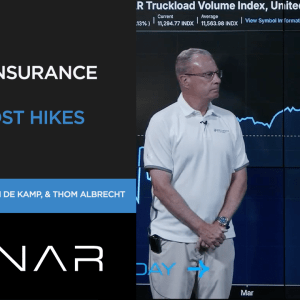
Freight broker insurance is in a frenzy, and premium hikes are getting ugly. Thom Albrecht helps break down how the CH Robinson verdict, underwriting pullback and cargo theft are driving double-digit to triple-digit cost increases for brokers. He also explains what’s changing in excess liability, why some underwriters are exiting the market, and what carriers […] The post Broker Insurance Frenzy: 3-Digit Cost Hikes Ahead appeared first on FreightWaves.
Source Lens
Industry Context
Useful background context, but lower-priority than direct platform, community, or operator intelligence.
Impact Level
medium
Use this briefing to decide whether your team needs an immediate workflow, policy, or reporting change.
Key Stat / Trigger
No single quantitative trigger surfaced in this report.
Focus on the operational implication, not just the headline.
Full Coverage
#fwtv_P3iLdcSFgQ. fwtv-panel{border:1px solid #d0d0d0;padding:18px;border-radius:6px;line-height:1. 6}#fwtv_P3iLdcSFgQ. fwtv-panel p{margin:0 0 12px}#fwtv_P3iLdcSFgQ. fwtv-note{font-style:italic;color:#666;margin-top:16px;padding-top:12px;border-top:1px solid #e0e0e0}Freight broker insurance is in a frenzy, and premium hikes are getting ugly.
Thom Albrecht helps break down how the CH Robinson verdict, underwriting pullback and cargo theft are driving double-digit to triple-digit cost increases for brokers. He also explains what’s changing in excess liability, why some underwriters are exiting the market, and what carriers and brokers should watch into peak season.
If you move freight, this is a real cost story—not noise. Freight broker insurance has entered a full-blown pricing crisis, with excess liability coverage costs rising 50% to triple digits and even primary coverage climbing sharply in the double digits — all since a pair of legal shocks hit the market this spring.
The turmoil is forcing brokers to rethink coverage limits, vendor technology relationships, and renewal strategies ahead of what analysts expect will be a prolonged inflationary environment. The disruption unfolded in three phases, according to Thom Albrecht, who discussed the market dynamics during this SONAR Market Update.
The first was “total chaos” following the Montgomery Supreme Court decision on May 14, which exposed brokers to motor-carrier-style liability. A brief calm in June ended abruptly on July 23, when the C. H. Robinson verdict — a $135 million judgment — rattled underwriters again.
“We’ve seen two underwriters exit the market, basically backing the paper over in London,” Albrecht said. “So there’s gonna be fewer options, a very inflationary environment, and there’s gonna be more questions that are asked of freight brokers than ever before as they go through their renewals.”
On primary coverage — the first $5 million of freight broker auto liability, or FBAL — Albrecht said increases are running in the “middle” double digits, well above 10% but short of 90%. For excess or surplus coverage above $5 million, the picture is far worse.
Smaller brokers with gross revenues of $30 million to $40 million that were paying roughly $10,000 a year for coverage could now face bills of $30,000 to $40,000. Larger brokers seeking excess capacity above $5 million are confronting 50% to 60% increases at the low end and triple-digit hikes at the top.
“The word to use is it’s a total frenzy right now,” Albrecht said, describing the post-verdict insurance environment for freight brokers. Underwriters are also pulling back on capacity, not just raising prices.
Albrecht described one large brokerage customer that had $20 million in coverage, cut it to $15 million to improve its renewal position, then was able to secure additional capacity after the Robinson verdict — ending up at $40 million to $50 million.
The cost increase on that expanded program, he said, was “way more than they would have ever envisioned four or five months ago.” Brokers that bundle cargo and auto liability with a single underwriter face compounding pressure, since cargo books have also turned unprofitable because of rising theft and fraud claims. The C. H.
Robinson case revealed details that help explain the size of the jury award, Albrecht noted. An attorney who reviewed the transcript told him the jury was shown video of an accident victim trapped in a burning vehicle.
Separately, a webinar Albrecht attended flagged that the driver had disabled his camera and GPS before the crash — a disclosure that could complicate Robinson’s appeal. The jury also found the driver to be a “borrowed employee” of Robinson in part because he had downloaded the C. H.
Robinson app, a legal theory that has significant implications for how brokers deploy their own technology with carrier partners. Albrecht said the goal for every freight broker navigating the new liability landscape is to achieve what he called the CAD standard: processes that are consistent, auditable, and defensible.
Meanwhile, he sees the freight cycle itself turning favorable for carriers, with a potential “supercycle” — defined as a recovery lasting more than two years — possible if regulatory enforcement continues to tighten.
He noted that the last five trucking recoveries each lasted between 18 and 24 months, making any extension beyond that threshold historically unusual. On the rate side, spot and contract rates are converging, with the gap between them below $0. 66, signaling further upward pressure ahead.
Freight broker excess liability insurance costs are rising 50% to triple digits following the May 14 Montgomery SCOTUS ruling and the July 23 C. H. Robinson $135 million verdict, with two London-market underwriters already exiting.
Small brokers with $30M–$40M in gross revenues could see annual premiums jump from roughly $10,000 to $30,000–$40,000; primary FBAL coverage is up mid-double digits. Albrecht says brokers should
Original Source
This briefing is based on reporting from Freightwaves. Use the original post for full primary-source context.
Style
Audience